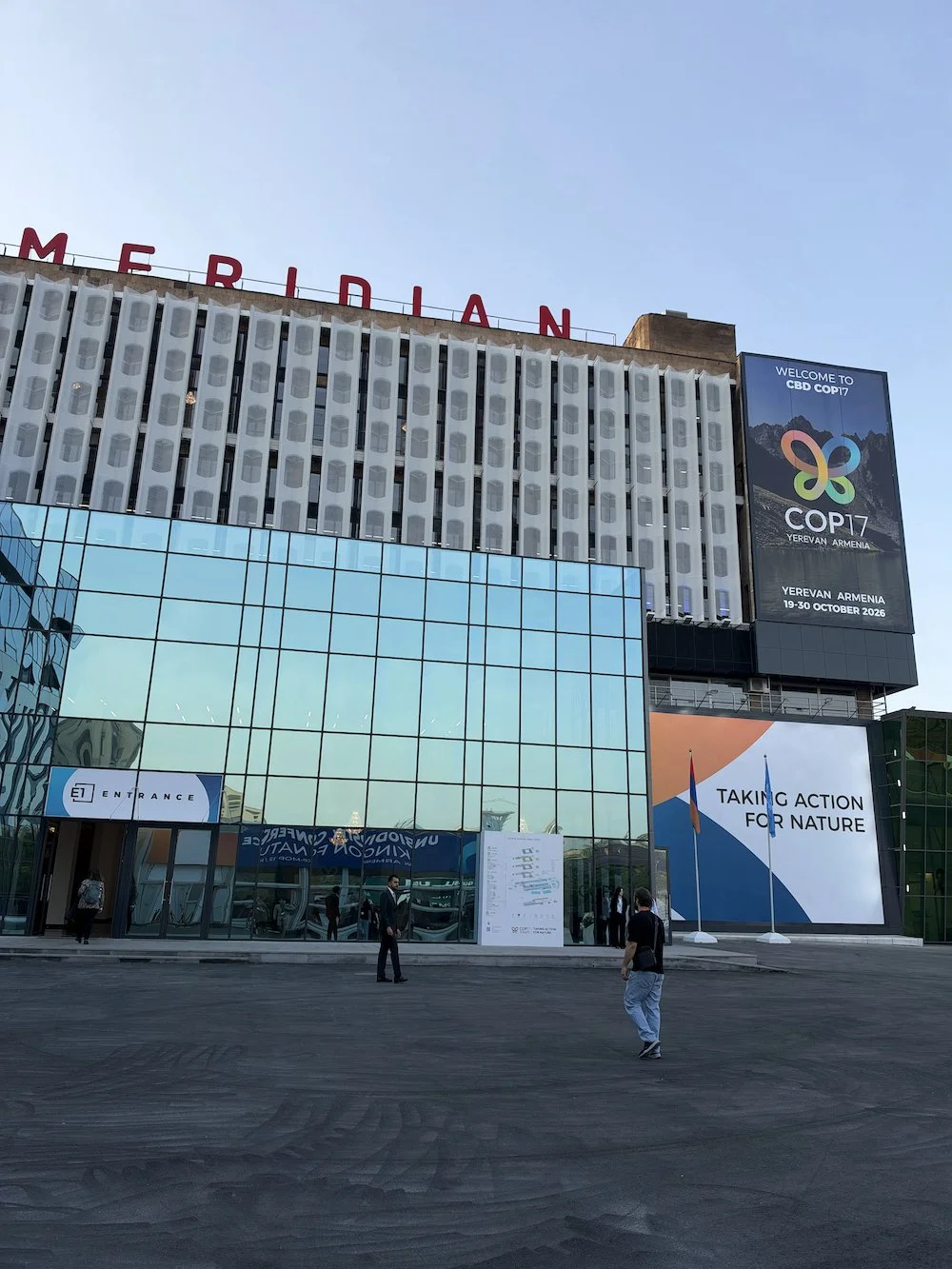
Meridian Conference Venue, CBD COP17. Yerevan, Armenia, October 2026. © 2026 Images for Inclusion Inc (IFI)
The seventeenth meeting of the Conference of the Parties (COP17) to the Convention on Biological Diversity (CBD) took place in Yerevan, Armenia, from October 19 to 30, 2026, with negotiations extending into the early morning of October 31. Held alongside CP-MOP-12 and NP-MOP-6, COP17 marked the first global review of collective progress toward implementing the Kunming-Montreal Global Biodiversity Framework (KMGBF).
For Images for Inclusion Inc (IFI), participation at COP17 represented the strategic continuation of its high-level engagement at COP16 in Cali (2024), where the permanent Subsidiary Body on Article 8(j) was established, and its first meeting (SB8J-1) in Panamá (2025), which initiated discussions on its Modus Operandi. In Yerevan, the central challenge shifted from institutional creation to operational reality: translating that milestone into structural arrangements that safeguard Indigenous Peoples' distinct collective rights, self-determined systems of representation, and full participation in decision-making.
This blog provides a detailed, firsthand examination of international environmental diplomacy, illustrating how the technicalities of UN procedural language serve as a battleground between state sovereignty and Indigenous self-determination. By exposing the systemic dilution of Indigenous Peoples’ distinct legal protections through terminological conflation, this record examines the immense challenge of fostering good-faith multilateral cooperation while preserving Indigenous sovereignty.
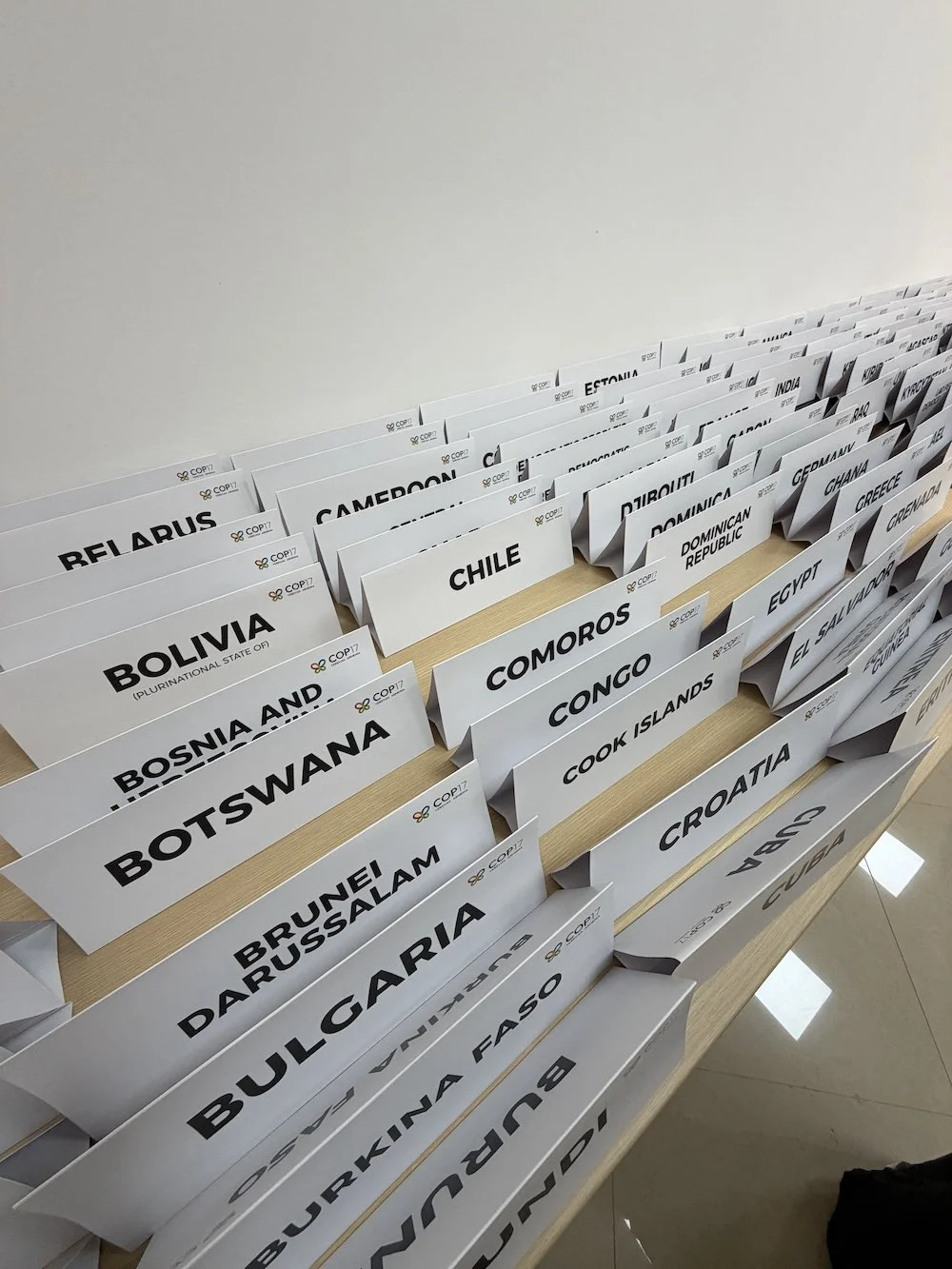
Country delegation nameplates at CBD COP17. Yerevan, Armenia, October 2026. © 2026 Images for Inclusion Inc (IFI)
The negotiations exposed a profound structural paradox. While scientific evidence widely recognizes the indispensable role of Indigenous Peoples in conserving global biodiversity, the internal dynamics of the CBD exposed a troubling contradiction. The pursuit of institutional consensus created severe tensions when the distinct rights and self-determined systems of Indigenous Peoples were squeezed into the shared “Indigenous Peoples and local communities” (IPLC) framework.
At COP17, this friction peaked during negotiations over the Modus Operandi for the new Subsidiary Body, specifically regarding regional sociocultural structures and seat allocation within the Friends of the Bureau. Indigenous representatives faced an intense false ultimatum: compromise on safeguards for their inherent rights, or risk leaving the body without the technical mechanisms required to function.
This political pressure laid bare the risks of obscuring distinct legal identities on the negotiating floor. In attempting to accommodate various local groups—especially where state recognition of Indigenous Peoples is absent or actively contested—institutional proposals risked blurring the lines between Indigenous Peoples and local communities. Amalgamating these groups under a collective "IPLC" umbrella threatens to dilute critical protections like self-determination and Free, Prior, and Informed Consent (FPIC) under UNDRIP and other international human rights instruments.
Compounding this, States Parties fiercely defended the strictly “Party-led” nature of the Convention, reinforcing an institutional framework in which the Subsidiary Body's advisory functions remain subject to decisions adopted by State Parties.
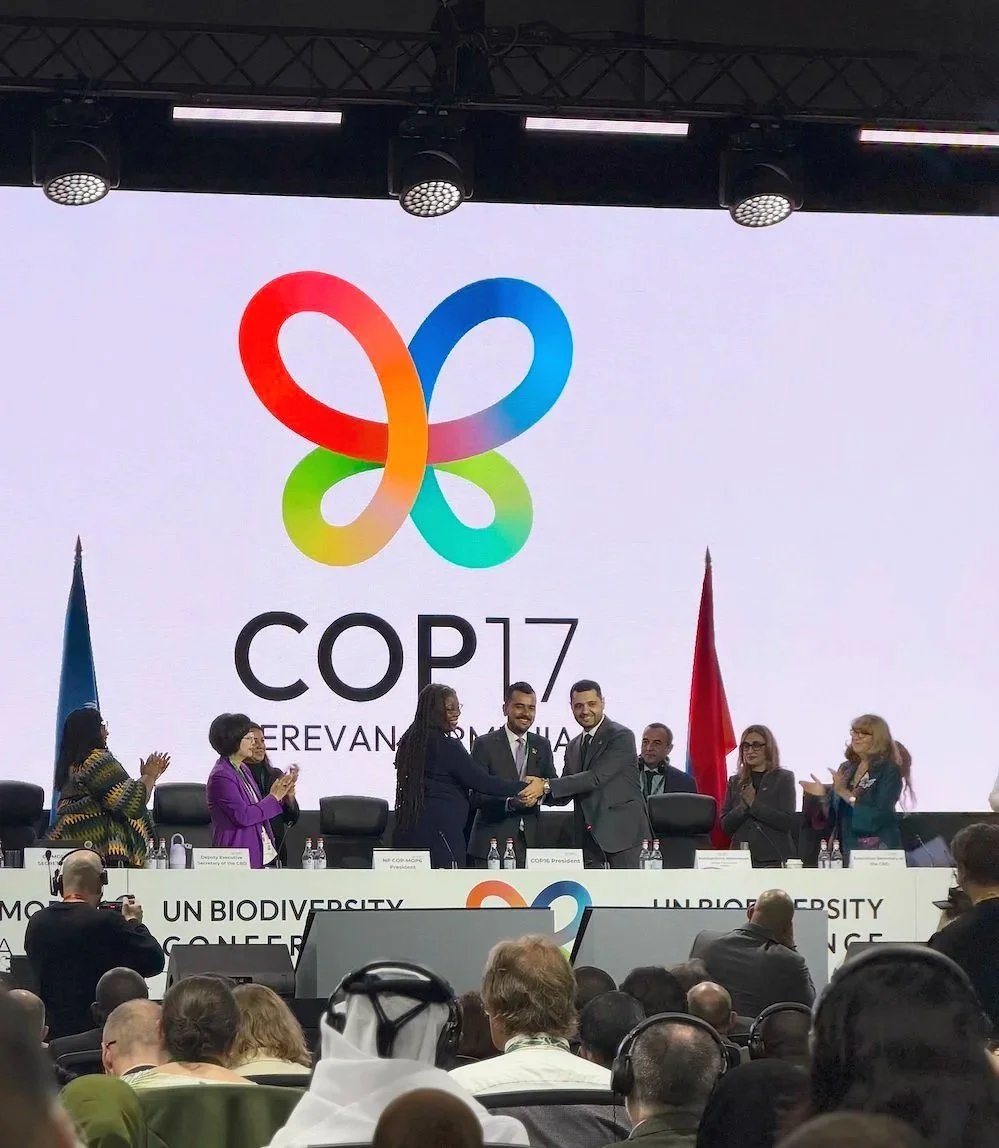
Opening ceremony of CBD COP17, Yerevan, Armenia, October 19, 2026. © 2026 Images for Inclusion Inc (IFI)
What follows is a raw, day-by-day, behind-the-scenes record of international diplomacy, documenting the crisis before the final outcomes were reached. It records specific state interventions, alternative proposals, bracketed texts, deep disagreements within the International Indigenous Forum on Biodiversity (IIFB) Caucus, and the procedural maneuvers that dictated the adoption of the Modus Operandi of the Subsidiary Body on Article 8(j) and Other Provisions of the Convention on Biological Diversity Related to Indigenous Peoples and Local Communities (SB8J).
Central to this chronicle is a recurring question:
How can Indigenous Peoples exercise their right to representation through their own institutions within an intergovernmental Convention dictated by States Parties? This tension connects the debate over seven Indigenous sociocultural regions versus five UN geographic regions, nomination procedures, and the contested seats within the Friends of the Bureau. Ultimately, it asks whether Indigenous Peoples must adapt to the geographical structures of sovereign states, or whether international structures will evolve to recognize Indigenous systems of self-organization.
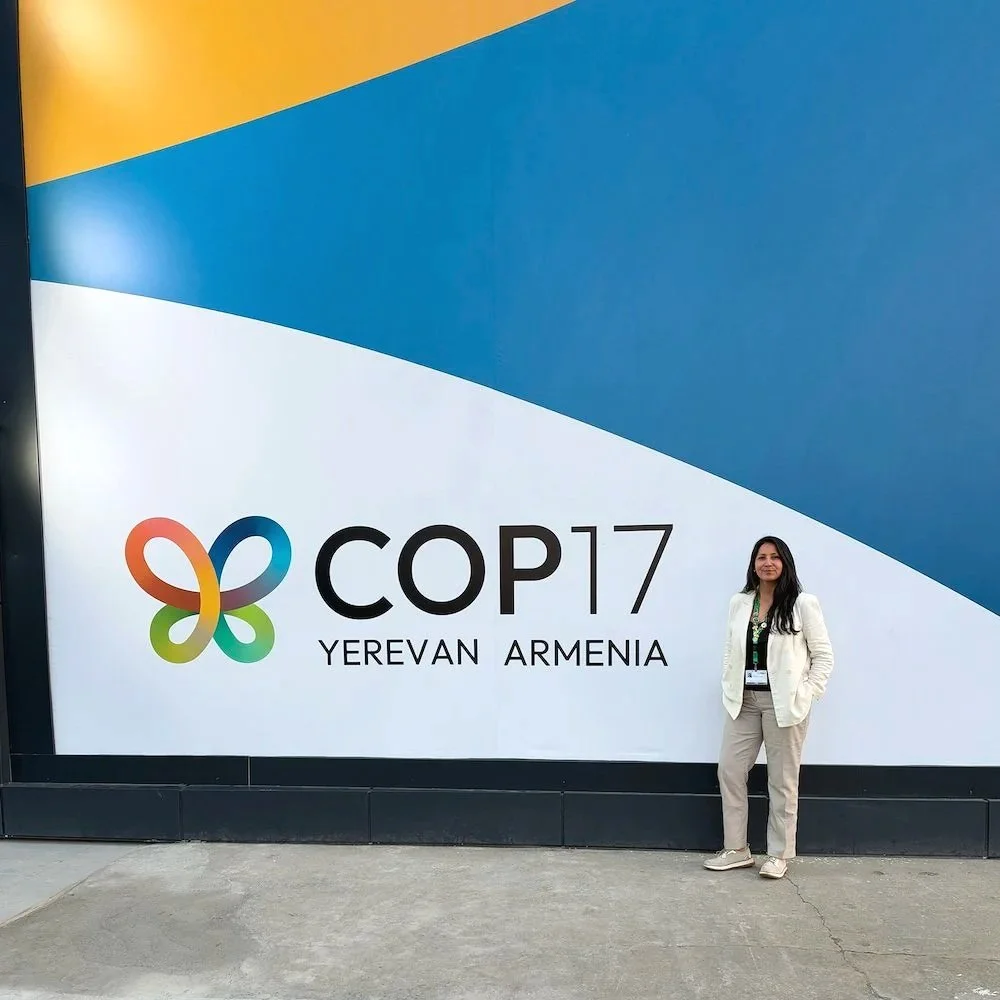
Lidia Arriagada Garcia, who is based between New York and Chile, represented Images for Inclusion Inc (IFI) as its official delegate at the 17th Conference of the Parties to the Convention on Biological Diversity (CBD COP17), held in Yerevan, Armenia, from October 19 to 30, 2026.
Serving as both Focal Point and Head of the Organization for IFI—a nonprofit, non-governmental organization with Special Consultative Status with the United Nations Economic and Social Council (ECOSOC)—she self-funded her participation to advocate for biodiversity conservation, the protection of the individual and collective rights of Indigenous Peoples, and their full and effective participation in decisions affecting their lands, waters, territories, traditional knowledge, and governance.
© 2026 Images for Inclusion Inc (IFI)
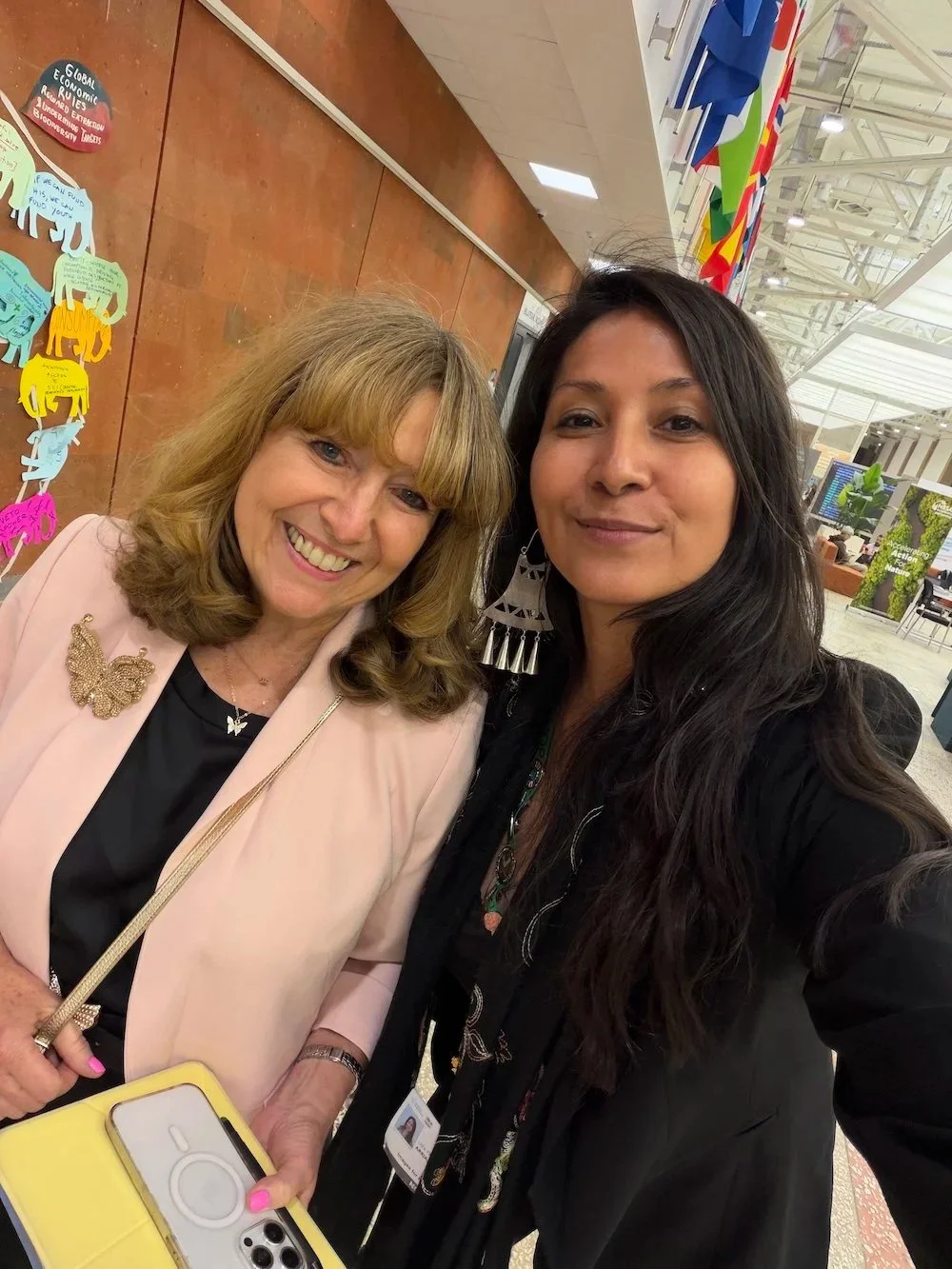
Lidia Arriagada Garcia, President and CEO of Images for Inclusion Inc (IFI), and Astrid Schomaker, Executive Secretary of the CBD, at COP17. Yerevan, Armenia, October 2026. © 2026 Images for Inclusion Inc (IFI)
Among the numerous agenda items at COP17, Arriagada Garcia focused specifically on Agenda Item 10(a), which addressed the Modus Operandi of the permanent Subsidiary Body on Article 8(j)—an institution established at COP16 in Cali, Colombia, in 2024.
A central tension within this item was the structural debate over representation: choosing between the seven Indigenous sociocultural regions and the five UN geographic regions.
This debate directly intersected with Indigenous Peoples' right to maintain their own institutions and participate through representatives chosen according to their own internal procedures, as recognized under Articles 3, 5, and 18 of the United Nations Declaration on the Rights of Indigenous Peoples (UNDRIP).
IFI’s delegate advocacy took place through participation in the International Indigenous Forum on Biodiversity (IIFB) Caucus, observation of formal negotiations (held only in English), and direct diplomatic engagement with representatives of States Parties.
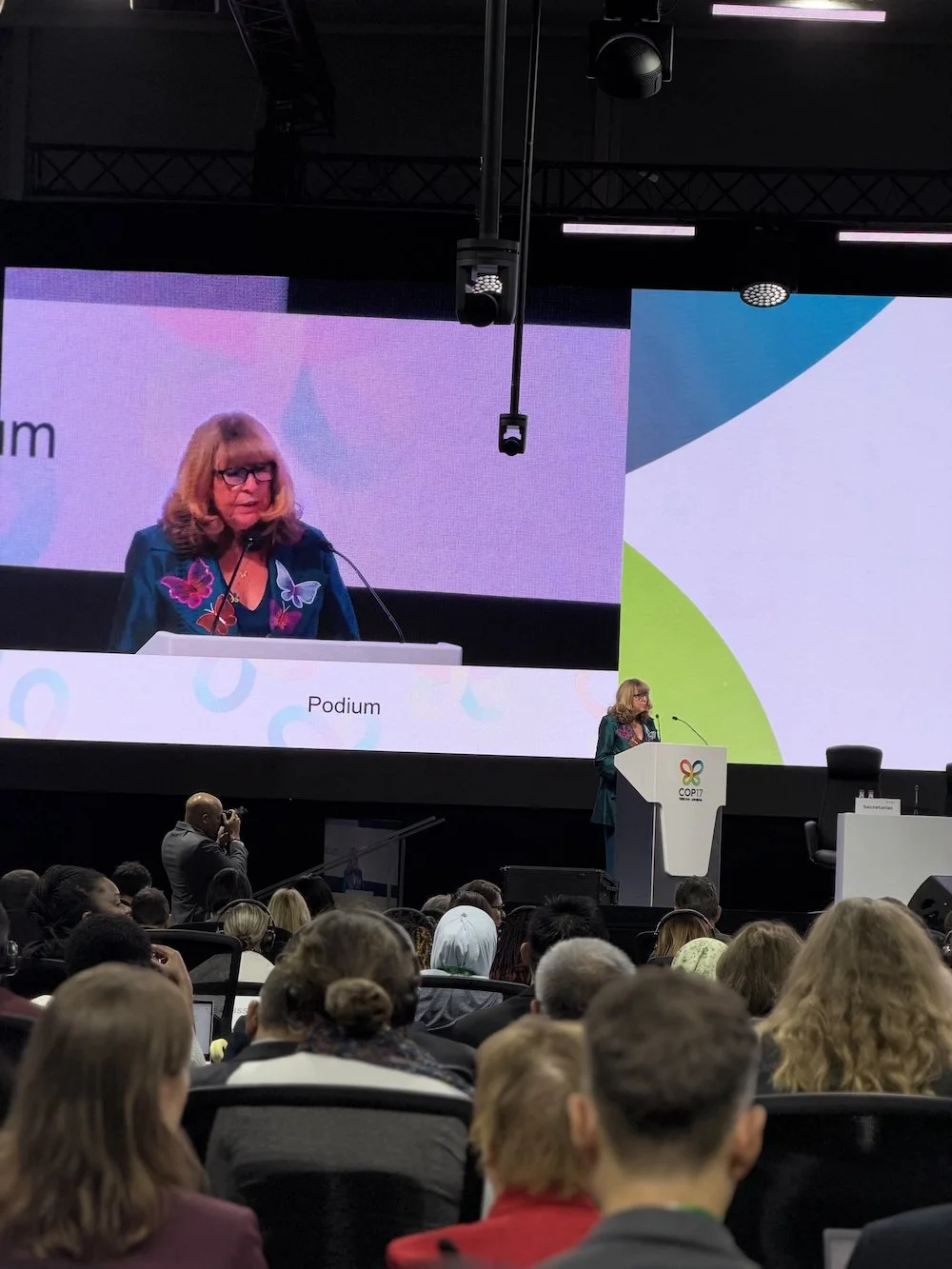
CBD Executive Secretary Astrid Schomaker addressing COP17. Yerevan, 2026. © 2026 Images for Inclusion Inc (IFI)
From the start, the initial IIFB Caucus meeting highlighted the complex road ahead, revealing deep disagreements among participants over terminology, collective rights, representation, and overarching negotiating strategy.
In this context, it is worth highlighting the following paragraphs from the study “Financing the Future: The Financial Needs of Indigenous Peoples to Support Their Actions for Biodiversity, Climate and the Protection of Mother Earth” (E/C.19/2024/7), issued on January 26, 2024, and prepared by Hindou Oumarou Ibrahim, an Indigenous Mbororo woman from Chad, internationally recognized advocate for Indigenous Peoples' rights and environmental protection, and former Chair of the United Nations Permanent Forum on Indigenous Issues (UNPFII). The study was submitted to the UNPFII at its twenty-third session, held in April 2024:
“Indigenous Peoples are the true guardians of the world’s biodiversity, ensuring the survival of nature as first responders on the ground who are fighting against the destruction of ecosystems and natural resources. Because their way of life depends on well-functioning ecosystems, Indigenous Peoples are on the front line of the impacts of climate change and biodiversity degradation.”
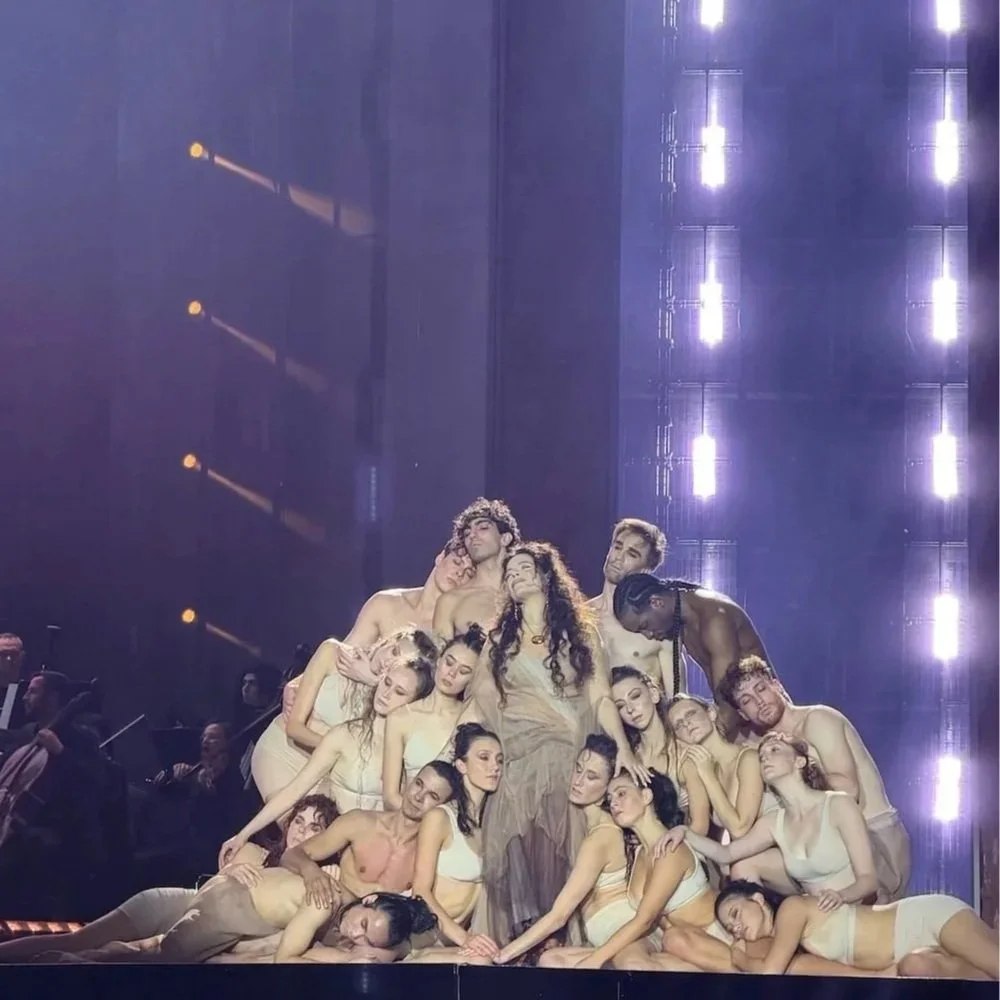
Singer Peruquois (center), embodying the Voice of Mother Earth, stands surrounded by contemporary dancers forming a living human sculpture as members of the Armenian State Symphony Orchestra perform in the shadows on the left—symbolizing humanity's fragile interdependence with the natural world and serving as a visceral call for world leaders to protect life on Earth—during the UN Biodiversity Conference (COP17) opening ceremony in Yerevan, Armenia. October 18, 2026. © 2026 Images for Inclusion Inc (IFI)
Significantly, the same study, in paragraph 45, explicitly calls for climate financing mechanisms to consider all seven Indigenous Peoples’ sociocultural regions, stating:
“It is of utmost importance that governments, philanthropic organizations, private entities and financial partners develop mechanisms and commitments to support and enable Indigenous Peoples’ initiatives and consider all seven sociocultural regions of the Indigenous Peoples.”
Footnote 48 further identifies the seven sociocultural regions recognized by the United Nations Permanent Forum on Indigenous Issues .
This reference is particularly relevant to the debates documented at COP17, where the recognition of those same seven Indigenous sociocultural regions became a central point of contention in negotiations concerning the Modus Operandi of the Subsidiary Body on Article 8(j).
Against this background, Images for Inclusion Inc (IFI) presents an account of its participation in COP17, documenting negotiations, interventions, procedural developments, and issues concerning Indigenous Peoples' rights and representation that its delegate followed throughout the Conference.
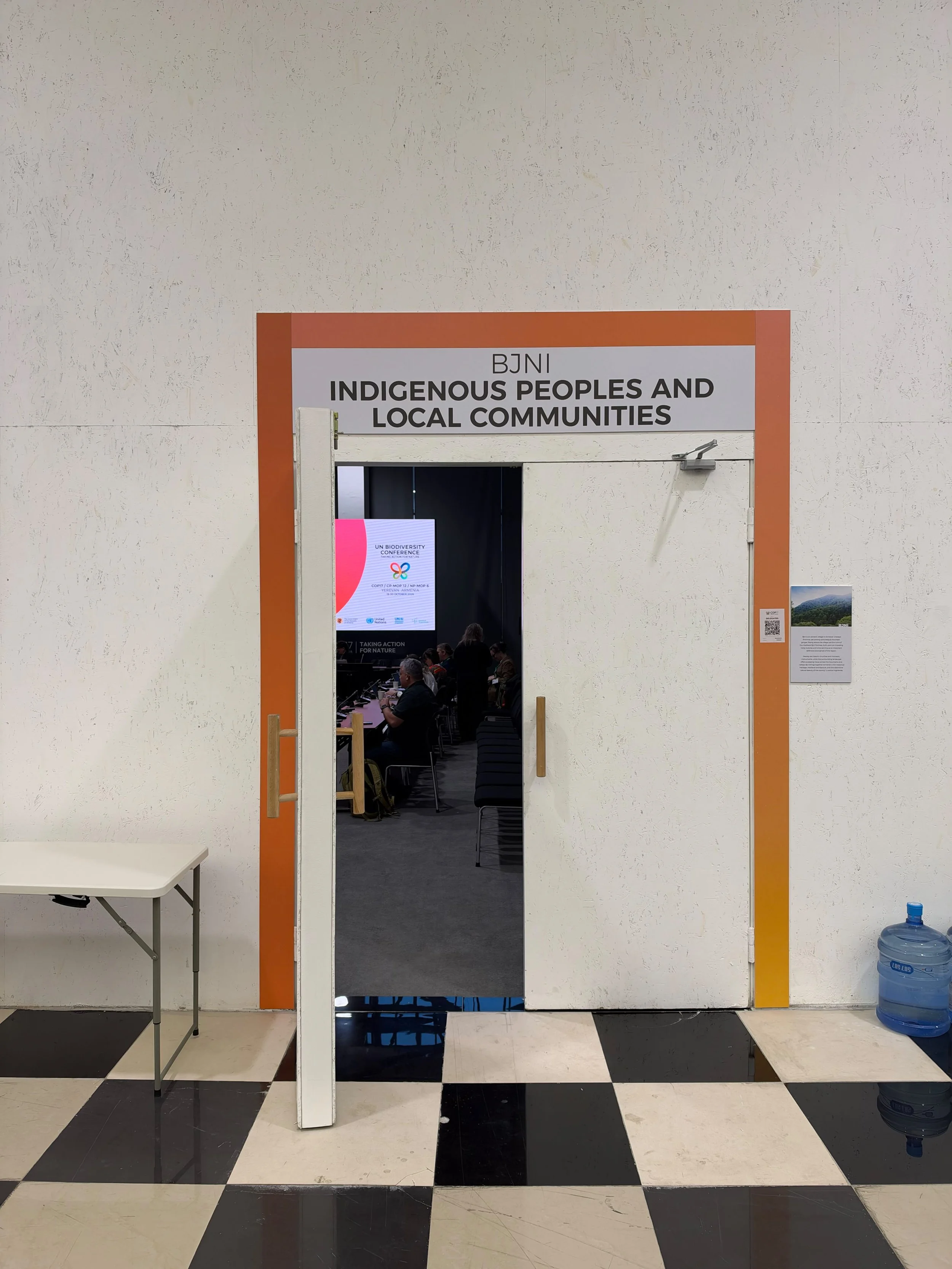
Entrance to Room BJNI, designated “Indigenous Peoples and Local Communities,” where the International Indigenous Forum on Biodiversity (IIFB) held its Caucus meetings during CBD COP17. Yerevan, Armenia, October 2026. © 2026 Images for Inclusion Inc (IFI)
October 18: The First IIFB Caucus — A Rushed Start
The International Indigenous Forum on Biodiversity (IIFB) Caucus began on Sunday, October 18, rather than Saturday, October 17. Only on Saturday we heard that the preparatory Caucus would last just one day before COP17 opened. With numerous agenda items to address, there was little time for deliberation and consensus-building, in stark contrast with past experiences at the UNPFII and EMRIP.
From then on, the IIFB Caucus was held within the Meridian Conference Venue, in the room assigned as "Indigenous Peoples and Local Communities", generally starting at 8:00 a.m. and scheduled to end at either 9:30 or 10:00 a.m., although some meetings started later and discussions sometimes continued well beyond their scheduled ending times. On October 27, the regular Caucus did not meet; instead, only the Article 8(j) commission was scheduled to convene to prepare for the Contact Group session.
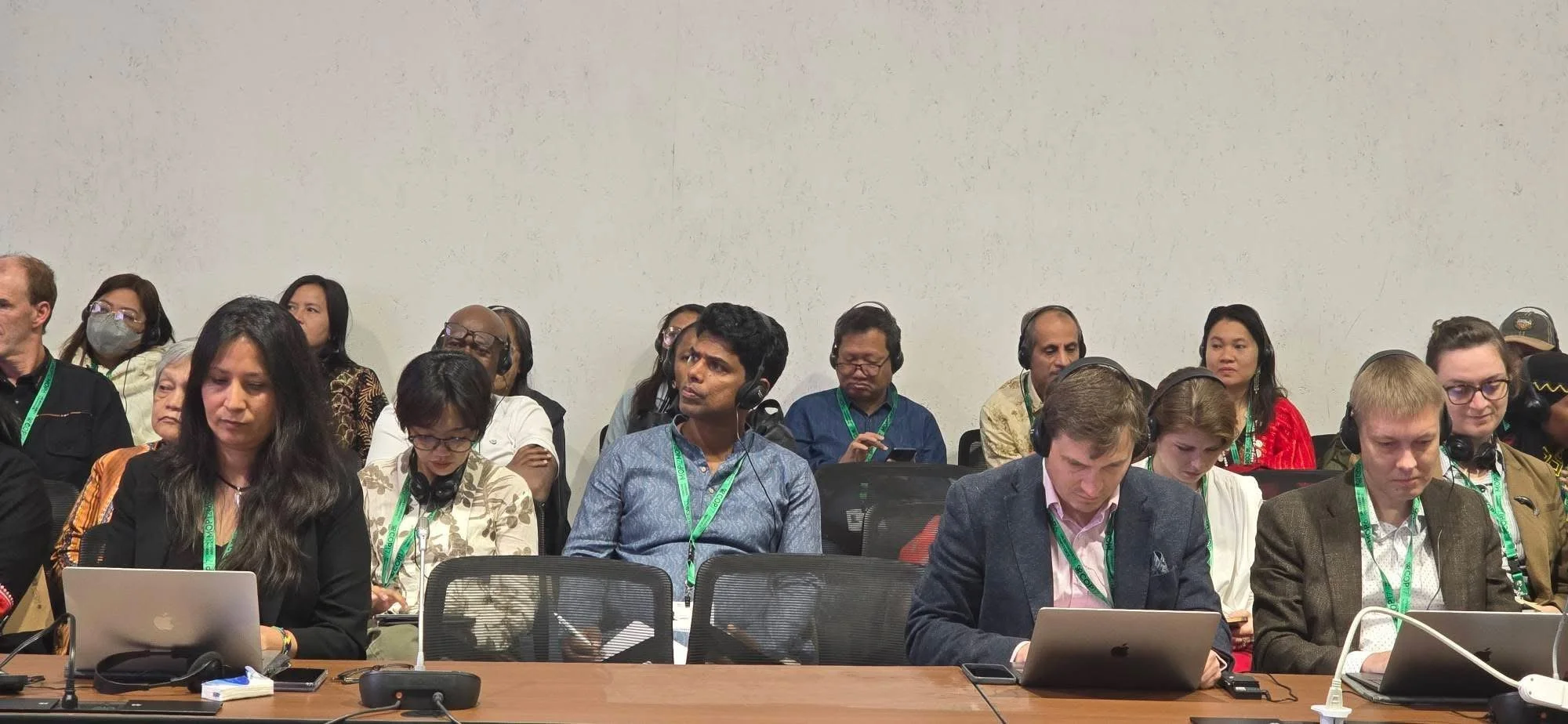
Participants during the IIFB Caucus meeting, including Lidia Arriagada Garcia (left). Yerevan, Armenia, October 18, 2026. Photograph: From IIFB’s Facebook.
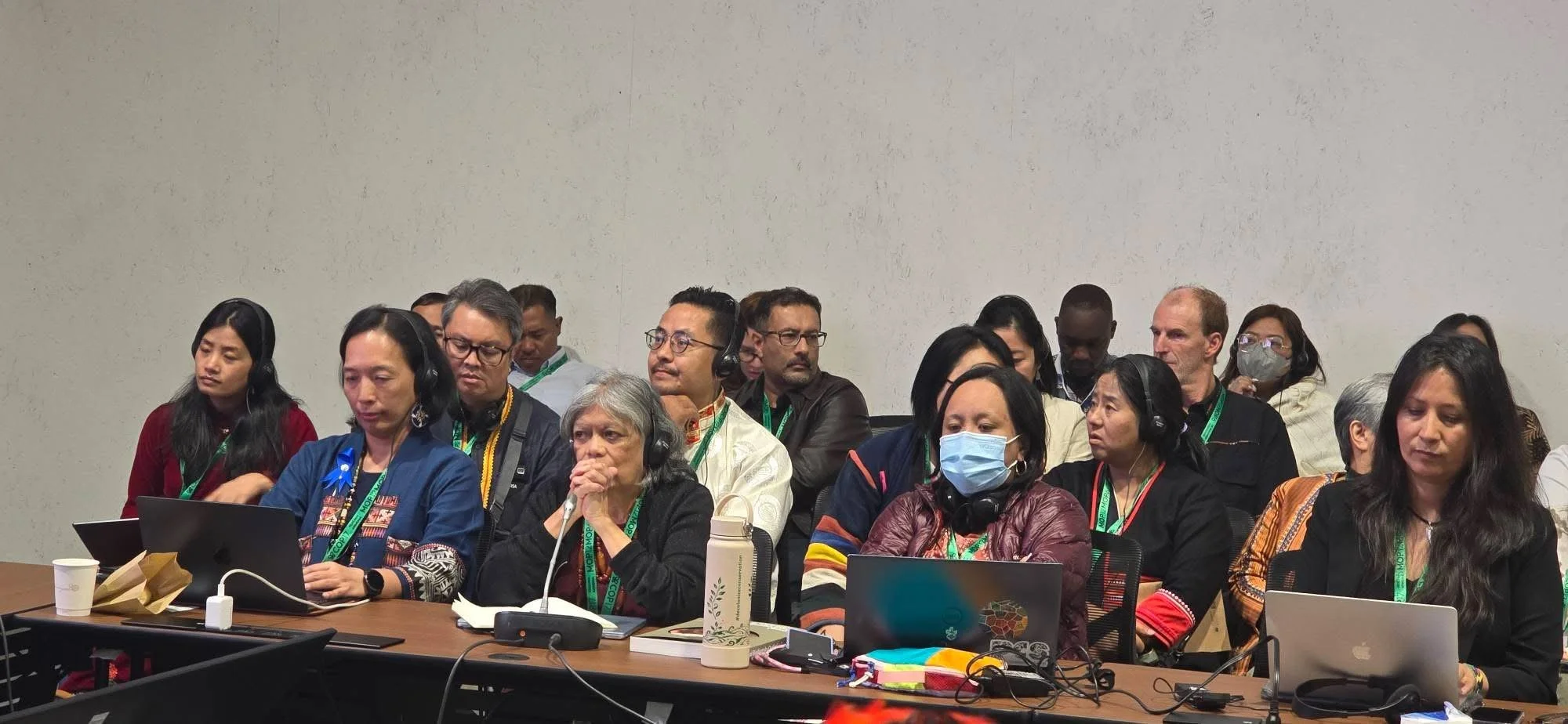
Following an opening invocation and regional introductions, working groups were organized. Lidia joined the group addressing Agenda Item 10, focusing particularly on the Modus Operandi under Item 10(a).
*Participants during the IIFB Caucus meeting, including Lidia Arriagada Garcia (right). Yerevan, Armenia, October 18, 2026. Photograph: From IIFB’s Facebook
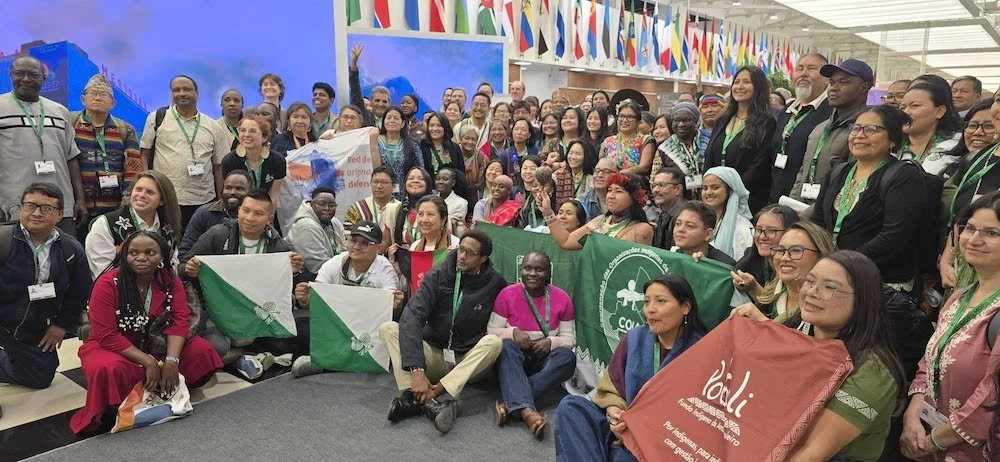
Participants, including Lidia Arriagada Garcia (top right), of the International Indigenous Forum on Biodiversity (IIFB) Caucus gathered ahead of CBD COP17. Yerevan, Armenia, October 18, 2026. Photograph from IIFB's Facebook
From the outset, concerns emerged over the conflation of the terms "Indigenous Peoples" and "local communities" into a single category. Lidia emphasized Indigenous Peoples' distinct collective rights and legal status under international law. An Arctic representative supported this by referencing an EMRIP study (A/HRC/EMRIP/2024/2), emphasizing their recognition as Peoples with the inherent right to self-determination.
Q'apaj Conde of the CBD Secretariat briefed participants on the upcoming negotiations, including regional representation, participation, and the glossary review process, noting that its outcome could not be prejudged. Discussions on the proposed Caucus statement revealed differing strategic approaches. An Arctic representative encouraged seeking consensus around a minimum standard for participation. While an IIFB representative acknowledged the concerns raised by Lidia and a Sámi representative, they cautioned that reopening bracketed language could jeopardize what had already been preserved, emphasizing the pragmatic need for government support.
These discussions ultimately raised a fundamental question: should the Modus Operandi be adopted at any cost? This question was compounded by debates over contested terminology concerning “actors other than national governments” and “major groups and other stakeholders.”
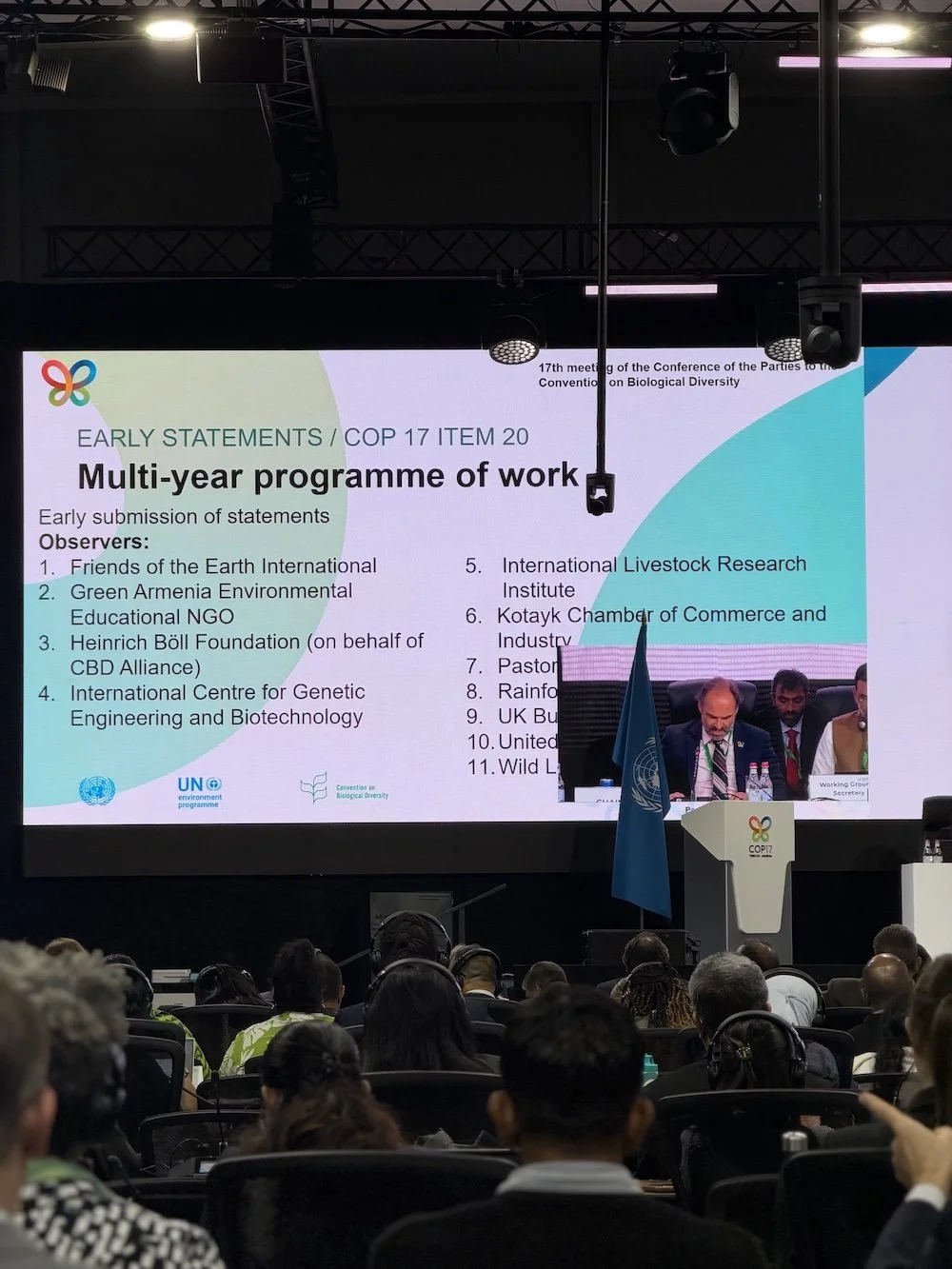
Working Group I session during CBD COP17, showing the presentation of early statements by observer organizations under Agenda Item 20, Multi-year Programme of Work. Yerevan, Armenia, October 19, 2026. © 2026 Images for Inclusion Inc (IFI)
October 19: COP17 Opens — The Debate Moves to the Negotiating Floor
The opening day of COP17 revealed continuing disagreements within the IIFB Caucus over transparency, consensus, and the proposed statement. Noticing that “waters” was missing from the language under discussion, Lidia intervened to request that “waters” be added alongside “lands and territories.”
Tensions also emerged when a Sámi representative pointed out problems with the proposed language and attempted to suggest alternative wording. However, the relevant text had already been moved from the screen during the IIFB Caucus meeting, making it difficult for him to identify the exact paragraph and recall the wording under discussion. The limited time available further complicated his efforts to formulate a specific amendment. Another Caucus participant requested five minutes to discuss it.
Separately, the representative emphasized that the Sámi were not willing to accept the proposed Modus Operandi “at any cost,” stressing the importance of respecting and safeguarding Indigenous Peoples' rights.
An IIFB Secretariat representative explained that the leadership had been asked to address the Modus Operandi and that the Caucus statement needed to remain concise. The representative indicated that the conflation of the terms “Indigenous Peoples” and “local communities” would not be addressed within the Modus Operandi, acknowledging that different perspectives existed on the issue.
The difficulty of recalling the proposed text once it was no longer displayed on the screen projected onto the wall for Caucus participants to view—having been shown for only a few seconds or, at most, a couple of minutes—highlighted the limited time available to examine such important documents, respond to their contents, and propose alternative language. These difficulties were compounded by the lack of advance circulation of documents and the pressure to reach agreement on proposed wording under considerable time constraints.
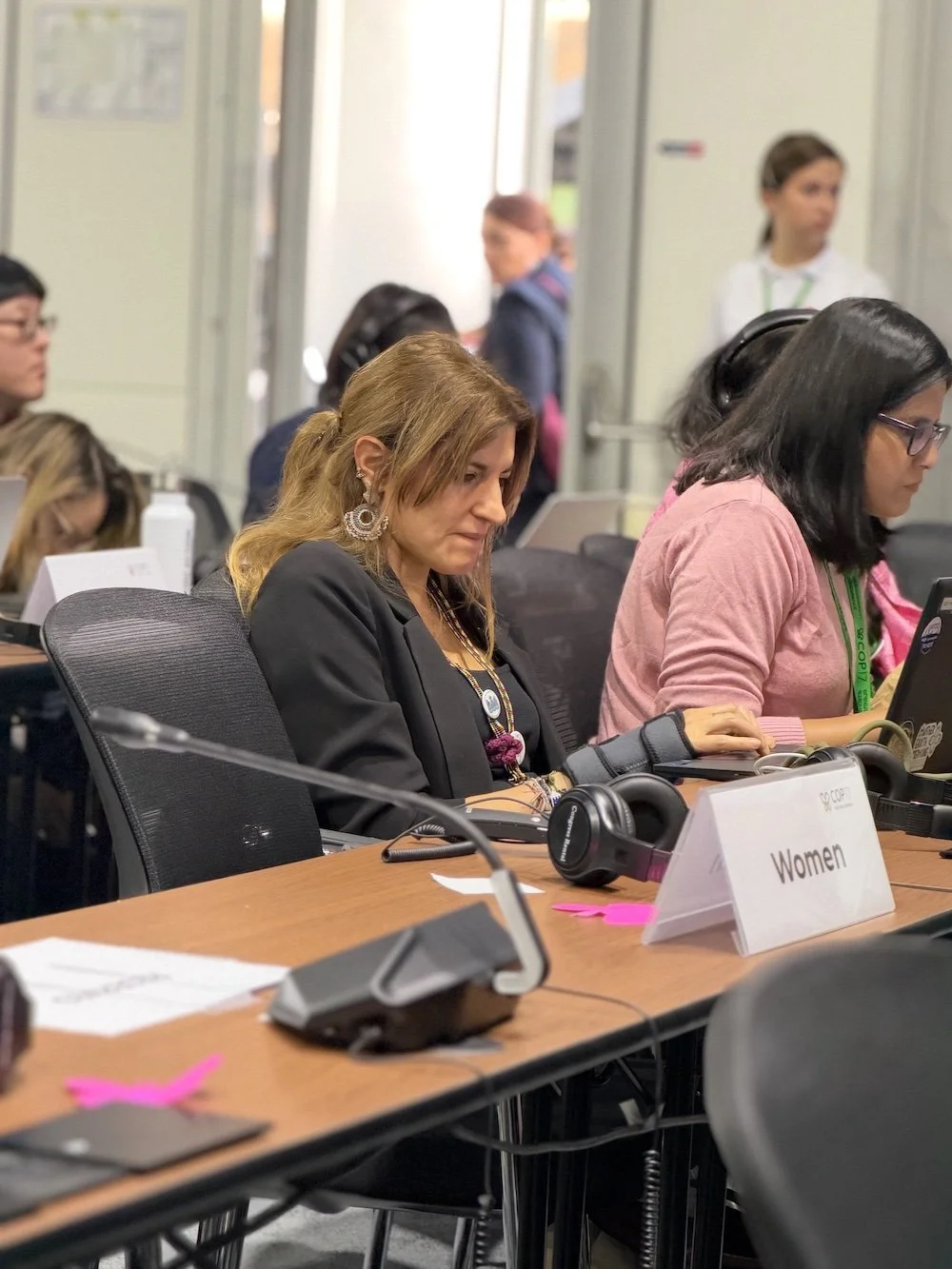
Participants during a COP17 meeting, with designated seating for women’s representatives. Yerevan, Armenia, October 19, 2026. © 2026 Images for Inclusion Inc (IFI)
Internal Call for Conceptual Clarity
Lidia Arriagada Garcia shared a vital reflection within the Latin America and the Caribbean WhatsApp/ FIIB-LAC COP17 network, emphasizing the urgent need to clearly differentiate the unique international legal status and inherent rights of Indigenous Peoples from those of local communities. She warned that conflating them under the “IPLC” umbrella would risk diluting the distinct rights of Indigenous Peoples and opening the door for States to create legal vacuums or restrictive laws that undermine those rights.
Identifying a pattern where attempts to clarify these differences are blocked or falsely labeled as a lack of solidarity, she proposed an internal Caucus consensus document to stop text rejections on the floor. Highlighting that this defense is rooted in self-determination, food sovereignty, and Article 19 of UNDRIP (not UNDROP) concerning consultation and consent (FPIC)—and is not a matter of funding alone—she urged the Caucus to base arguments on legal foundations rather than emotional appeals to break this cycle, confront historical dispossession, and protect minimum standards within the CBD.
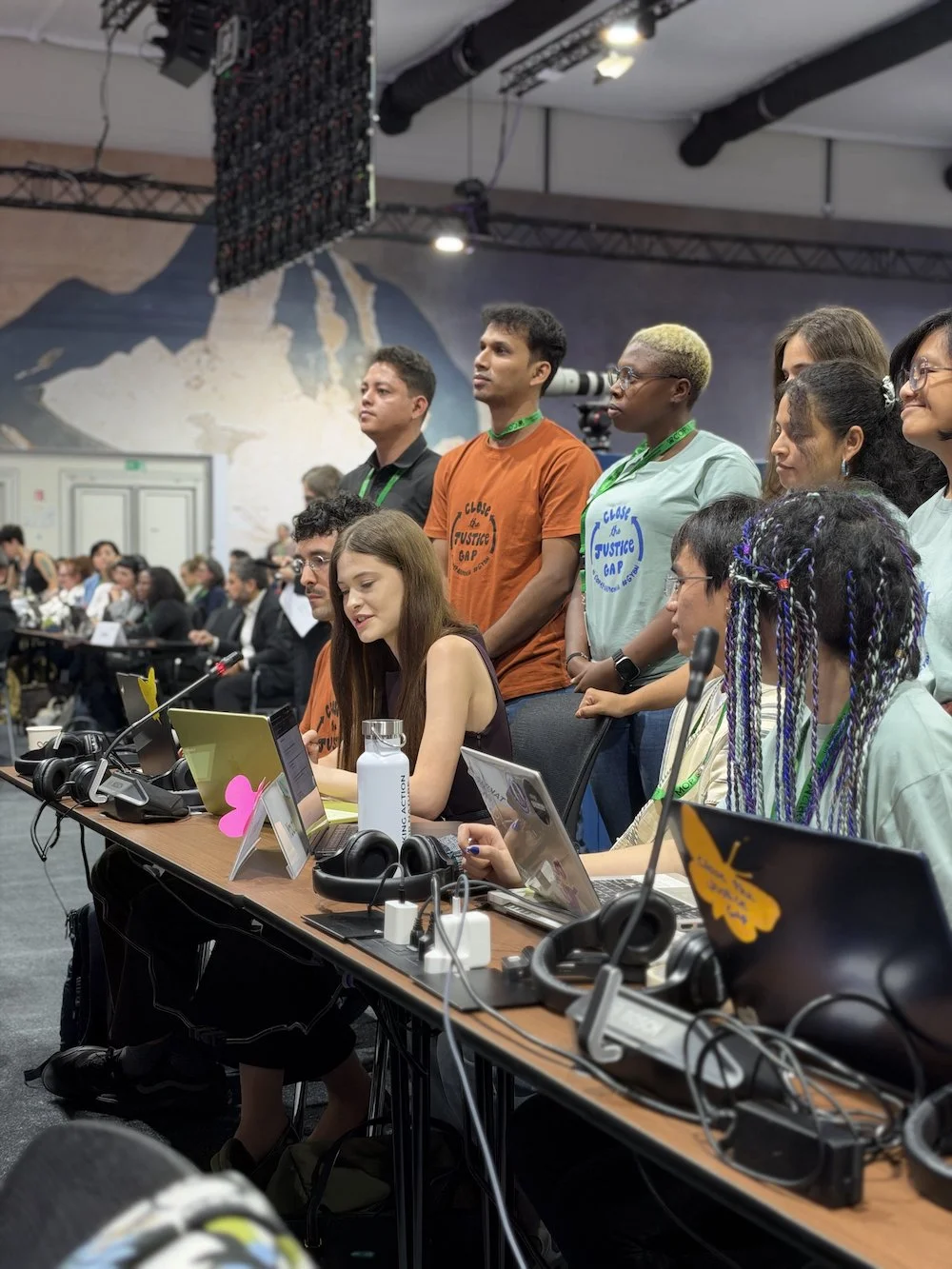
Youth representatives delivering a statement during a Working Group session at CBD COP17. Yerevan, Armenia, October 19, 2026. © 2026 Images for Inclusion Inc (IFI)
Opening Plenary: From Commitments to Implementation
The COP17 opening plenary began with remarks from the President of the Conference of the Parties, followed by the CBD Executive Secretary, who emphasized collective accountability, national ambition, biodiversity financing, equity, and the urgency of implementation. The remarks also highlighted the participation of Indigenous Peoples, local communities, women, and youth, stressing that commitments would be meaningless without implementation. Following an adjournment, the plenary resumed, with groups encouraged to deliver their statements. The IIFB subsequently delivered its opening statement, referring to Indigenous Peoples' right to self-determination.
Agenda Item 10(a): Every Word Matters
At approximately 7:48 p.m., formal negotiations turned to the Modus Operandi of the Permanent Subsidiary Body on Article 8(j). Behind the technical language lay a fundamental question: How would Indigenous Peoples' own systems of representation be recognized within a Party-led Convention?
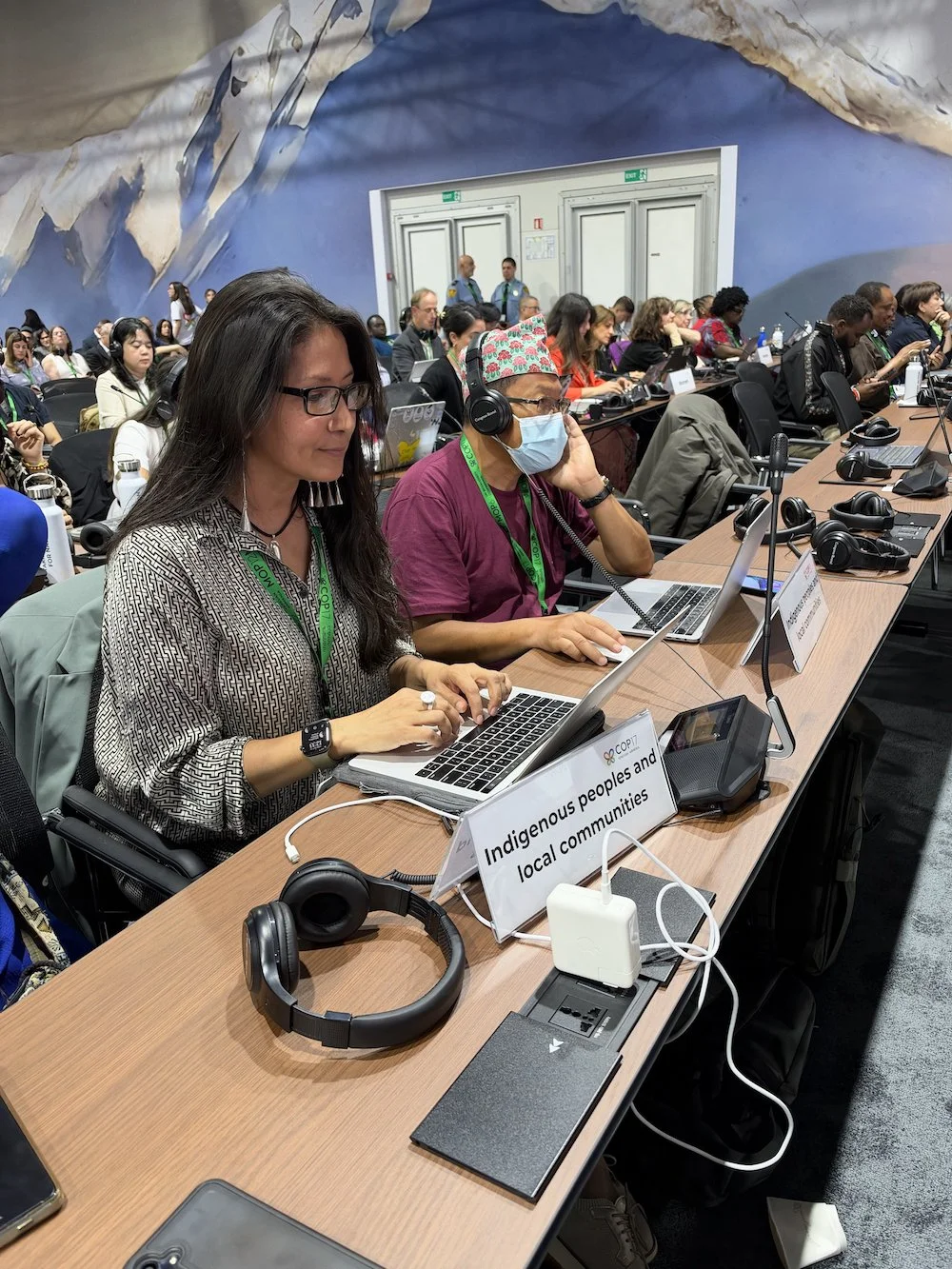
Lidia Arriagada Garcia, participating in the CBD COP17 proceedings, seated in the section designated for Indigenous Peoples and local communities. Yerevan, Armenia, October 19, 2026. © 2026 Images for Inclusion Inc (IFI)
The debate over seven Indigenous Peoples sociocultural regions versus five UN geographic regions exposed different positions among the Parties. Australia supported the seven sociocultural regions, while Uganda favored the UN regional system. Brazil expressed flexibility, and Norway emphasized Indigenous Peoples' ability to represent themselves. Canada stressed the Party-led nature of the Convention while questioning why its regional system should be imposed on the Subsidiary Body. As negotiations progressed, delegates worked through bracketed text concerning institutional responsibilities, participation, regional representation, and intergenerational dialogue. The discussions demonstrated why the modus operandi was more than a procedural matter: the arrangements being negotiated would influence how Indigenous Peoples participate and are represented within the new Subsidiary Body.
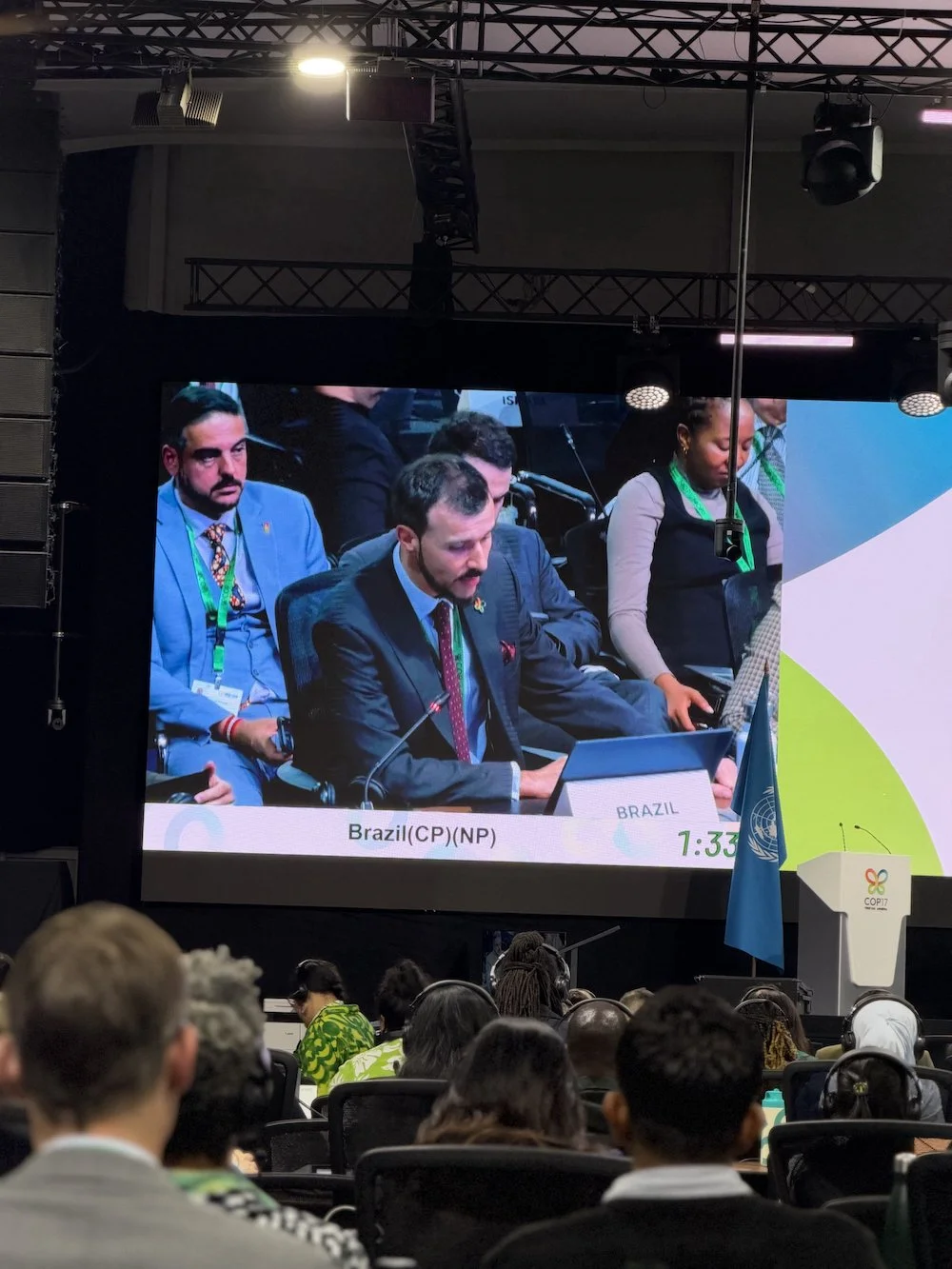
Brazil's delegation delivering a statement at a official proceedings of the UN Biodiversity Conference (COP17). Yerevan, Armenia, October 19, 2026. © 2026 Images for Inclusion Inc (IFI)
Section IV: The Bureau, Co-Chairs, and the Limits of Representation
As negotiations moved to Section IV, concerning the Bureau and Co-Chairs, disagreements continued over the respective roles of Parties, Indigenous Peoples’ representatives, and the institutional arrangements of the new Subsidiary Body. Throughout the negotiations, Co-Chair Jennifer repeatedly sought to build consensus through diplomatic language, procedural flexibility, and direct appeals to the Parties. Thanking delegations for their flexibility, she would ask whether they “could we live with the text” displayed on the screen or whether the proposed wording was acceptable. At other moments, she invited objections, suggested deleting language or removing brackets, and encouraged Parties to reflect on outstanding proposals before moving forward.
The Co-chair’s interventions reflected the painstaking process of negotiating language acceptable to different delegations. “I think we are moving in a very constructive way,” she remarked during one exchange, later thanking Parties for their “constructive spirit.” When objections were raised, she acknowledged them as having been heard “loud and clear.” The podium also encouraged delegates to “think outside the box,” recognizing the distinctive institutional arrangements being developed for the Modus Operandi of the Permanent Subsidiary Body on Article 8(j).
These efforts occasionally produced visible progress. When brackets were cleared from one provision, the room applauded. Yet agreement on individual passages did not resolve the broader disagreements over representation and institutional responsibilities.
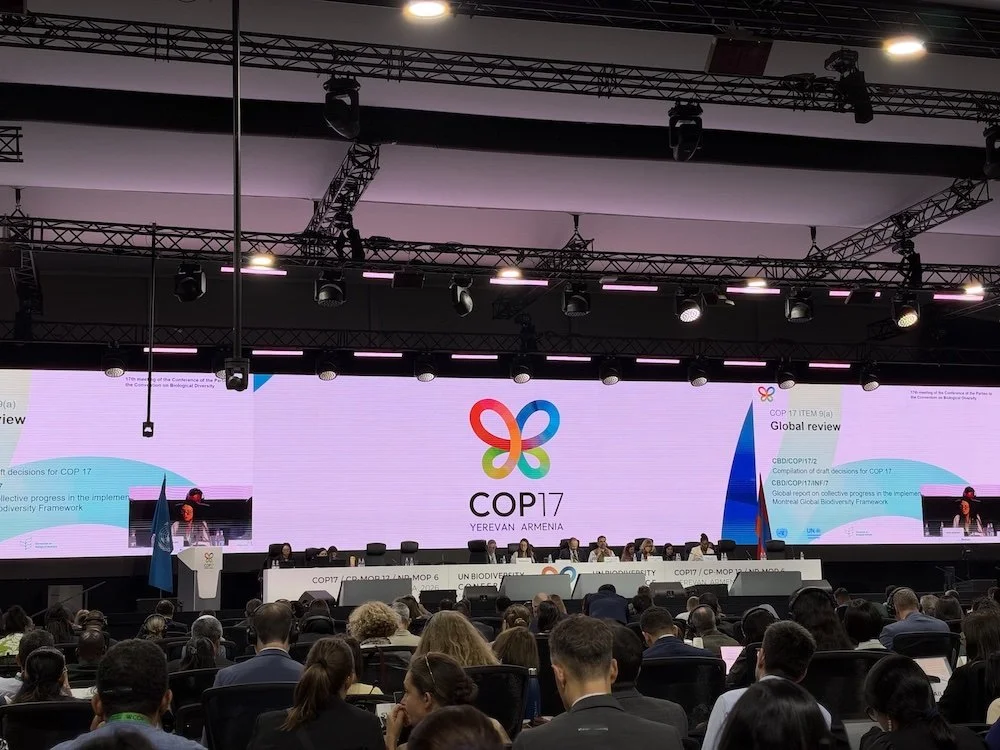
Working Group session at CBD COP17. Yerevan, Armenia, October 19, 2026. © 2026 Images for Inclusion Inc (IFI)
Canada sought clarification of the respective roles of Parties and the Bureau, while the Russian Federation questioned aspects of the proposed governance structure. The exchanges highlighted the unusual nature of a Subsidiary Body whose institutional arrangements would include Indigenous representatives alongside Parties.
Further disagreements emerged over the Friends of the Bureau. The Russian Federation argued that this group should not be larger than the Bureau itself and called for compromise. The delegation also proposed limiting representation to one representative per meeting, while concerns arose over whether such restrictions would permit meaningful Indigenous Peoples’ participation.
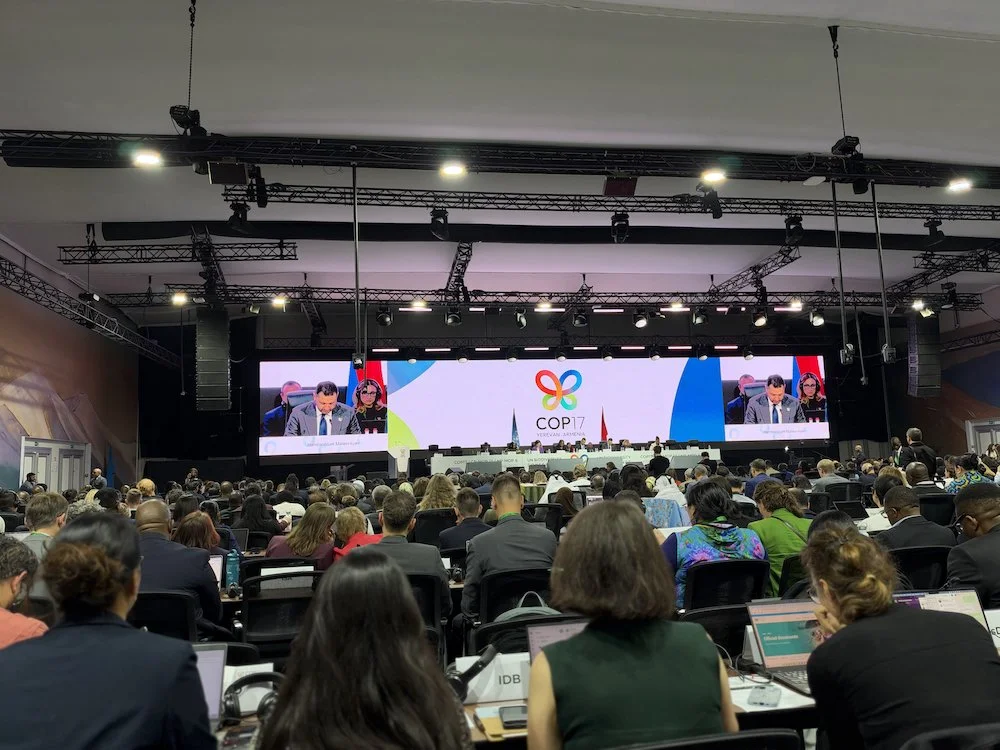
Working Group session at CBD COP17. Yerevan, Armenia, October 19, 2026. © 2026 Images for Inclusion Inc (IFI)
Regional representation remained contentious. Namibia objected to a reference to the United Nations Permanent Forum on Indigenous Issues (UNPFII), while Norway continued addressing Indigenous regional representation. Uganda called for invitations to remain discretionary and raised the possibility of splitting a paragraph if negotiations continued in the proposed direction.
The exchanges illustrated the delicate balance between diplomatic compromise and substantive participation. Every proposed deletion, retained bracket, and request for flexibility carried implications for how Indigenous Peoples would be represented within the new Subsidiary Body.
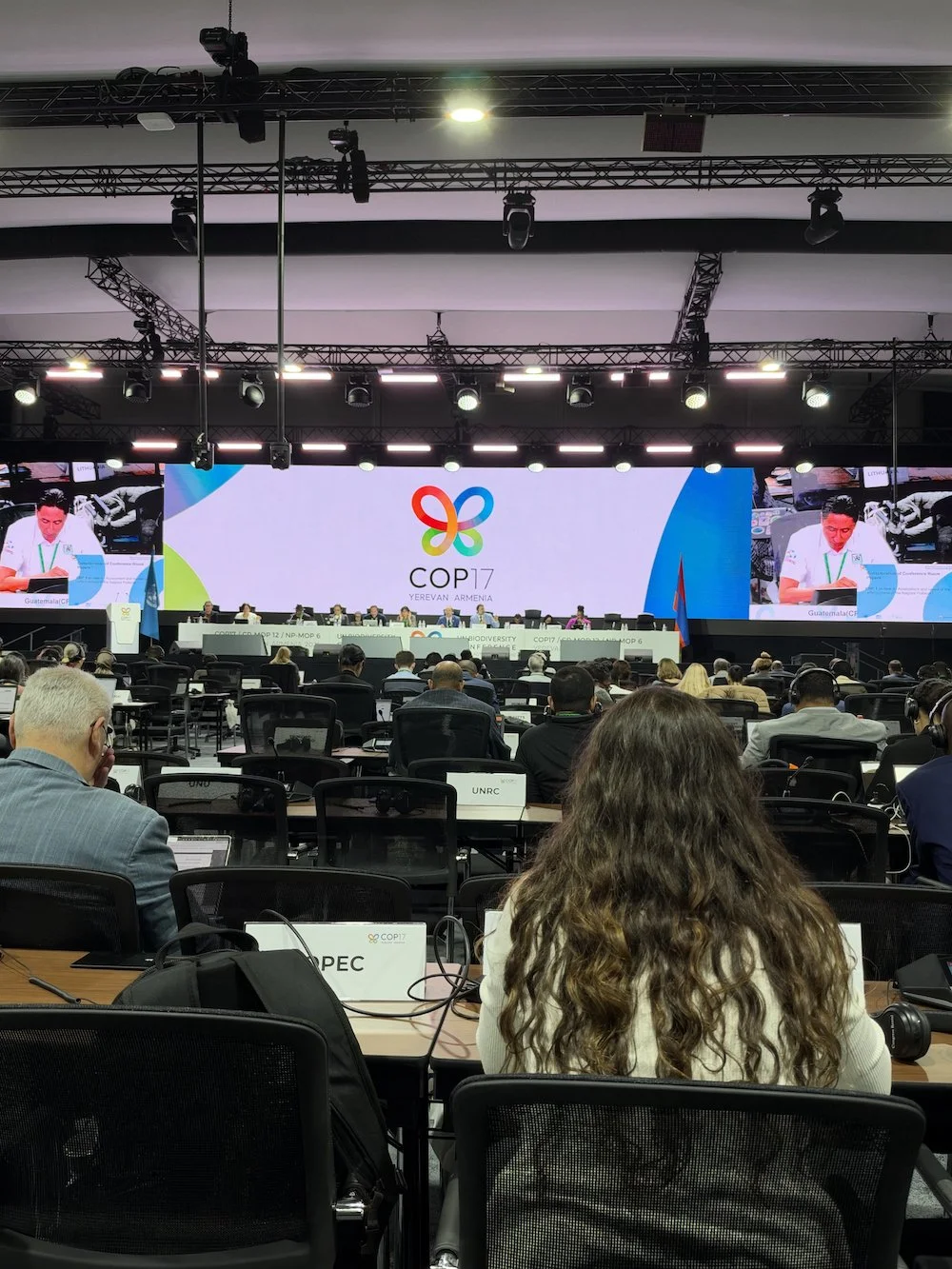
Guatemala’s delegate during a Working Group session at CBD COP17. Yerevan, Armenia, October 19, 2026. © 2026 Images for Inclusion Inc (IFI)
October 20: Scientific Evidence, Biodiversity Financing, and the Struggle for Direct Access
On October 20, Lidia attended negotiations on Agenda Item 17(e), concerning the IPBES work programme, followed by discussions on resource mobilization under Item 8(a).
Diplomatic Nuances of the Contact Group Negotiations
The morning discussions revealed how individual words shaped diplomatic negotiations. Argentina sought to delete certain provisions, while New Zealand proposed replacing “mandate” with “encourage,” gaining Argentina's support. Russia questioned terminology concerning “major groups and other stakeholders” and “actors other than national governments,” while Brazil proposed alternative language. The Co-Chair encouraged compromise, with unresolved language remaining in brackets.
In the afternoon, the Democratic Republic of the Congo questioned the effectiveness of the resource mobilization strategy, while Kenya challenged progress toward the $30 billion annual financing commitment for 2030.
Direct access to funding for Indigenous Peoples became a significant issue. Guatemala supported direct access for Indigenous Peoples and local communities, while Brazil raised access for Indigenous Peoples, local communities, women, and youth. Peru emphasized developed countries' financial obligations toward developing countries.
The negotiations highlighted a central challenge: securing biodiversity financing while determining who could access it and under what conditions.
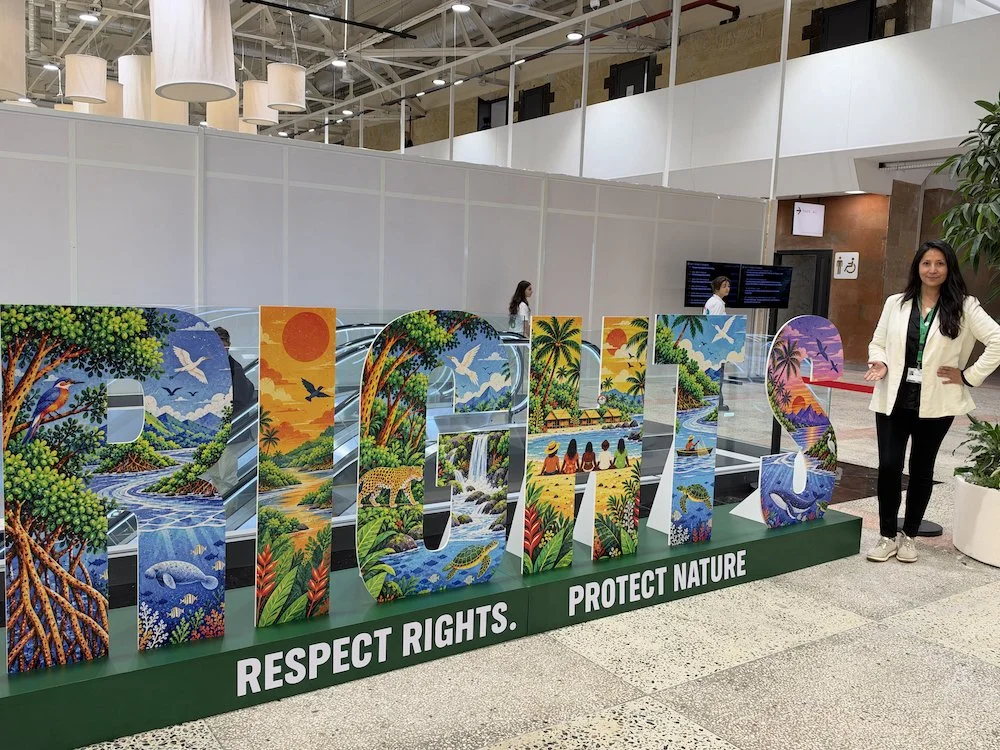
Lidia Arriagada Garcia, President and CEO of Images for Inclusion Inc (IFI), beside the "Respect Rights. Protect Nature" installation at CBD COP17 in Yerevan, Armenia, on October 21, 2026—a visual centerpiece underscoring the recognition of Indigenous Peoples' customary land, territory, and self-determination rights as foundational to biodiversity conservation. © 2026 Images for Inclusion Inc (IFI)
October 21: Indigenous Peoples' Representation, State Sovereignty, and Negotiating Compromises
October 21 exposed a fundamental strategic disagreement over whether to accept an imperfect Modus Operandi to maintain negotiating momentum or allow more time to safeguard Indigenous Peoples' rights, including free, prior and informed consent (FPIC), self-determination, and long-term representation.
During the morning IIFB Caucus, a representative of Indigenous Peoples recalled the 30-year struggle leading to the adoption of the UNDRIP, emphasizing the consequences of the proposed arrangements for future generations and suggesting that negotiations could wait if consensus remained elusive.
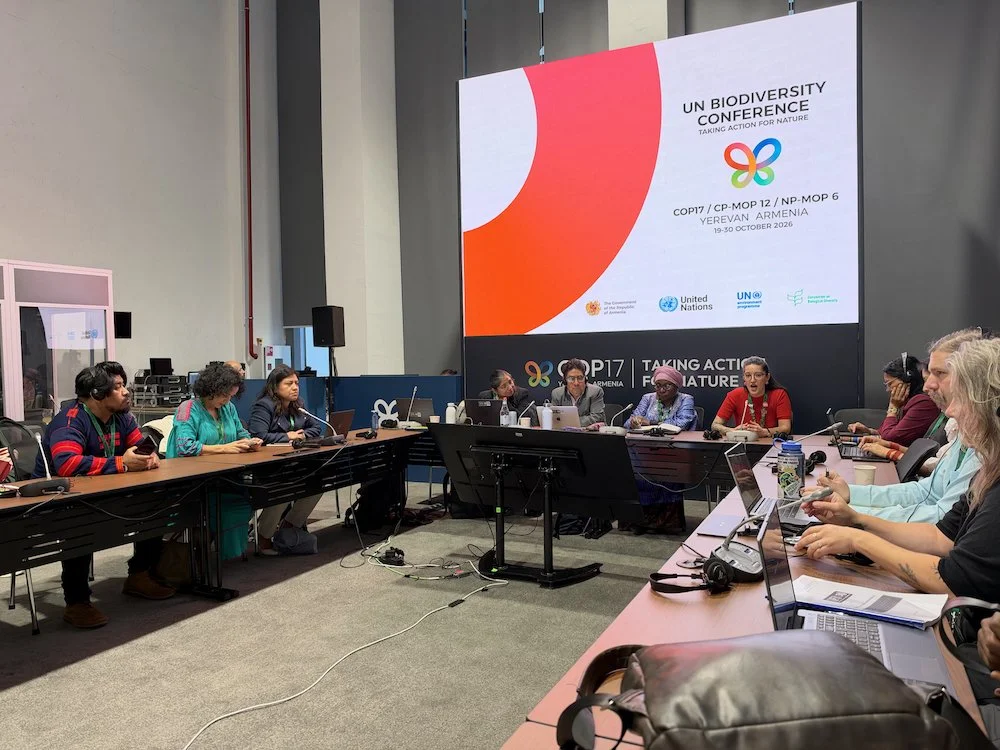
A representative of Mexico addressing the International Indigenous Forum on Biodiversity (IIFB) Caucus during CBD COP17. Yerevan, Armenia, October 21, 2026. © 2026 Images for Inclusion Inc (IFI)
A representative of Mexico cautioned, “Do not lose the momentum,” advocating agreement on the essential elements while continuing to address outstanding issues.
During the Caucus, Lidia Arriagada Garcia defended the seven Indigenous Peoples sociocultural regions, arguing that the CBD’s intergovernmental structure did not require Indigenous Peoples to adopt the five geographic regions used by States Parties. Citing Articles 5 and 18 of UNDRIP, Lidia stressed that Indigenous Peoples' own representative institutions must be respected and urged the Caucus not to make premature concessions while negotiations were still underway.
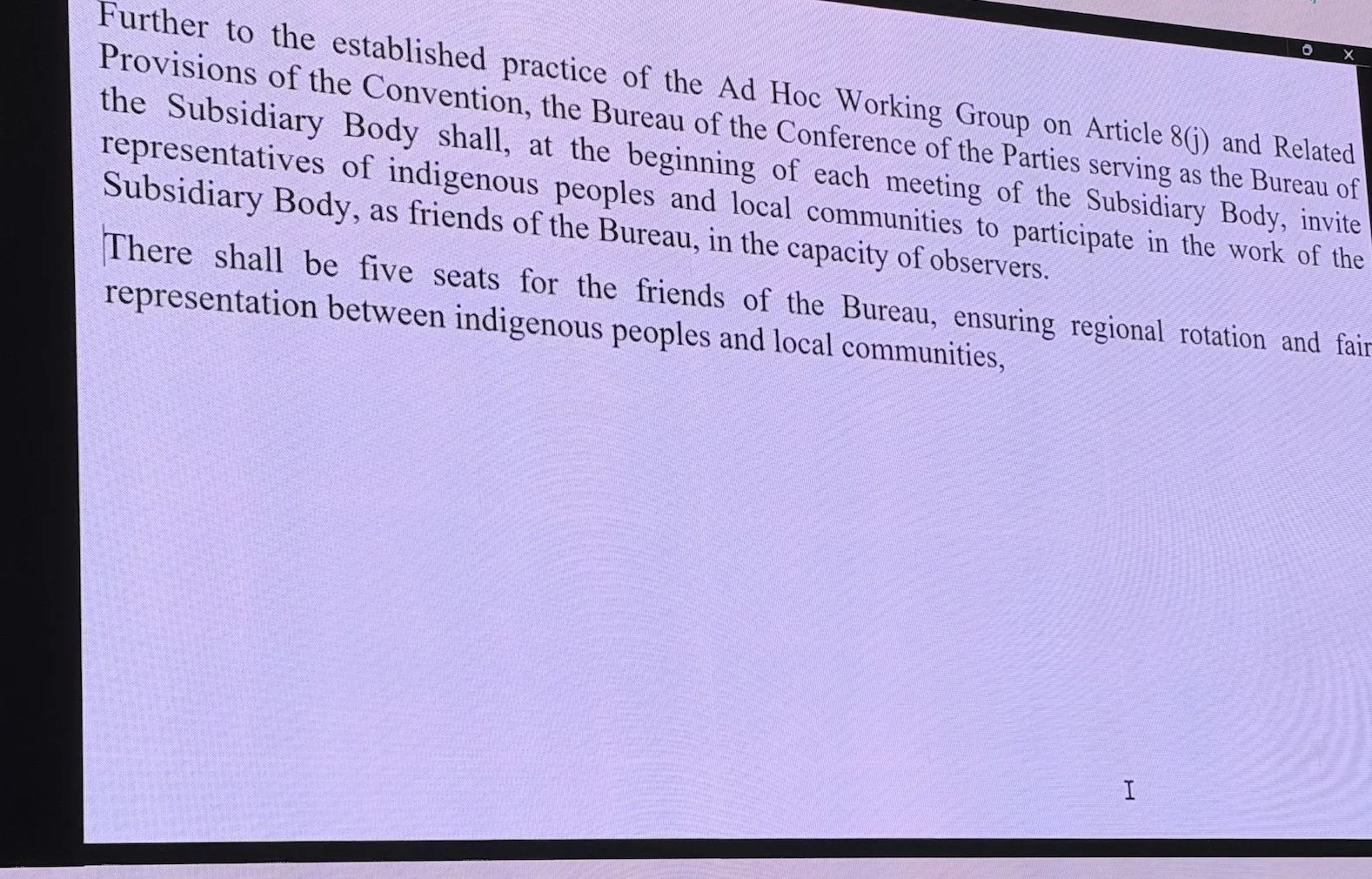
Draft negotiating text projected during the Working Group I Contact Group on Article 8(j) on October 21, 2026, showing the proposed language allocating five seats to representatives of Indigenous Peoples and local communities as "friends of the Bureau, in the capacity of observers." CBD COP17, Yerevan, Armenia. © 2026 Images for Inclusion Inc (IFI)
Discussions also raised the controversial proposal that representatives receive national government endorsement, highlighting tensions between State authority and Indigenous Peoples' right to choose their own representatives.
In afternoon Contact Groups, negotiators deleted “technical mentoring and advisory support” from a capacity-building provision and clashed over “water security,” “crisis” versus “challenges,” sovereignty, and national jurisdiction in the climate change text.
During the evening Article 8(j) session, Parties debated allocating five versus nine seats to Indigenous Peoples and local communities as Friends of the Bureau (supported by Brazil and the EU), alongside competing proposals for nominations through Indigenous Peoples' “own governance structure” versus national endorsement. With no consensus, the Co-Chair kept the paragraph in brackets.
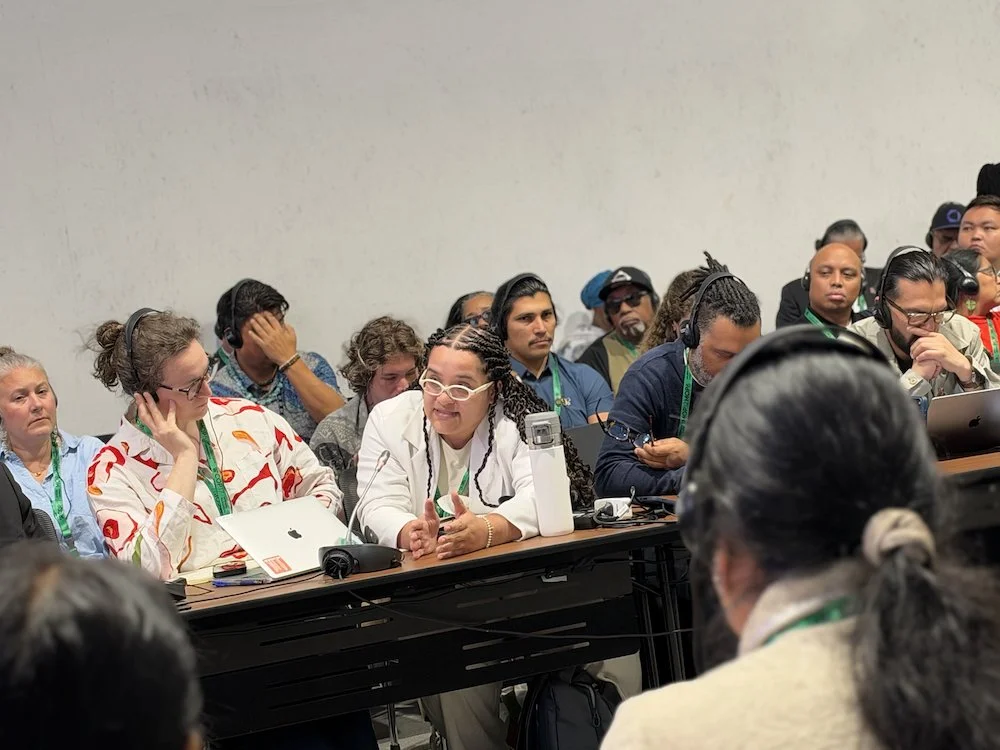
A participant addressing the International Indigenous Forum on Biodiversity (IIFB) Caucus during CBD COP17. Yerevan, Armenia, October 22, 2026. © 2026 Images for Inclusion Inc (IFI)
October 22: local communities, Indigenous Peoples Rights, Seven Sociocultural Regions, and the Limits of Solidarity
Thursday exposed growing tensions over the conflation between Local Communities and Indigenous Peoples' rights and representation. Within the IIFB caucus, representatives of Indigenous Peoples from the Arctic, Latin America, and North America who advocated for their distinct collective rights faced repeated accusations, both direct and indirect, of acting in bad faith, lacking solidarity with local communities, promoting separation, and creating division. These accusations presented a false dilemma, suggesting that defending Indigenous Peoples' rights meant opposition and hostility towards local communities.
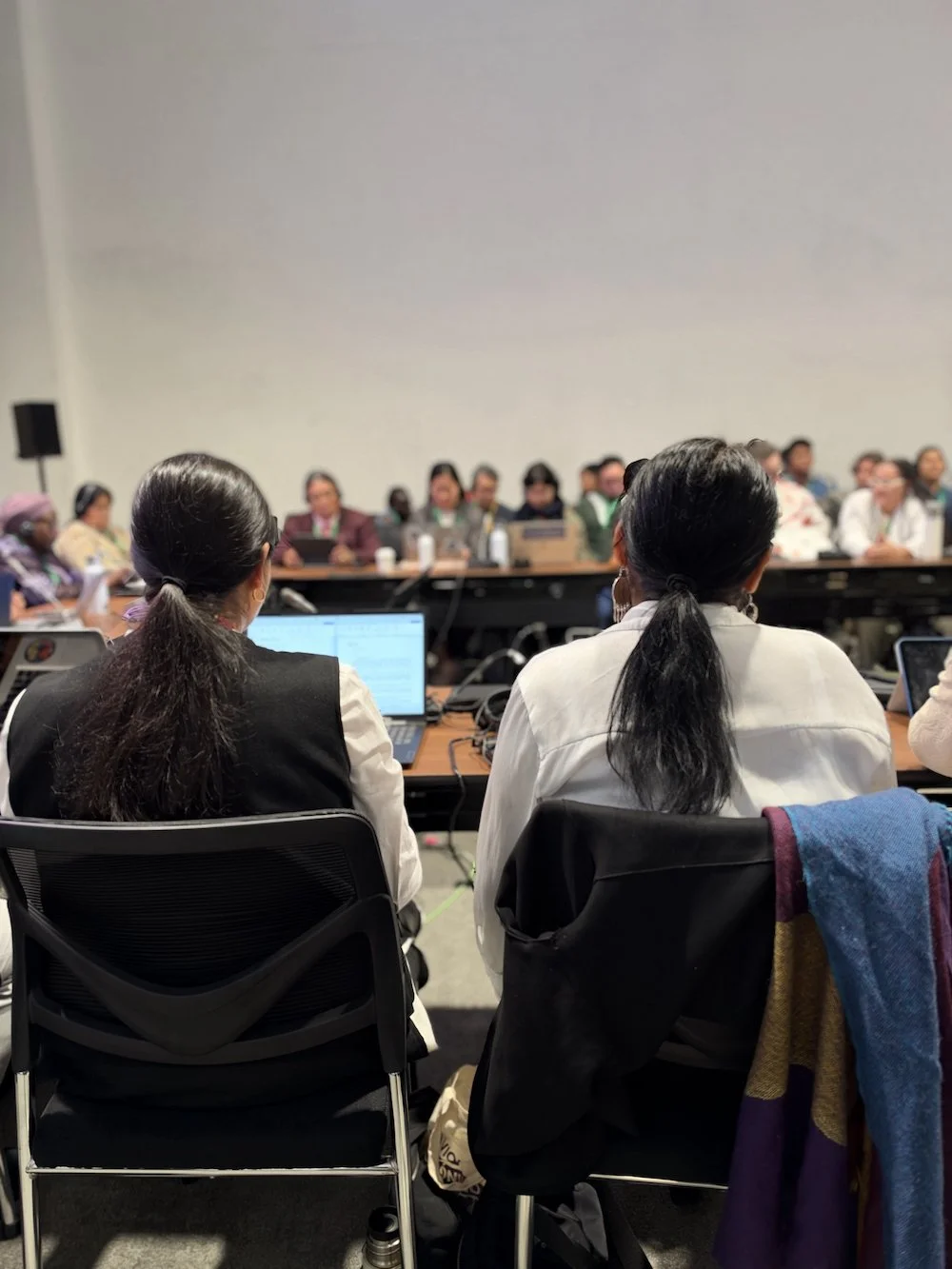
Participants attending the International IIFB Caucus meeting during CBD COP17. Yerevan, Armenia, October 22, 2026. © 2026 Images for Inclusion Inc (IFI)
The tension shifted the focus from the legal distinctions of Indigenous Peoples under international law being defended toward judgments about the solidarity and intentions of those raising them. According to IFI’s Focal Point defending Indigenous Peoples' distinct rights under UNDRIP was not an attack on local communities, nor did recognizing those rights require denying the interests of other groups such us those of local communities.
During the morning Caucus, representatives of Indigenous Peoples also emphasized the importance of recognizing Indigenous territories as a distinct category rather than subsuming them under broader protected-area frameworks.
Meanwhile, negotiations on the Modus Operandi exposed competing approaches to representation. The Russian Federation emphasized the five UN geographic regions, while Canada defended Indigenous Peoples' self-organization through seven sociocultural regions.
Mexico and the European Union also supported recognition of the seven regions. Competing proposals contemplated five, nine, or ten seats for the Friends of the Bureau, while another proposal considered seven seats for Indigenous Peoples and three for local communities. These disagreements raised questions about representation through Indigenous Peoples' own institutions and procedures, as recognized under Articles 5 and 18 of UNDRIP.
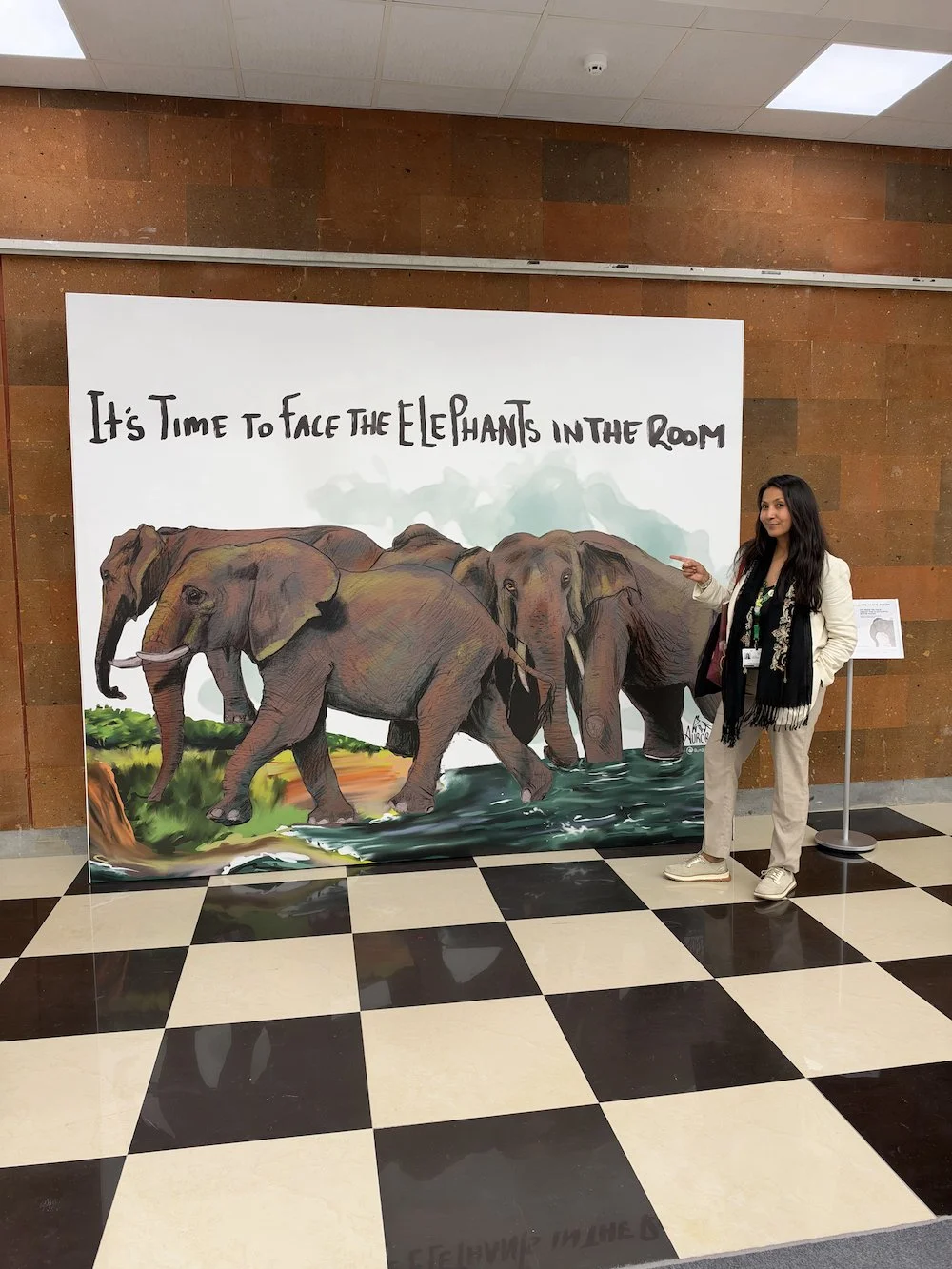
Lidia Arriagada Garcia, President and CEO of Images for Inclusion Inc (IFI), beside the “It’s Time to Face the Elephants in the Room” artwork displayed at CBD COP17 in Yerevan, Armenia. Photograph taken on October 26, 2026. © 2026 Images for Inclusion Inc (IFI)
At one of the 2 Working Groups and amid these tensions, Lidia Arriagada Garcia personally approached Aluki Kotierk, the current Chair of the United Nations Permanent Forum on Indigenous Issues (UNPFII), requesting that she attend the IIFB Caucus to explain the importance of preserving the seven Indigenous sociocultural regions and clarify that defending Indigenous Peoples' specific rights should not be interpreted as an offense against local communities. Arriagada Garcia was informed that Kotierk's speaking engagement had already been scheduled and Kotierk attended the caucus the following morning, October 23.
That evening, negotiations on biodiversity and climate change continued with unresolved language concerning ecological integrity, national planning, domestic legislation, and implementation resources under Article 20 of the Convention.
The underlying question remained unresolved: could Indigenous Peoples retain their own systems of representation within an institutional framework whose procedures were negotiated and adopted by States Parties?
Yet, it was time to face the elephants in the room.
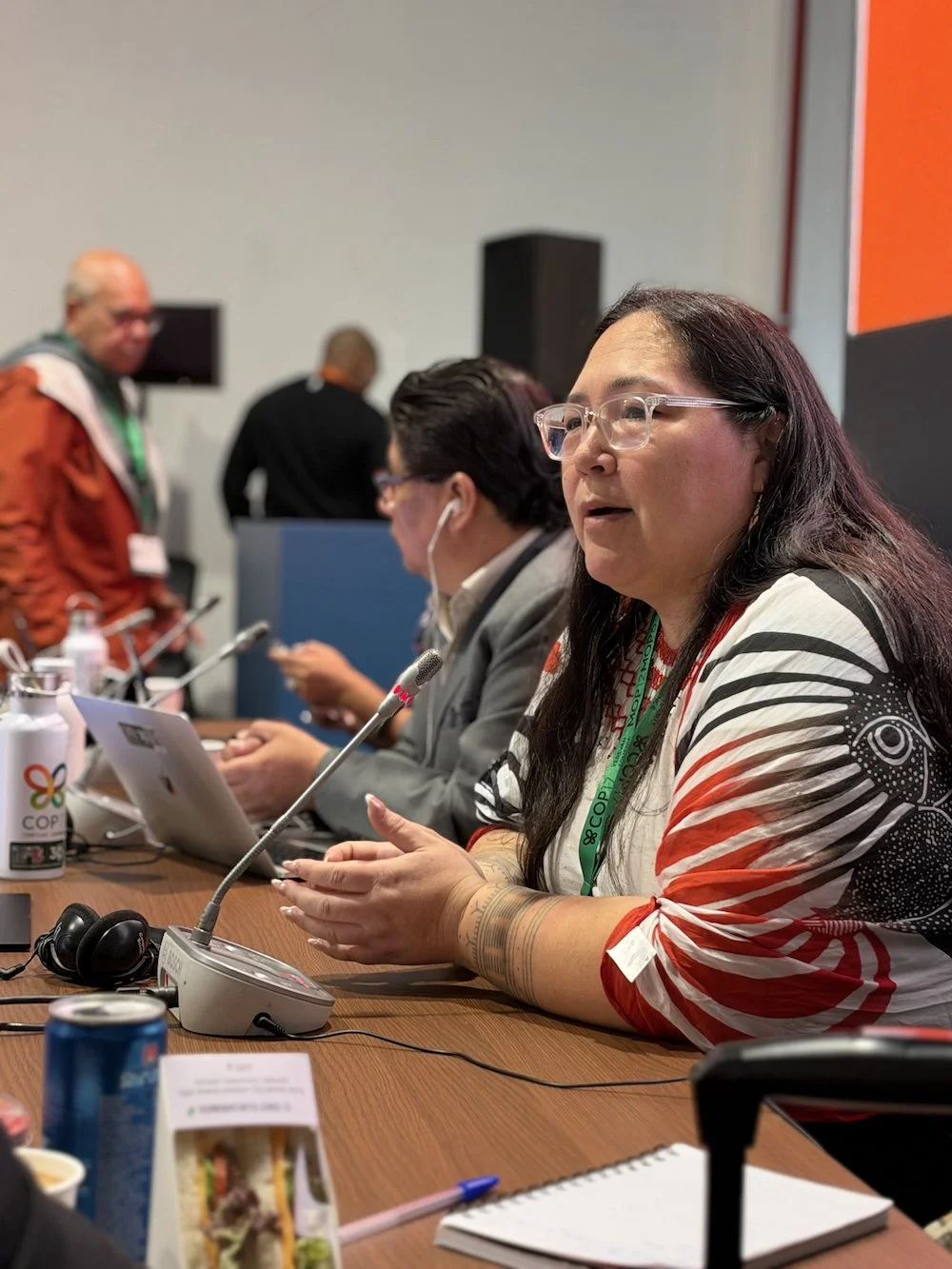
Aluki Kotierk, Chair of the United Nations Permanent Forum on Indigenous Issues (UNPFII), addressing the IIFB Caucus during CBD COP17. Yerevan, Armenia, October 23, 2026. © 2026 Images for Inclusion Inc (IFI)
October 23: Inuk leader Aluki Kotierk, Chair of the UNPFII, Participates as an Invited Speaker at the IIFB Caucus
On Friday, October 23, the Indigenous Peoples and Local Communities Caucus, convened by the IIFB, welcomed Aluki Kotierk, Chair of the United Nations Permanent Forum on Indigenous Issues (UNPFII), as an invited speaker to address Indigenous Peoples' right to determine their own representation.
Following her presentation, during a question-and-answer session, one Caucus participant raised concerns about the conflation of Indigenous Peoples and local communities and the recognition of the seven Indigenous Peoples sociocultural regions, while another questioned the Permanent Forum's influence over environmental conventions.
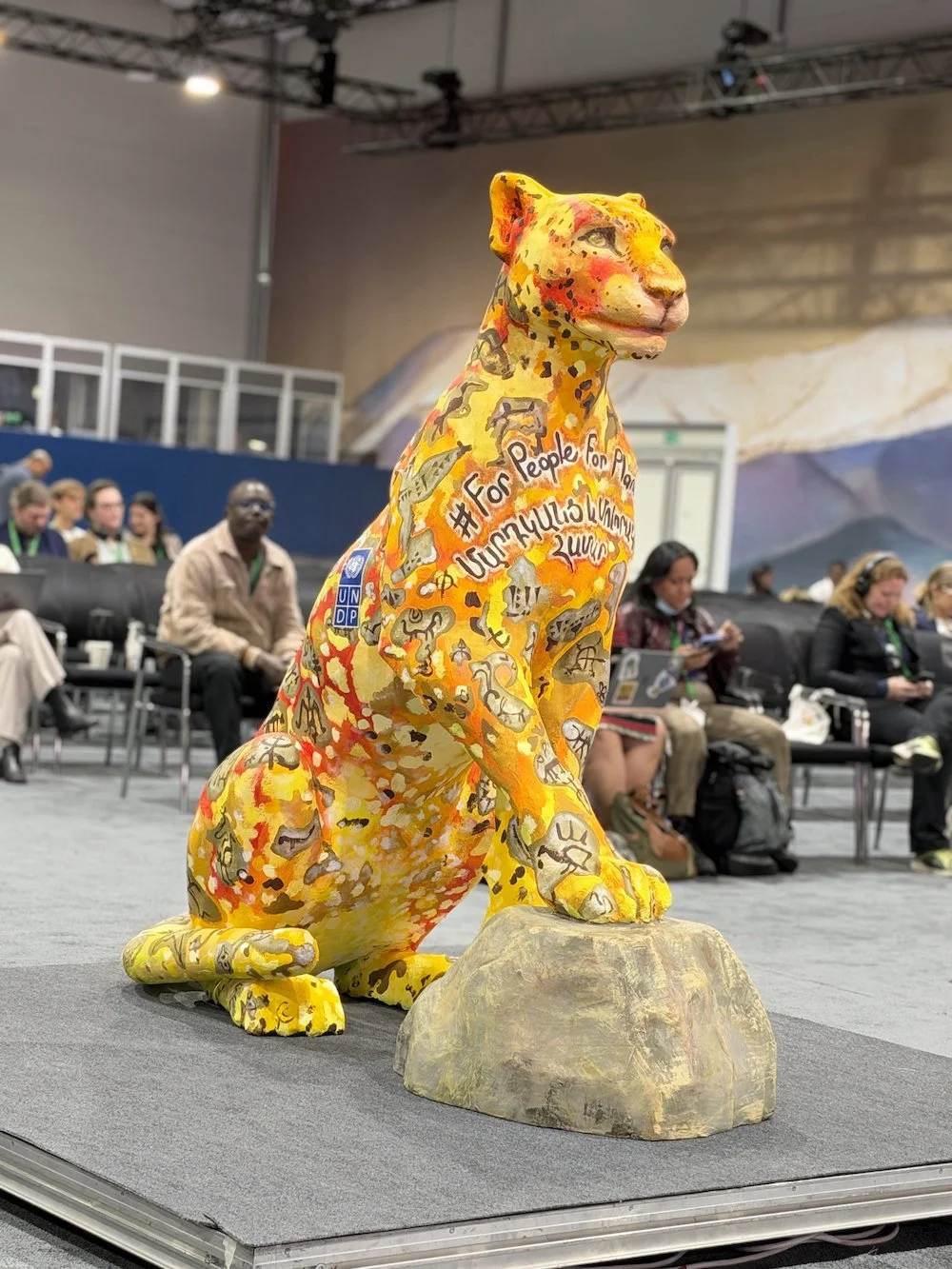
Life-size Caucasian leopard sculpture created by Armenian artist Yevgine Onanyan for UNDP, highlighting wildlife and biodiversity conservation at CBD COP17. Yerevan, Armenia, October 2026. © 2026 Images for Inclusion Inc (IFI)
Kotierk referred to the July 2023 joint statement by the UNPFII, the Expert Mechanism on the Rights of Indigenous Peoples, and the Special Rapporteur on the rights of Indigenous Peoples. She explained that the statement addressed the conflation of Indigenous Peoples with non-Indigenous entities. She emphasized that the Permanent Forum had not prescribed how to resolve the issue and highlighted Indigenous Peoples' right to self-determination and their own forms of governance. She stressed:
“Indigenous Peoples have to figure out how to make sure that there is no conflation.”
At Images for Inclusion Inc, we believe it is worth highlighting that the aforementioned joint statement explicitly states:
“The term Indigenous Peoples has been used in conjunction with other ambiguous terms and groups such as ‘local communities.’ In fact, the characteristics, nature, and origins of the rights of Indigenous Peoples are very different from other groups. Therefore, Indigenous Peoples should not be grouped with an undefined set of communities that may have very different rights and interests.”
and,
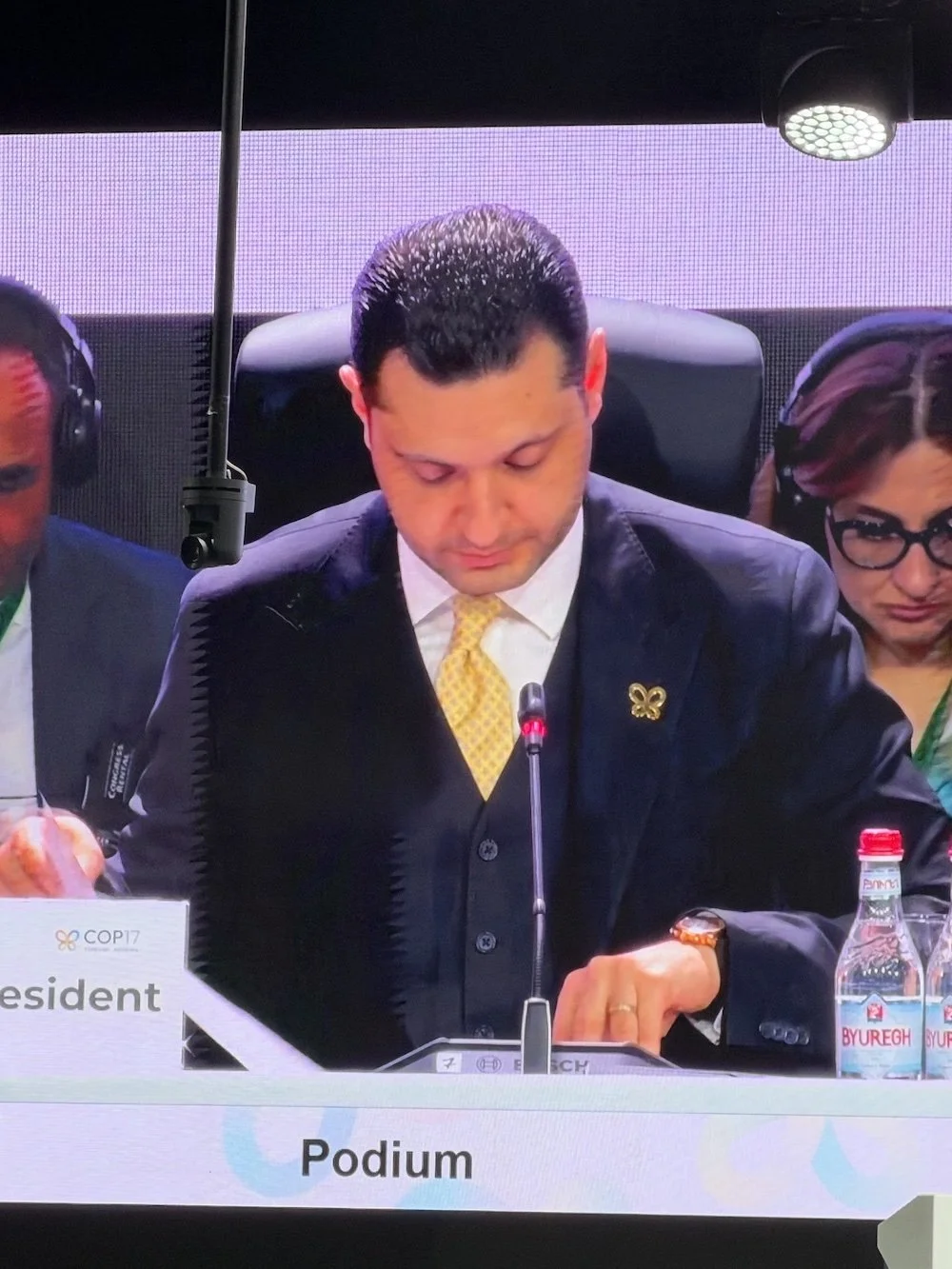
COP17 President Hambardzum Matevosyan presiding over the Conference proceedings. Yerevan, Armenia, October 23, 2026. © 2026 Images for Inclusion Inc (IFI)
“the UN mechanisms of Indigenous Peoples urge all UN entities in their methods of work to refrain from conflating, associating, combining, or equating Indigenous Peoples with non-indigenous entities, such as minorities, vulnerable groups, or ‘local communities.’ We further request that all UN Member State parties to treaties related to the environment, biodiversity, and climate cease using the term ‘local communities’ alongside ‘Indigenous Peoples,’ so that the term ‘Indigenous Peoples and local communities’ is no longer used.”
Kotierk also emphasized continued dialogue and consensus.
Afterwards, a Caucus participant invoked Article 3 of UNDRIP, emphasizing Indigenous Peoples' right to self-determination and affirming: “Indigenous Peoples are not creations of States,” and questioned the selection procedures for a proposed Expert Group. In response, it was explained that the Secretariat would facilitate a call for nominations rather than the selection being exclusively an internal Caucus matter.
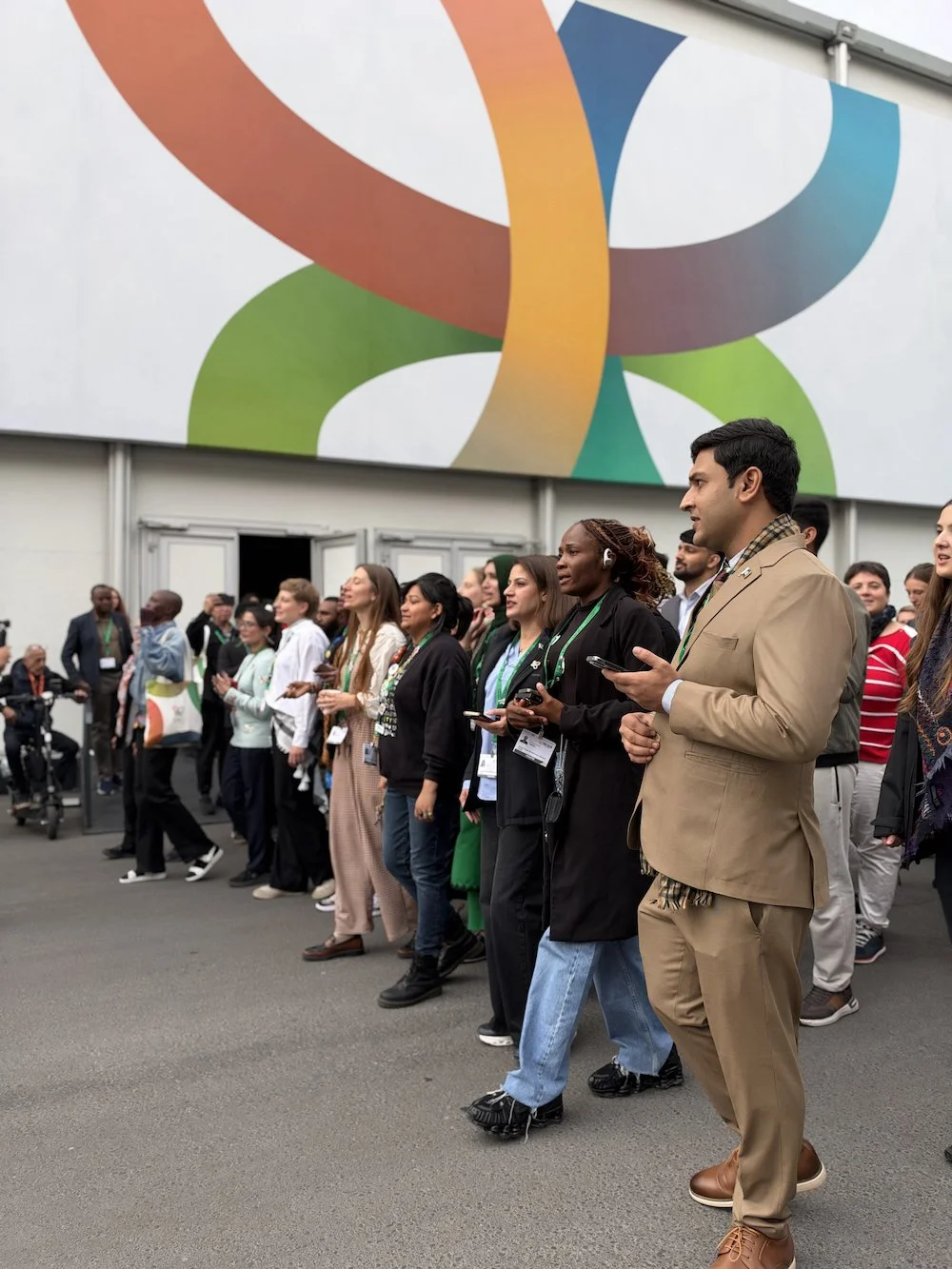
COP17 participants singing in a peaceful demonstration outside the conference venue. Yerevan, Armenia, October 2026. © 2026 Images for Inclusion Inc (IFI)
Formal Negotiations on the Modus Operandi — Divergent Positions Among States Parties
Later, during formal negotiations on the Modus Operandi, the Russian Federation opposed explicitly mentioning women and youth, Tuvalu defended their inclusion, and Indonesia supported an alternative formulation referring to existing provisions.
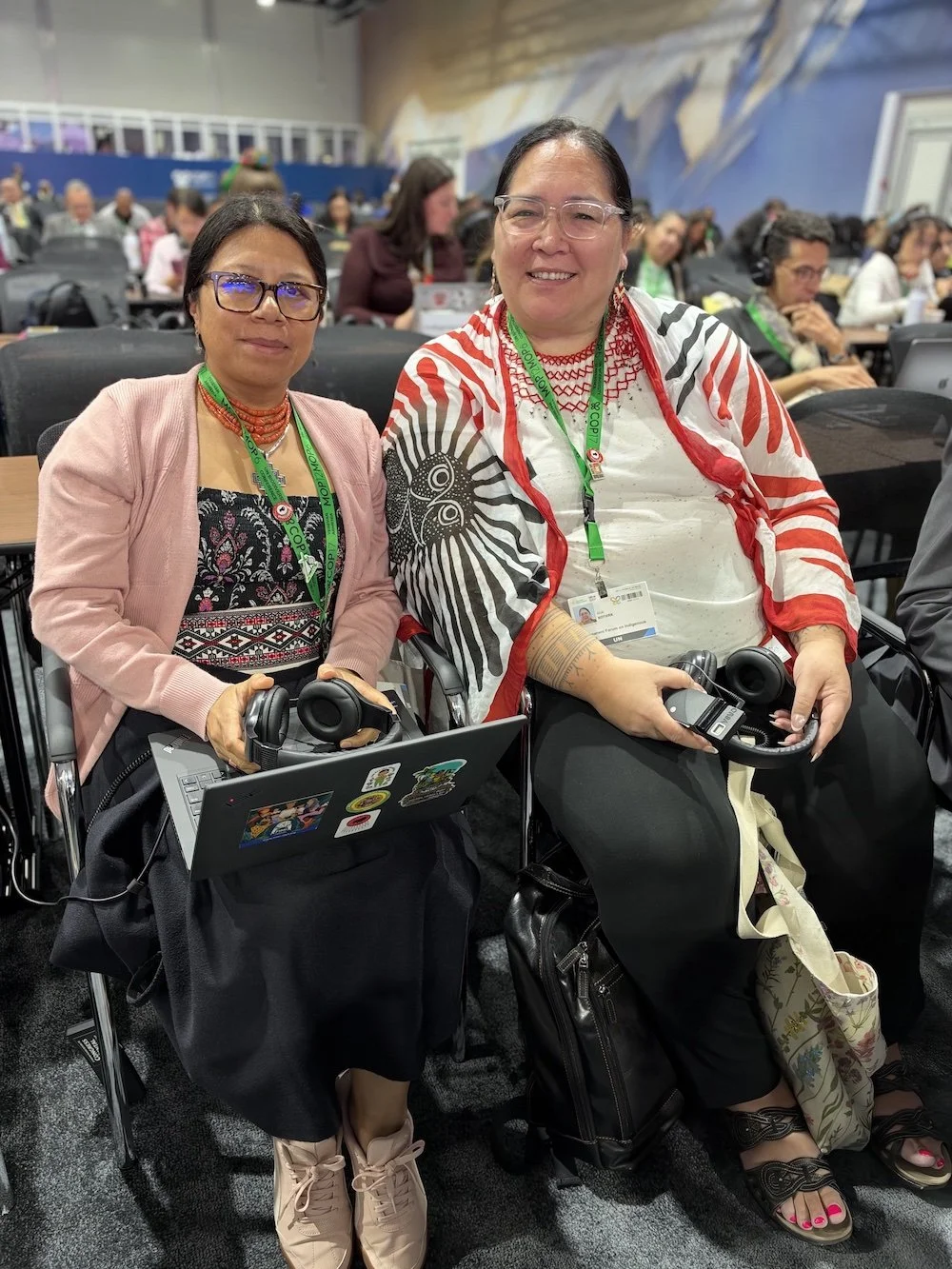
Mirian Masaquiza Jerez, UN DESA Senior Social Affairs Officer, and Aluki Kotierk, Chair of the UN Permanent Forum on Indigenous Issues (UNPFII), during a COP17 Working Group session. Yerevan, Armenia, October 23, 2026. © 2026 Images for Inclusion Inc (IFI)
During Working Group I, a representative of the EU approached Arriagada Garcia and two other Indigenous women, seated in the IPLC-designated row, and in the absence of IIFB negotiators or representatives, the EU representative sought their guidance and support after the African group questioned Footnote 1 of the draft decision entitled Recommendations of the Permanent Forum on Indigenous Issues, arguing that the document referenced was outdated. Footnote 1 cited “United Nations, Treaty Series, vol. 1760, No. 30619,” the official treaty reference for the Convention on Biological Diversity. Acting in her personal capacity, Arriagada Garcia consulted Mirian Masaquiza of UN DESA and subsequently shared a technical argument advocating retention of the official treaty citation for consistency, clarity, and alignment with United Nations documentation standards, stating:
"The inclusion of the United Nations Treaty Series citations in Footnote 1 is a standard United Nations editorial guideline for referencing core international instruments upon their first mention in a text. By maintaining these footnotes, we simply cite the treaties deposited with the Secretariat-General using their official, unique archival identifiers. For the sake of consistency, technical clarity, and alignment with standard UN document formats, we should prefer to retain the footnotes as originally prepared by the Secretariat."
Later, a possible opening emerged near adjournment: Canada requested reconsideration of regional representation, while Panama reiterated its proposal concerning the seven Indigenous Peoples’ sociocultural regions. The Co-Chair directed that the seven regions be reflected in the negotiating text, identifying them as “the basis for the next conversation.”
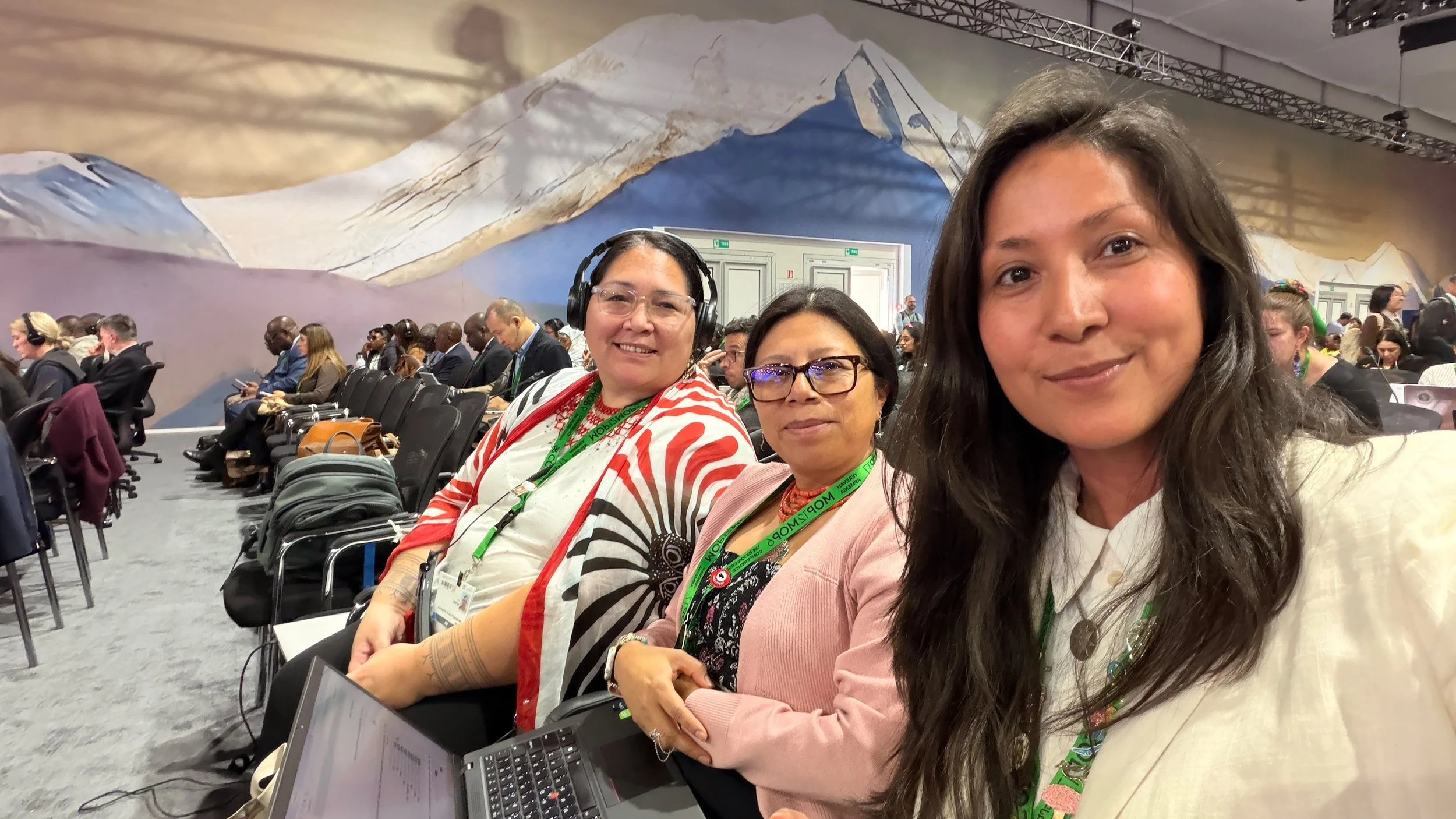
Aluki Kotierk, Chair of the UNPFII; Mirian Masaquiza Jerez from UN DESA; and Lidia Arriagada Garcia, President and CEO of Images for Inclusion Inc. COP17, Yerevan, Armenia, October 23, 2026. Photograph: Courtesy of Mirian Masaquiza.
The negotiations remained unresolved as the session adjourned. That evening, the COP plenary continued considering and adopting decisions under the Convention and its Protocols.
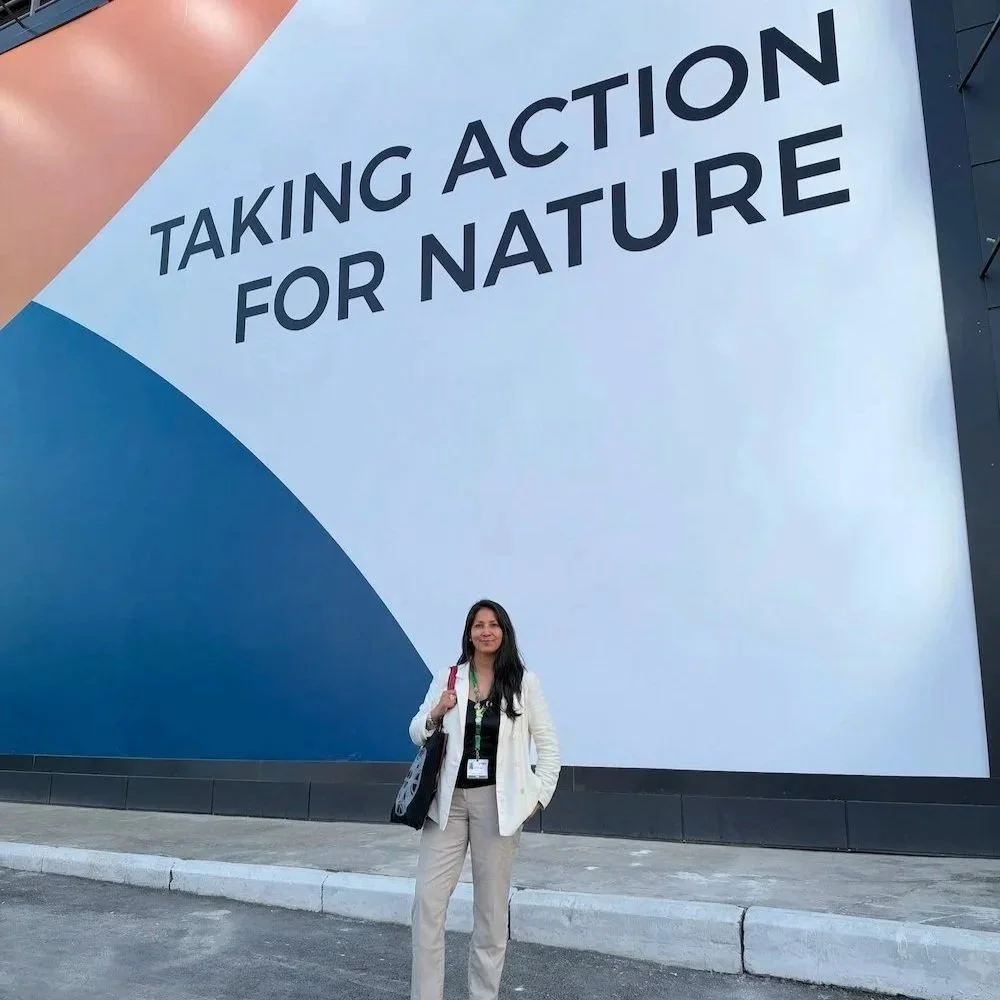
Lidia Arriagada Garcia, President and CEO of Images for Inclusion Inc, at the COP17. Yerevan, Armenia, October 26, 2026. © 2026 Images for Inclusion Inc (IFI)
October 26: Holding the Line on Indigenous Peoples’ Self-Representation
By Monday, October 26, following Sunday’s Culture and Biodiversity Field Trip, the IIFB Caucus resumed its deliberations amid mounting pressure to reconcile competing positions on the Modus Operandi of the Subsidiary Body on Article 8(j).
Three fundamental issues remained deeply contested: recognition of the seven Indigenous Peoples sociocultural regions, the allocation of seats within the Friends of the Bureau, and the procedures through which Indigenous Peoples would select their own representatives.
At the heart of these disagreements was a fundamental question: whether Indigenous Peoples' representation would reflect their own institutions and decision-making processes or be shaped by externally imposed arrangements.
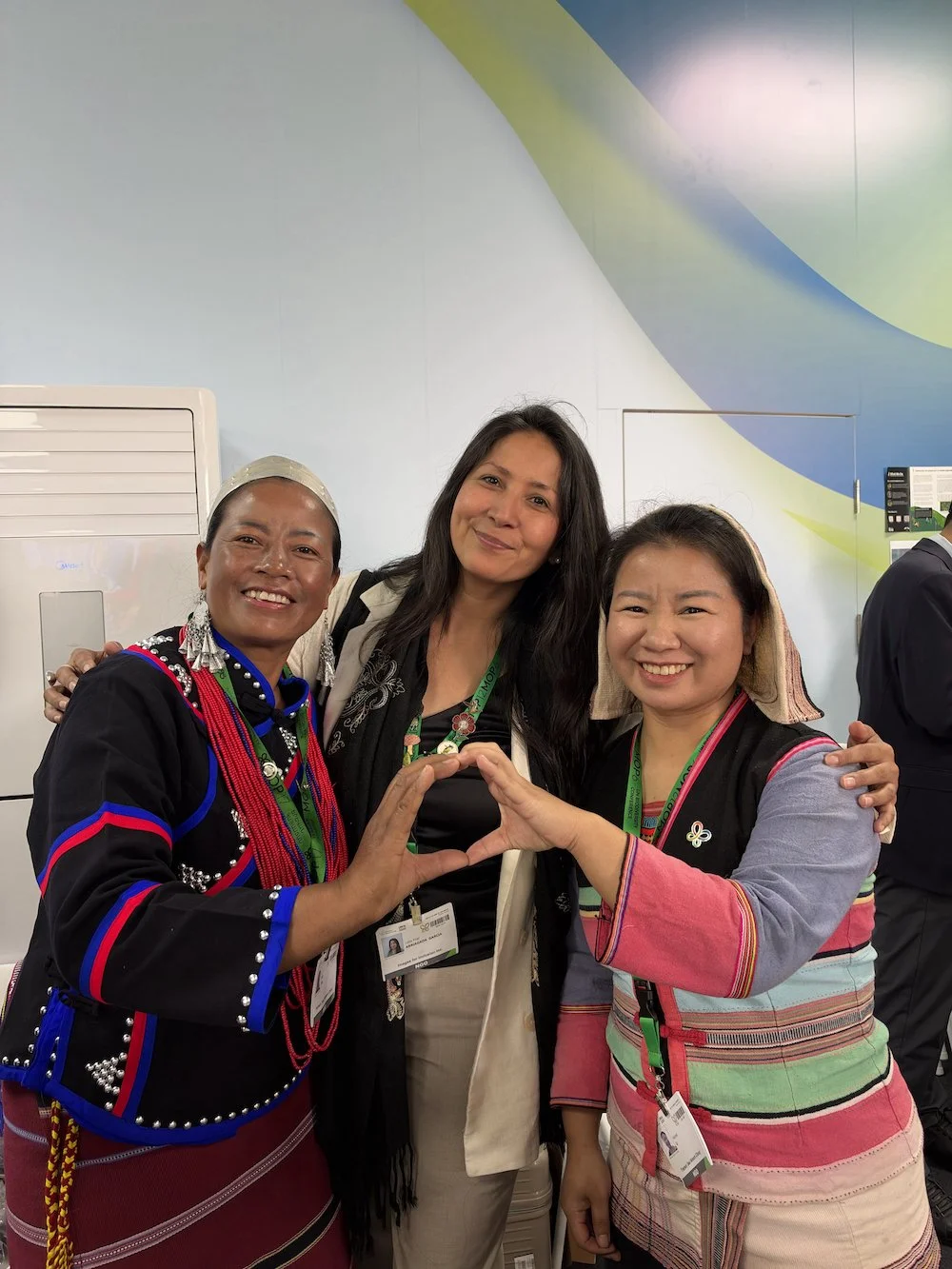
Lidia Arriagada Garcia with Indigenous women from China at the Chinese Pavilion during CBD COP17. Yerevan, Armenia, October 26, 2026. © 2026 Images for Inclusion Inc (IFI)
The discussion exposed a fundamental strategic disagreement: Should Indigenous Peoples maintain their demands for recognition and full and effective participation, even without consensus among Parties, or accept a compromise to prevent the negotiations from stalling?
Some participants warned that failure to reach agreement on five or seven regions could jeopardize adoption of the Modus Operandi.
A proposed Plan B involved avoiding explicit reference to the regions while retaining numerical representation and language recognizing selection through Indigenous Peoples' own governance structures and procedures.
Others rejected the idea that securing the Modus Operandi should require abandoning established principles of Indigenous Peoples representation. Participants questioned whether the Caucus should anticipate what Parties might reject and compromise before the negotiations had concluded.
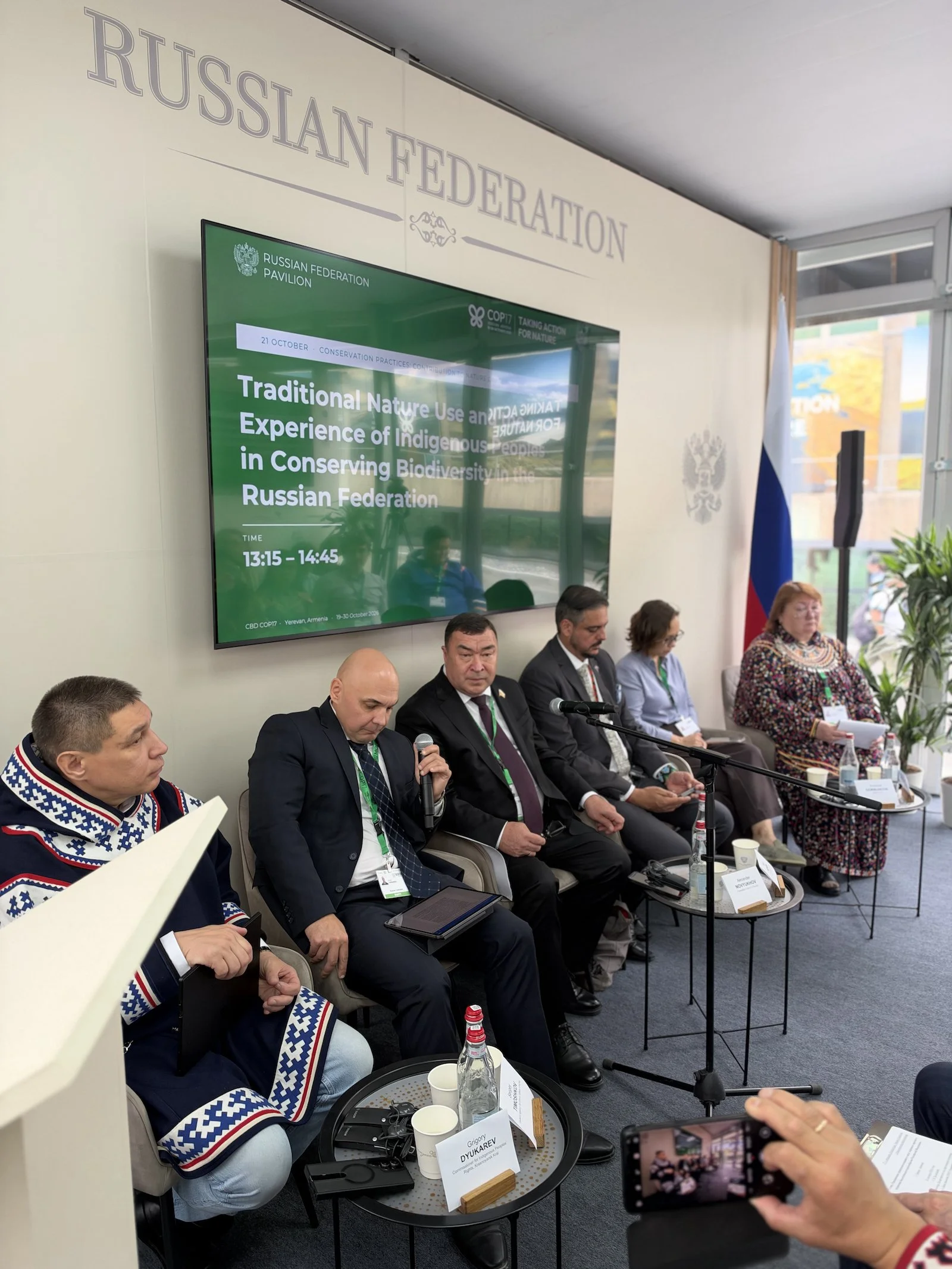
Brazil delegate participating as a panelist in the Russian Federation’s side event on Indigenous Peoples’ traditional nature use and biodiversity conservation. CBD COP17, Yerevan, Armenia, October 21, 2026. © 2026 Images for Inclusion Inc (IFI)
At approximately 11:00 a.m., Lidia Arriagada Garcia intervened to defend the explicit recognition of the seven Indigenous Peoples’ sociocultural regions, arguing that the absence of consensus among Parties at that stage was not sufficient reason to abandon the language proposed.
She also urged the IIFB Caucus to “stick with 10” regarding representation in the Friends of the Bureau, emphasizing the importance of securing Indigenous Peoples' full and effective participation.
Rather than conceding in advance, she proposed two strategies:
Ensure that the person designated to represent the Caucus in negotiations was prepared to defend the Indigenous Peoples seven sociocultural regions, particularly because she considered that an earlier opportunity to defend the position had not been used strongly enough.
Seek an intervention from the Chair of the UNPFII , referring to Article 42 of the United Nations Declaration on the Rights of Indigenous Peoples (UNDRIP), concerning the promotion of respect for and its full application, which states:
“The United Nations, its bodies, including the Permanent Forum on Indigenous Issues, and specialized agencies, including at the country level, and States shall promote respect for and full application of the provisions of this Declaration and follow up the effectiveness of this Declaration.
Her position was that the Caucus should continue advocating for the Indigenous Peoples seven sociocultural regions rather than remove them from consideration before the Parties had reached a final decision.
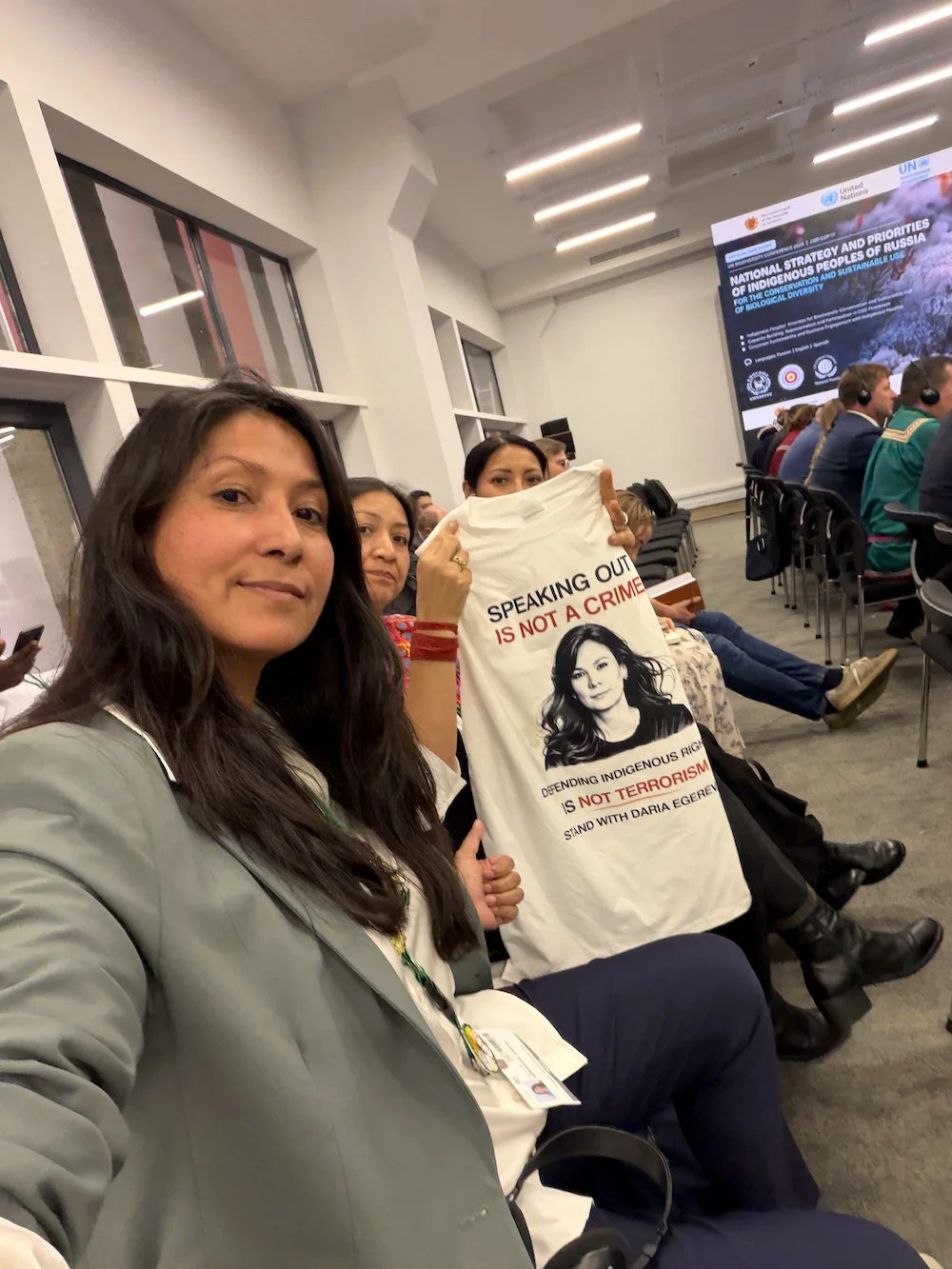
A solidarity T-shirt reading “Speaking Out Is Not a Crime — Defending Indigenous Rights Is Not Terrorism — Stand with Daria Egereva,” during CBD COP17, Yerevan, Armenia, October 2026. © 2026 Images for Inclusion Inc (IFI)
A Caucus divided over rights, representation, and compromise
The exchanges revealed competing understandings of consensus, equality, and the relationship between Indigenous Peoples and local communities.
Some representatives emphasized that Indigenous Peoples are rights holders, not merely stakeholders, and warned that weakening their representation could establish a negative precedent. Others stressed the need for inclusiveness, equitable participation, and agreement among the caucus's different constituencies.
Representatives from the Arctic defended the seven sociocultural regions and questioned proposals that would dilute their recognition. A representative from the Arctic emphasized that their position reflected collective Indigenous Peoples representation rather than an individual or organizational preference.
Local communities' representatives raised concerns about proposals perceived as assigning representation exclusively to Indigenous Peoples. They also challenged the suggestion that majority support within the caucus necessarily constituted consensus.
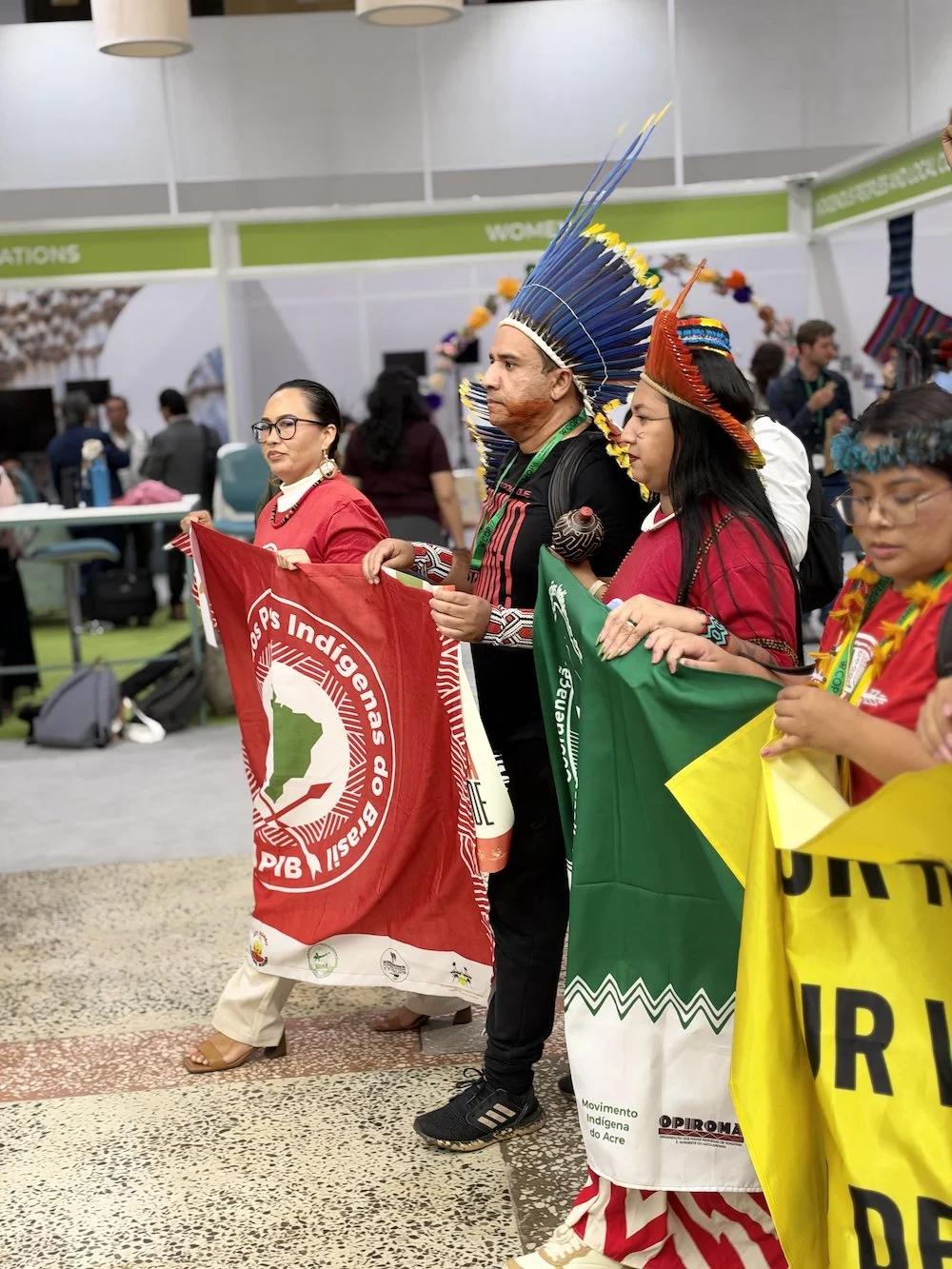
Indigenous Peoples from Brazil participating in a peaceful and silent demonstration for at CBD COP17. Yerevan, Armenia, October 21, 2026. © 2026 Images for Inclusion Inc (IFI)
The disagreement extended to the number and distribution of seats. Proposals involving ten representatives, seven Indigenous representatives and three local communities' representatives, and other arrangements circulated during the discussion. These competing formulations illustrated the difficulty of reconciling different approaches to representation.
Traditional knowledge: A specific textual intervention
Arriagada Garcia also intervened on paragraph 4 of the proposed Modus Operandi, requesting that the text explicitly refer to “traditional knowledge”, rather than relying on a general reference to knowledge holders.
During the exchange, the proposed language was discussed with members of the IIFB Caucus. Following clarification of her request, the word “traditional” was added to the text under discussion.
The intervention addressed an important distinction: recognizing traditional knowledge explicitly within the institutional arrangements of the Subsidiary Body on Article 8(j), rather than leaving its identification implicit.
The question of who speaks for Indigenous Peoples
As discussions continued, participants raised concerns about the mandate and accountability of those speaking on behalf of the caucus in negotiations. Some argued that representatives should reflect agreed positions and defend them effectively, particularly when draft provisions were increasingly qualified by references to national legislation and national circumstances.
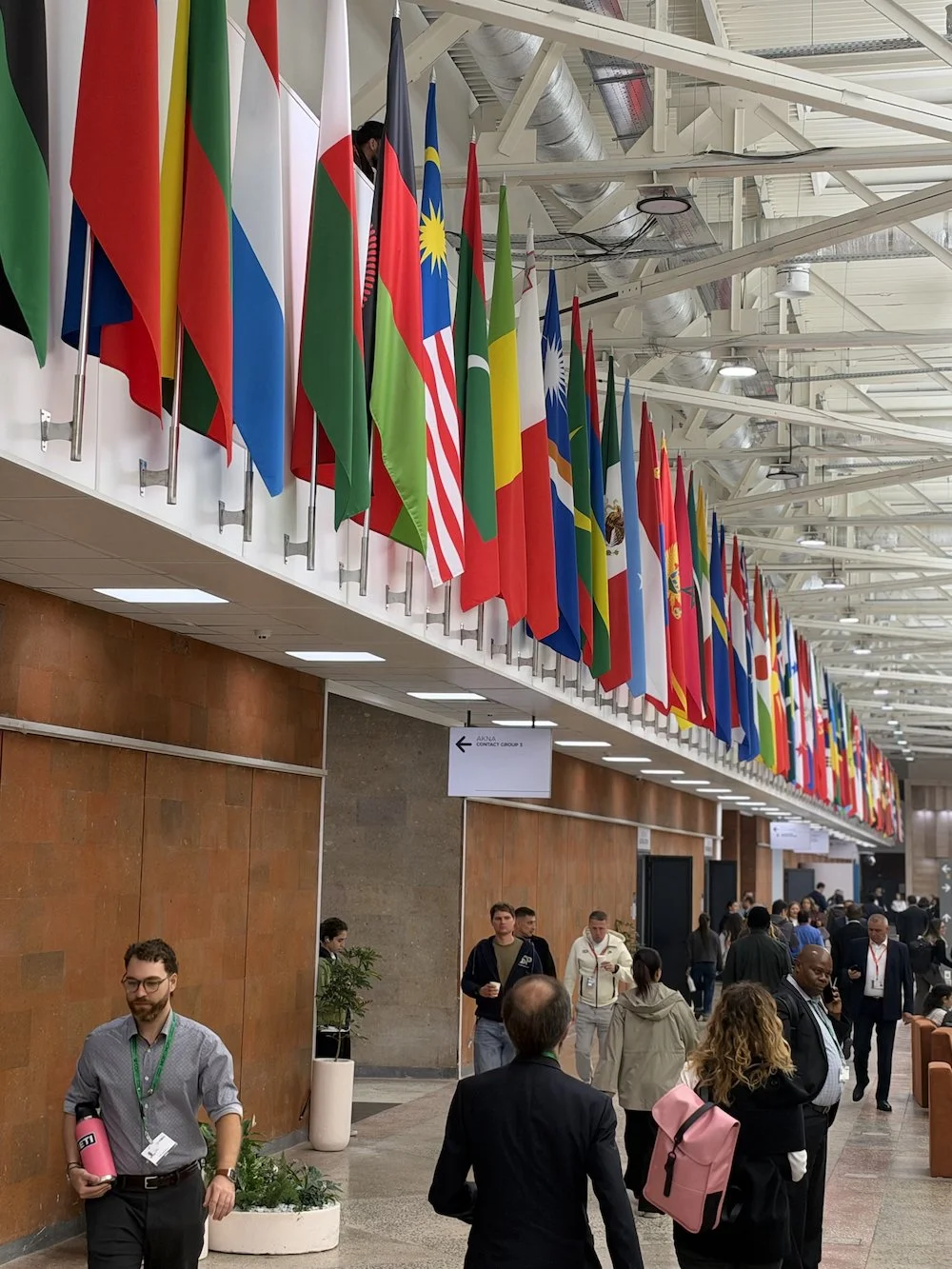
National flags lining the main corridor of the COP17 conference venue. Yerevan, Armenia, October 2026. © 2026 Images for Inclusion Inc (IFI)
Others emphasized the need for negotiation, flexibility, and continued engagement with Parties. The debate became increasingly tense, including disagreements about whether the Caucus had already reached consensus and whether representatives were being asked to concede positions previously defended.
The discussions ultimately demonstrated that the controversy concerned more than the allocation of seats.
At stake was whether Indigenous Peoples' own systems of representation and governance would be meaningfully reflected in the new Subsidiary Body on Article 8(j) institutional arrangements, or subordinated to alternative geographic and procedural formulas.
For Arriagada Garcia, the priority remained the same: defend the seven Indigenous sociocultural regions, maintain the proposal for ten seats, and pursue a negotiating strategy capable of protecting Indigenous Peoples' full and effective participation.
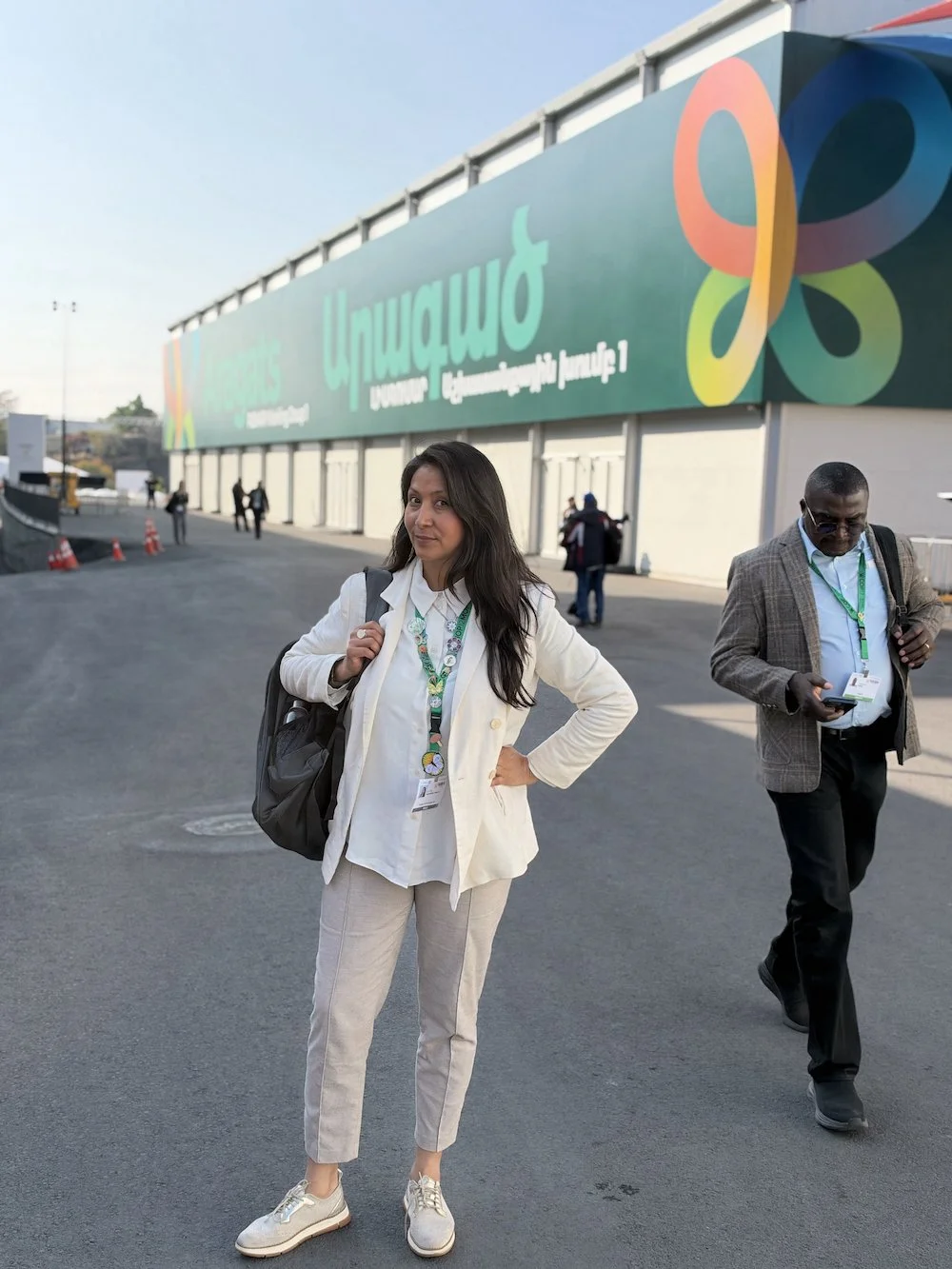
Lidia Arriagada Garcia, President of Images for Inclusion Inc (IFI), at CBD COP17. Yerevan, Armenia, October 23, 2026. © 2026 Images for Inclusion Inc (IFI)
October 27: Indigenous Territories, Human Rights, and the Limits of Conservation
On Tuesday, October 27, the International Indigenous Forum on Biodiversity (IIFB) Caucus meeting was cancelled.
The previous day, an announcement circulated on behalf of the IIFB Caucus Co-Chairs informing participants that only the Article 8(j) commission would meet to prepare for the upcoming Contact Group session.
Regional Consultations, Transparency, and the Right to Dissent
Although the IIFB Caucus meeting was cancelled, discussions continued within the COP17 2026 LAC WhatsApp group. Lidia Arriagada Garcia called for greater transparency, requesting that the regional coordinator share negotiating developments with all participants rather than a select few. He agreed that information should not be exclusive.
The exchanges revealed disagreements over Indigenous Peoples’ representation. Five regions reportedly supported advancing the Modus Operandi, ten representatives, and recognition of the seven Indigenous Peoples’ sociocultural regions, while Arctic and North American representatives expressed disagreement. The proposed allocation of seven seats for Indigenous Peoples and three for local communities remained subject to negotiations, including whether it would appear in the text or an internal agreement.
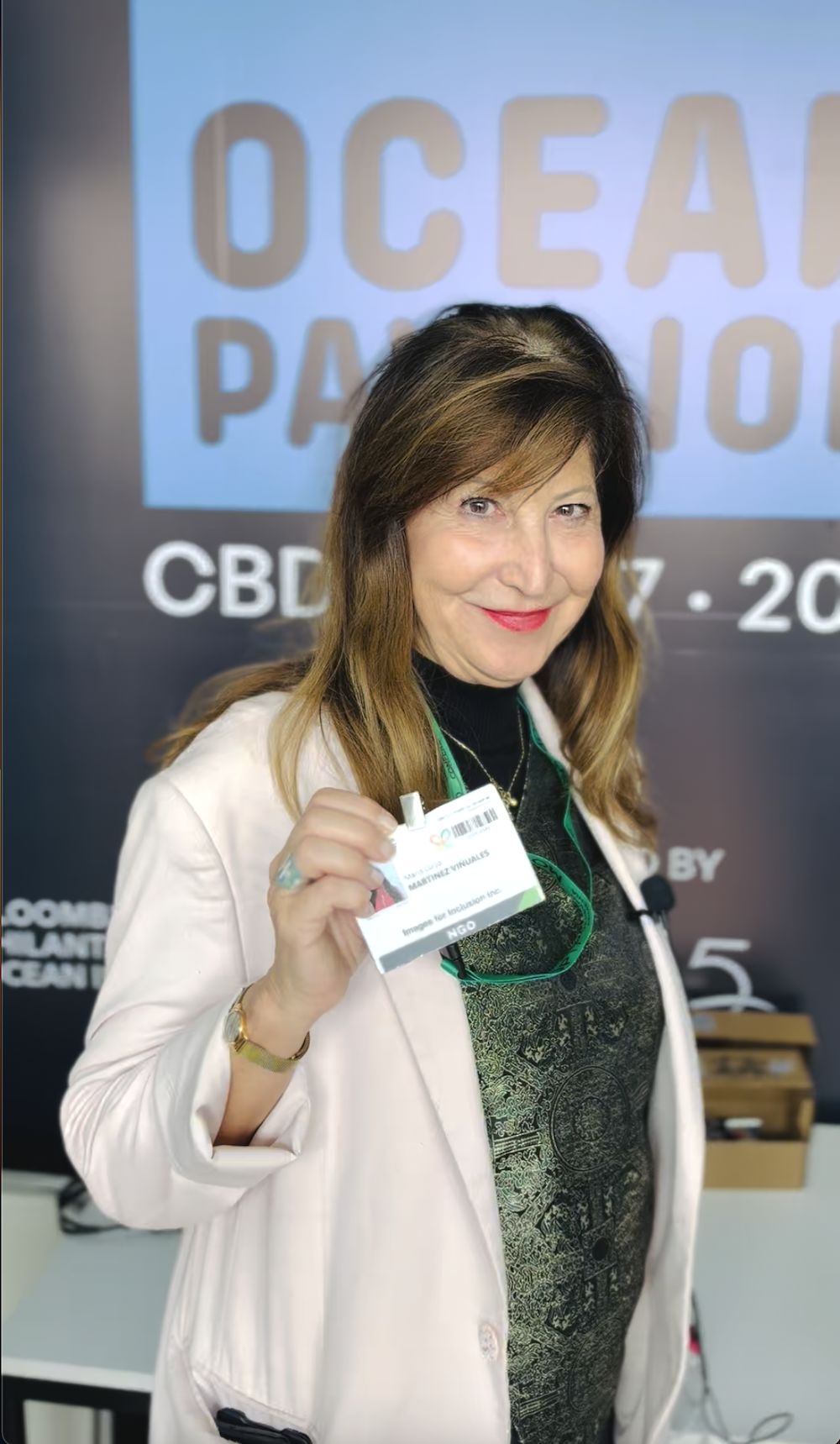
Marisa Martínez, Spanish / French / English interpreter, attending COP17 independently with delegate accreditation from Images for Inclusion Inc (IFI). Yerevan, Armenia, October 28, 2026. © 2026 Images for Inclusion Inc (IFI)
Arriagada Garcia challenged what she described as attempts to silence Indigenous Peoples’ rights advocacy through accusations of disrespect, division, or lack of solidarity. She warned that conflating Indigenous Peoples with local communities could undermine recognition of their distinct rights to self-determination and free, prior and informed consent (FPIC), particularly where national legislation determines their implementation.
Rejecting accusations of discrimination against local communities, she stated: “We are not selfish, nor do we want to divide, nor do we think they don't have rights, nor are we discriminating against them."
She requested that the regional coordinator address these concerns. Another participant explicitly supported her position, highlighting the broader tensions over Indigenous Peoples representation, transparency, and the right to dissent.
That afternoon negotiations focused on proposed voluntary guidelines concerning Indigenous and traditional territories, biodiversity conservation, ecosystem restoration, and environmental impact assessments. Discussions revealed continuing disagreements over how Indigenous Peoples' rights should be reflected in conservation policies and national legislation.
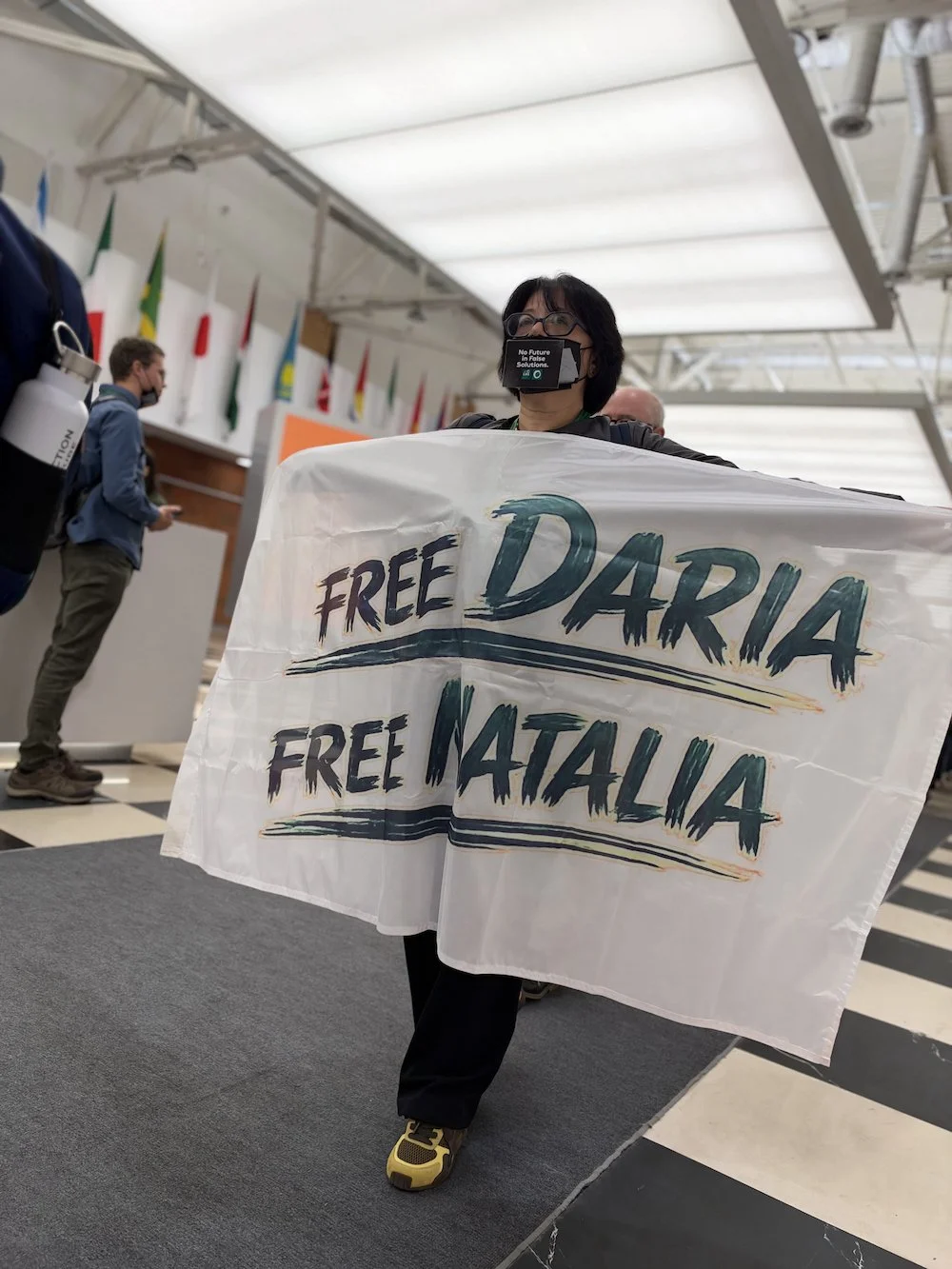
Peaceful, silent demonstration. CBD COP17, Yerevan, Armenia, October 23, 2026. © 2026 Images for Inclusion Inc (IFI)
A central debate concerned Indigenous and traditional territories (ITTs) and their relationship to protected areas under Target 3 of the Kunming-Montreal Global Biodiversity Framework. Canada emphasized respect for Indigenous Peoples' rights, while Brazil raised concerns about maintaining existing protections and regulations where Indigenous territories overlap protected areas. Tuvalu opposed one proposed formulation, and the Co-Chair requested further consultations.
Negotiations also addressed a human rights-based approach, including references to the United Nations Declaration on the Rights of Indigenous Peoples, participation in decision-making, and the protection of traditional sustainable practices. Delegations debated language concerning national legislation, customary governance, and the recognition of Indigenous Peoples’ representative institutions.
Further disagreements emerged over the proposed guidelines’ title and references to Peoples of African descent comprising collectives embodying traditional lifestyles. Brazil advocated language recognizing their contributions to biodiversity conservation, while other delegations requested clarification or additional time. The wording remained contested.
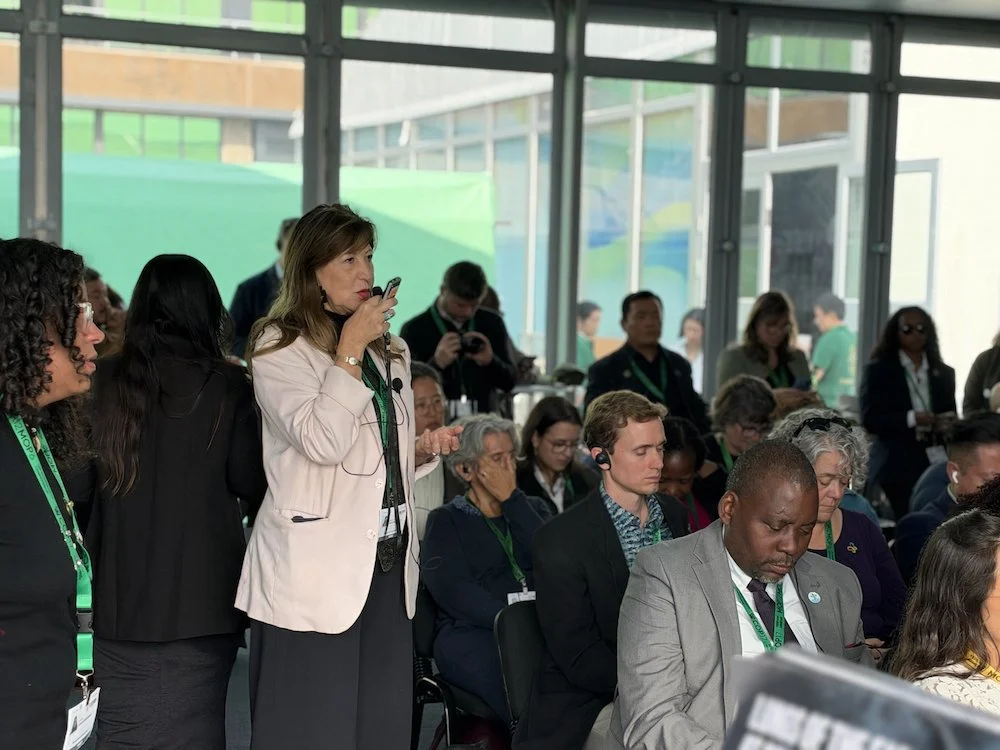
Marisa Martínez, interpreter and IFI delegate, providing interpretation during COP17 proceedings. Yerevan, Armenia, October 28, 2026. © 2026 Images for Inclusion Inc (IFI)
As negotiations continued, India and the Russian Federation objected to proposed human rights language. The Co-Chair sought compromises and indicated that smaller negotiating groups would continue examining unresolved provisions, including those concerning Indigenous and traditional territories.
Discussions exposed a fundamental tension: how to reconcile Biodiversity Conservation frameworks and national legislations with the recognition of Indigenous and traditional territories, customary governance, and Indigenous Peoples' distinct rights. The proposed guidelines remained under negotiation, with several provisions requiring further consultations.
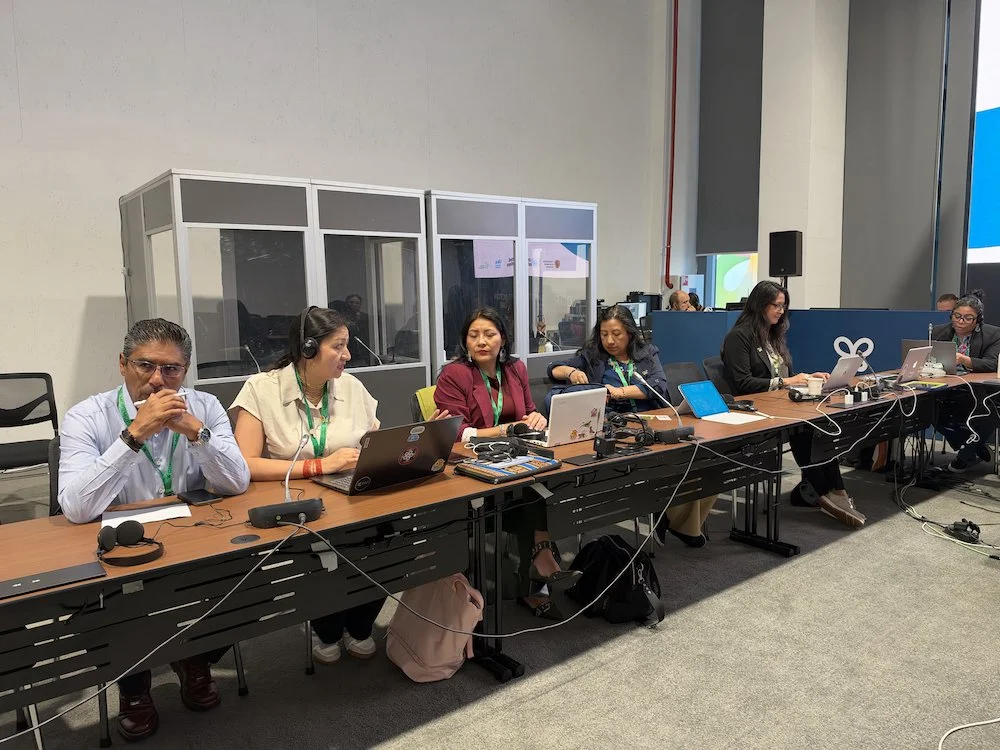
Lidia Arriagada Garcia (far right, wearing a black blazer) participating in the IIFB Caucus morning meeting at CBD COP17. Yerevan, Armenia, October 28, 2026, 8:15 a.m. © 2026 Images for Inclusion Inc (IFI)
October 28: Indigenous Representation, Historical Discrimination, and the Right to Dissent
On Wednesday, the Indigenous Peoples and Local Communities Caucus, convened by the International Indigenous Forum on Biodiversity, continued debating a proposal for ten seats for the Friends of the Bureau of the Subsidiary Body on Article 8(j), with representatives selected through their own governance procedures but without explicit recognition of the seven Indigenous sociocultural regions.
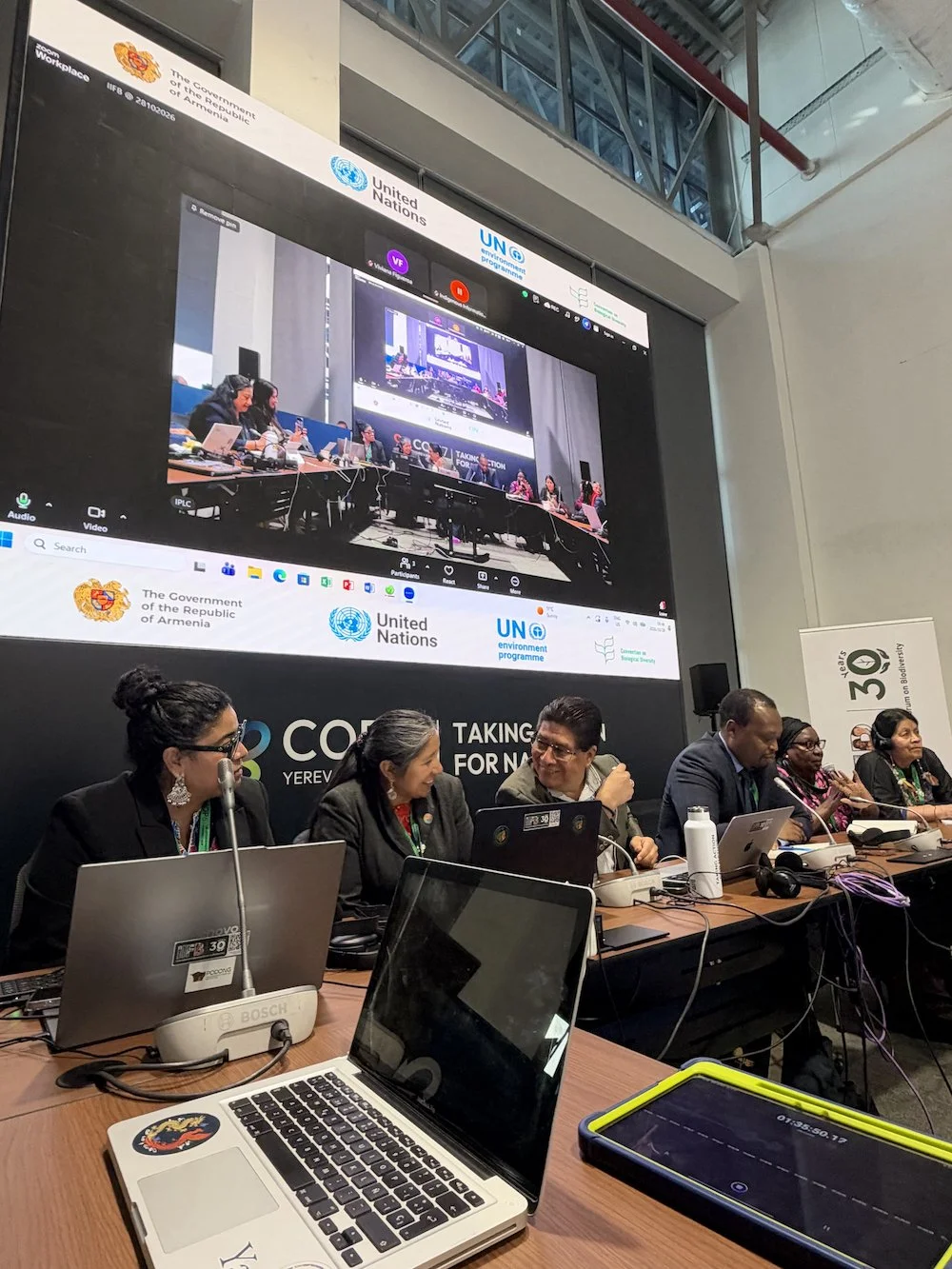
IIFB Caucus meeting during discussions concerning the Code of Conduct, attended by Olivier Rukundo of the CBD Secretariat. COP17, Yerevan, Armenia, October 28, 2026. © 2026 Images for Inclusion Inc (IFI)
A Visit from Olivier Rukundo: The Reminder of the Code of Conduct Rules
Olivier Rukundo, Head of the Engagement and Cooperation Unit at the CBD Secretariat, visited the IIFB Caucus following complaints of harassment within the Caucus, reminding participants of the Code of Conduct and potential consequences for violations.
Lidia was the first participant to respond. While acknowledging that a representative of local communities might have been addressed inappropriately, she identified a troubling pattern in the treatment of Indigenous participants defending their distinct collective rights.
Drawing on her Mapuche family history, she recalled the land and territory dispossession created by the Chilean State and the discriminatory and racial stereotypes historically directed against members of the Mapuche People in Chile—including lazy, dirty, alcoholic, violent, terrorist, and now narco-terrorist—to discredit legitimate demands for the recognition of their rights.
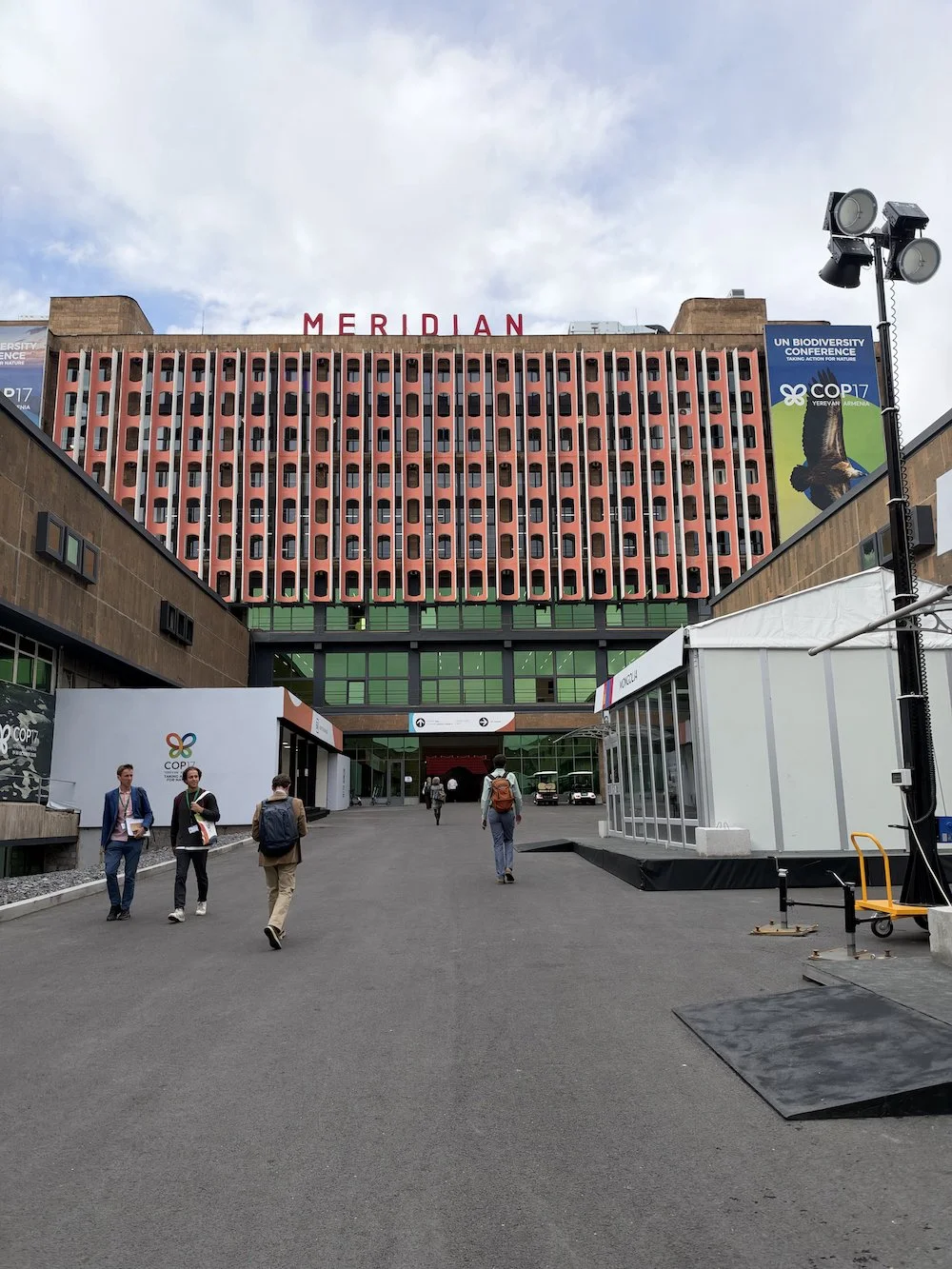
Meridian Convention Centre, venue of CBD COP17. Yerevan, Armenia, October 2026. © 2026 Images for Inclusion Inc (IFI)
Then, she stated that she had observed a similar pattern within the caucus, where participants invoking UNDRIP and defending Indigenous Peoples' distinct rights had repeatedly been characterized as insensitive, selfish, divisive, exclusionary, discriminatory, aggressive, and that morning, even immature.
She argued that such characterizations risked delegitimizing legitimate Indigenous Peoples demands to include Indigenous Peoples’ rights. The Secretariat subsequently emphasized the importance of being:
“hard on the issue and soft on the people,” while clarifying:
“This is not our process. This is the Parties' process.”
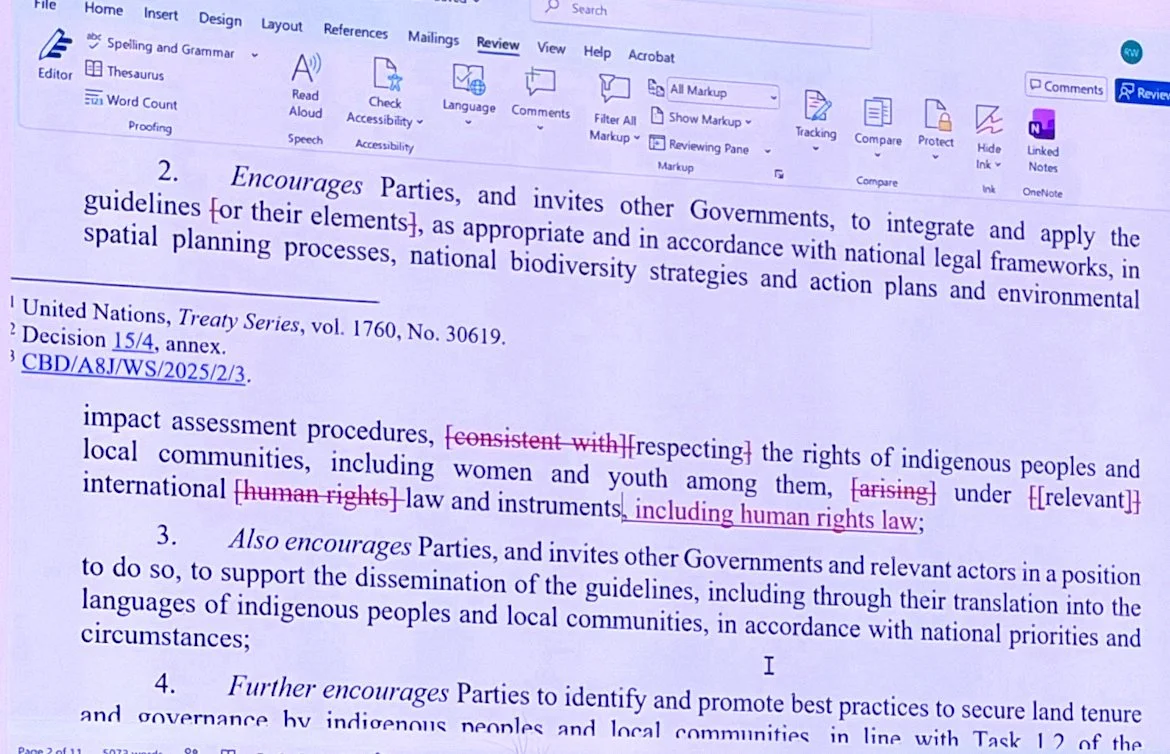
Negotiations on Indigenous Peoples’ rights and international human rights law. CBD COP17, Yerevan, Armenia, October 28, 2026. © 2026 Images for Inclusion Inc (IFI)
Formal Negotiations: Indigenous Territories and Human Rights
Later that morning, negotiations on Article 8(j) exposed a recurring tension between national sovereignty and international protections for Indigenous Peoples’ rights.
Discussions concerning Indigenous and traditional territories (ITTs), protected areas, and free, prior and informed consent (FPIC) repeatedly returned to references to national legislation and circumstances, particularly at the Russian Federation's insistence.
The European Union proposed additional references to international instruments, while explicit recognition of international human rights law encountered resistance.
Mexico subsequently proposed broader language referring to relevant international law, illustrating how negotiations could move toward consensus while losing explicit human rights terminology.
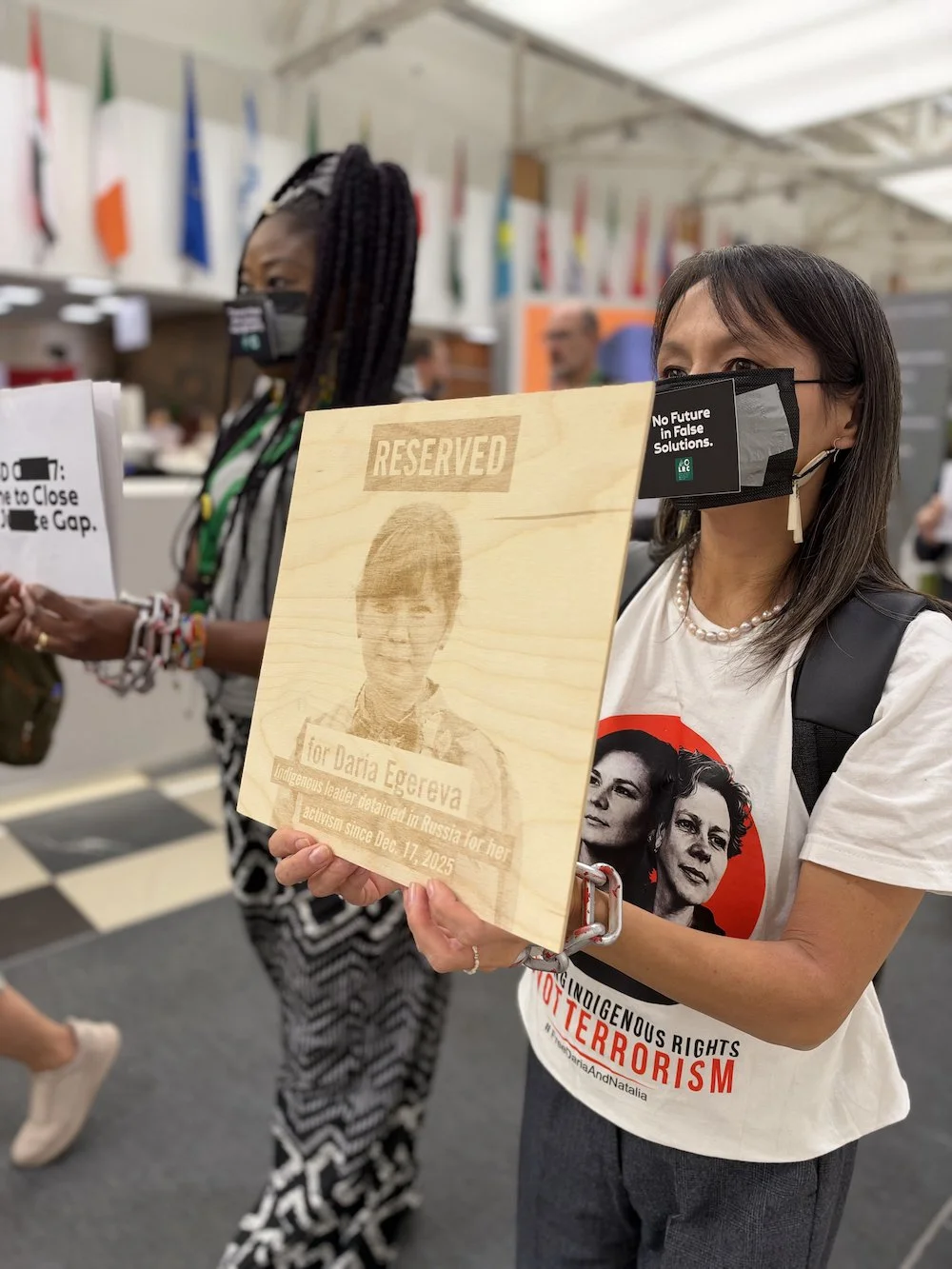
Advocates calling for the release of Indigenous leader Daria Egereva, detained in Russia. CBD COP17, Yerevan, Armenia, October 23, 2026. © 2026 Images for Inclusion Inc (IFI)
Co-Chair Jennifer's facilitation revealed the delicate politics of negotiating language. At one point, she asked, “Can I propose to delete human rights?” as delegations struggled to agree on references to international human rights law. Her repeated questions about lifting brackets, deleting disputed wording, and accommodating national legislation made Lidia Arriagada Garcia's stomach sink, as they demonstrated how the search for consensus could reshape the legal specificity of a proposed decision and impact Indigenous Peoples' right on the territories. When opposition persisted, the discussion moved toward broader references to relevant international law.
During the afternoon session of Working Group I, under Agenda Item 14(b) on engagement with subnational governments, cities, and other local authorities, Canada challenged proposed language that would have recognized Indigenous Peoples and local communities as local authorities. Canada raised concerns that such a characterization could undermine Indigenous Peoples’ right to self-determination. The disputed wording was subsequently deleted from the draft decision.
Together, these exchanges demonstrated how seemingly technical drafting choices could influence the recognition of Indigenous Peoples territories, customary governance, and internationally protected rights within the Convention's implementation framework.
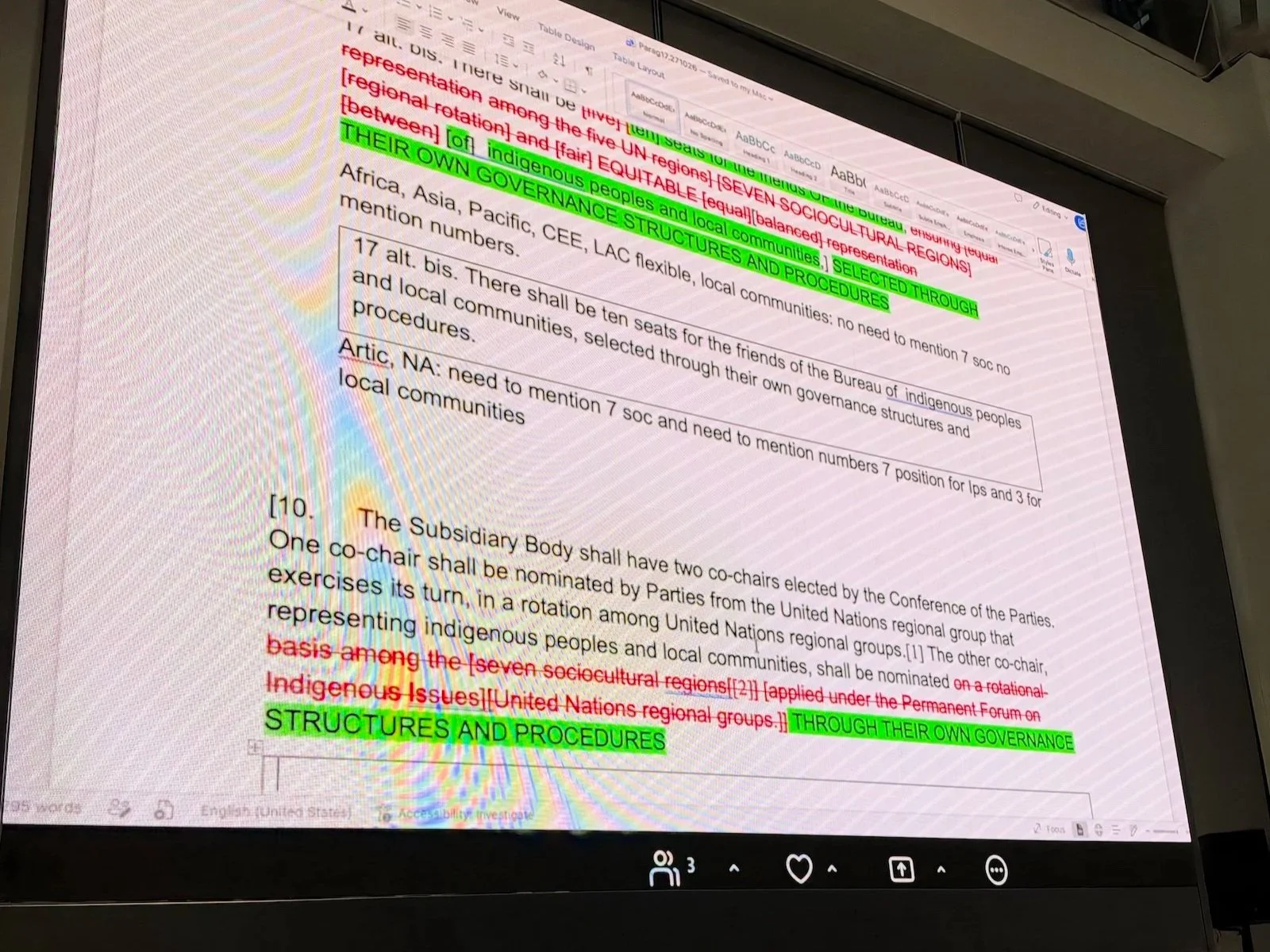
IIFB Caucus meetings at CBD COP17. Yerevan, Armenia, October 29, 2026.© 2026 Images for Inclusion Inc (IFI)
October 29: A long day —Crisis of Consensus and Indigenous Peoples Representation
As COP17 approached its conclusion, tensions within the Indigenous Peoples and Local Communities Caucus intensified over the Modus Operandi of the Subsidiary Body on Article 8(j).
At the center of the dispute was proposed paragraph 17 alt., providing ten seats for the Friends of the Bureau, with representatives selected through their own governance structures and procedures. Although participants acknowledged agreement on the total number of seats, their distribution remained contested. Proposals included seven seats for Indigenous Peoples and three for local communities, or five for each, while the explicit recognition of the seven Indigenous sociocultural regions remained unresolved.
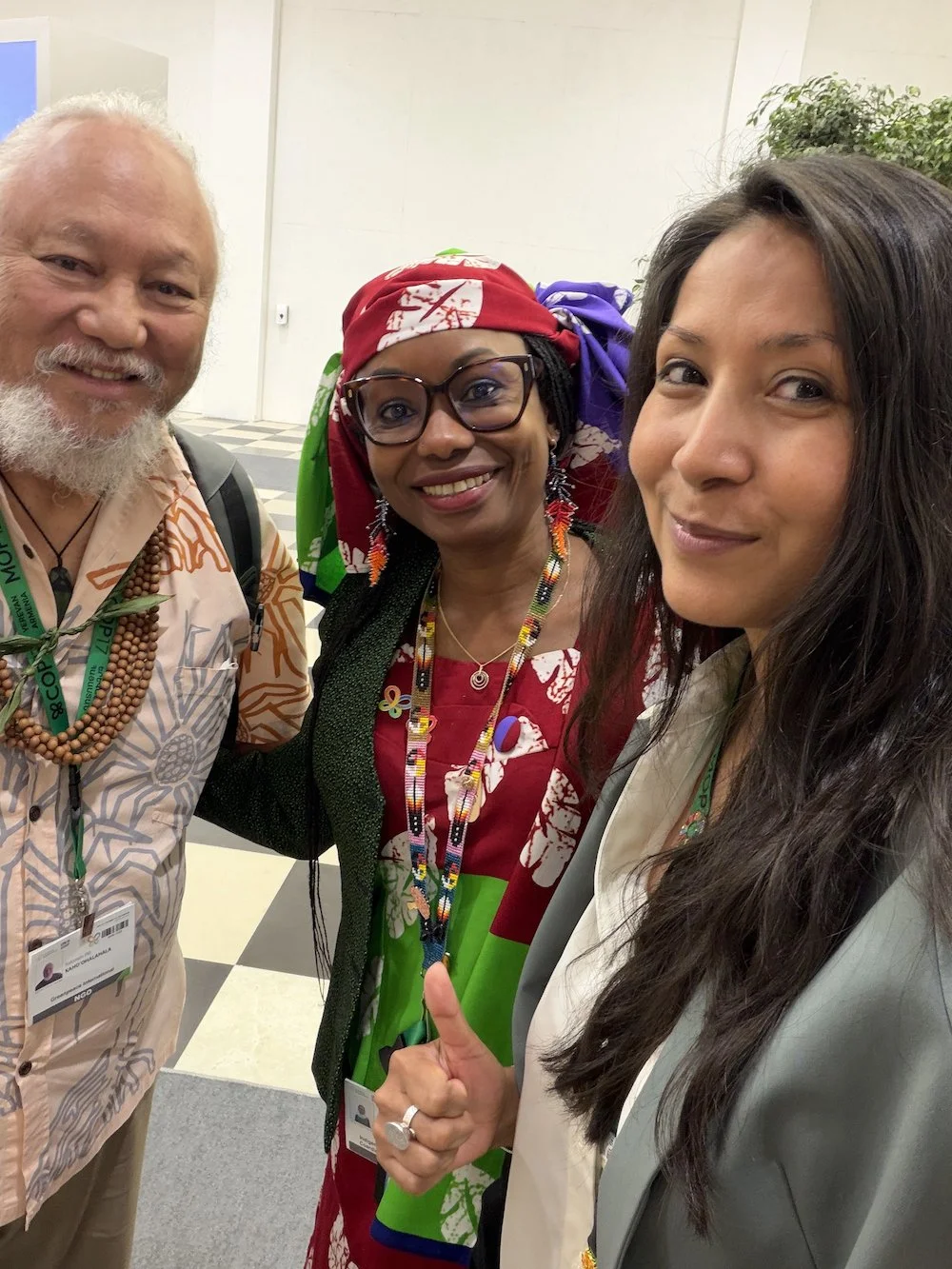
Solomon Pili Kahoʻohalahala, Native Hawaiian elder; Hindou Oumarou Ibrahim; and Lidia Arriagada Garcia, at COP17, October 29, 2026. © 2026 Images for Inclusion Inc (IFI)
Hindou Oumarou Ibrahim, Former Chair of the UNPFII, Defends the Seven Indigenous Sociocultural Regions
Lidia Arriagada Garcia, IFI’s delegate, had previously spoken with Hindou Oumarou Ibrahim, President of the Association for Indigenous Women and Peoples of Chad (AFPAT) and former Chair of the United Nations Permanent Forum on Indigenous Issues, about raising her concerns about disagreements concerning the seven Indigenous sociocultural regions and the proposed allocation of seven Friends of the Bureau seats for Indigenous Peoples and three for local communities and the lack of the UNPFII’s chair participation during the Parties negotiations in the Contact Groups.
During this morning of the IIFB Caucus meeting, Hindou made an extraordinary intervention, strongly defending the seven Indigenous Peoples sociocultural regions and the 7–3 allocation, rejecting the 5–5 allocation.
Hindou also called for transparency, rebuilding trust, and reaching a common position so Indigenous Peoples and Local Communities representatives could speak with one voice.
Referring to her participation in ministerial consultations as a delegate of Chad, she warned that continued disagreements could lead to postponement until COP18. She also addressed regional differences concerning local communities and the drought and hardships affecting Indigenous Peoples in her home country. “We are the guardians of the ecosystem and Mother Earth,” she stated, referring to people who are dying and experiencing drought every day there. She urged participants to reach consensus and move forward together.
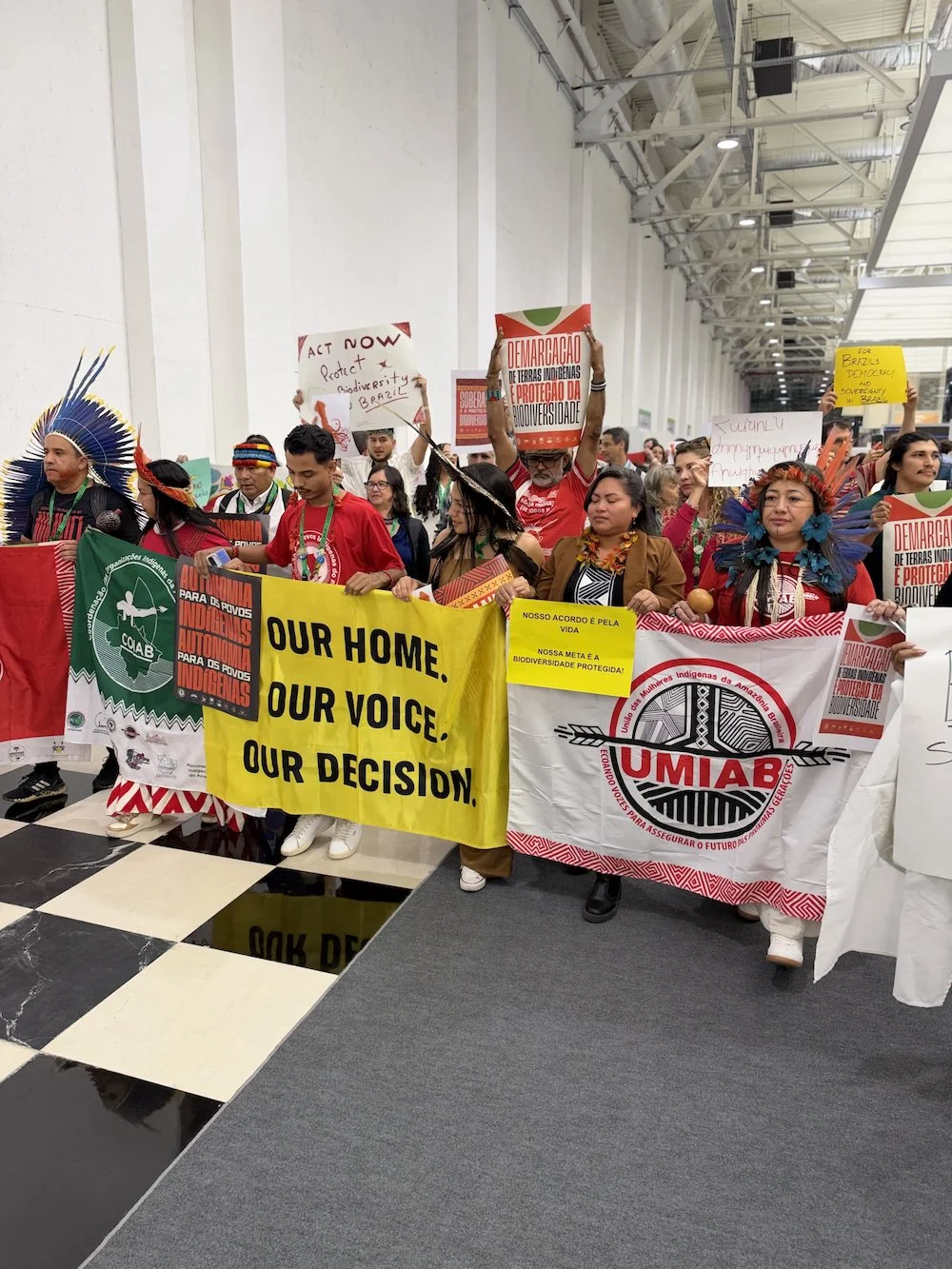
Indigenous Peoples peacefully demonstrating in silence during CBD COP17. Yerevan, Armenia, October 21, 2026. © 2026 Images for Inclusion Inc (IFI)
Who Speaks for the Caucus?
Several Indigenous Peoples’ representatives questioned how competing proposals had reached ministerial consultations and whether positions communicated to Parties reflected agreements reached within the Caucus.
Indigenous participants raised concerns about transparency, regional mandates, and the procedures used to establish consensus. Some defended the seven sociocultural regions and warned against compromising before Parties had completed negotiations.
Others emphasized the urgency of adopting the Modus Operandi, even if doing so required further concessions. An IIFB Caucus Co-Chair acknowledged the absence of clear guidelines for reaching consensus, raising further concerns about the Caucus's internal decision-making procedures.
One participant underscored the distinction between consensus on ten seats and the absence of consensus on their allocation. Others questioned whether the Caucus's internal decision-making procedures were sufficiently clear and accountable. The exchanges also revived proposals for separate organizing spaces for Indigenous Peoples and local communities, reflecting longstanding disagreements over their distinct identities and representation.
The central question was no longer simply how many seats would be secured for Indigenous Peoples, but who had the authority to determine and communicate a collective negotiating position when consensus remained disputed.
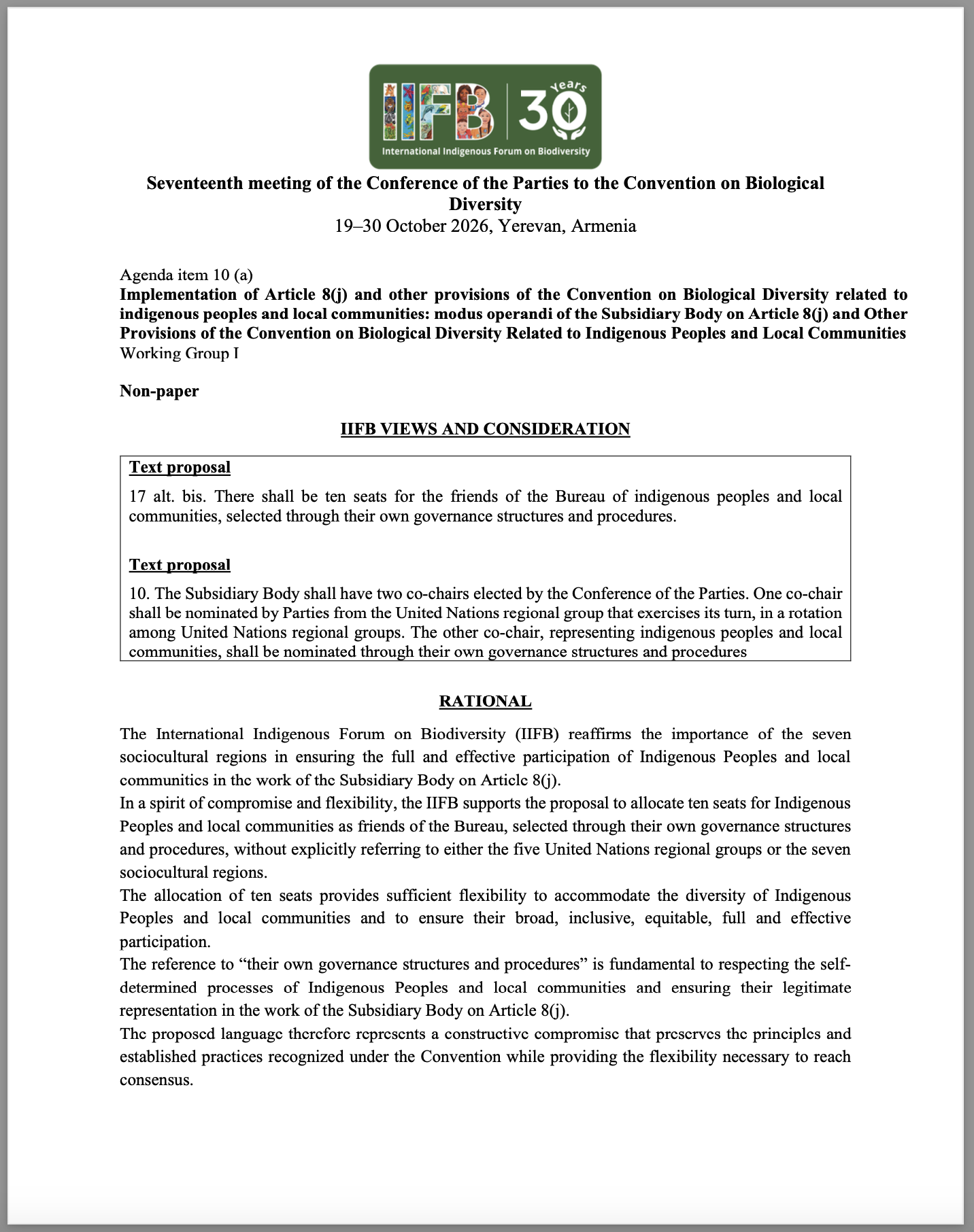
IIFB Position item 10_v3. October 2026
A Disputed IIFB Position: “Consensus Without Consensus” (Consenso Desconsensuado)
Further tensions emerged the same day within the IIFB Article 8(j) WhatsApp group over a document titled IIFB Position item 10_v3, reportedly shared with States Parties despite unresolved disagreements within the Caucus. Some participants questioned how a negotiating position could have been communicated without consensus. When one representative explicitly asked whether the document reflected an agreed Caucus position, it was confirmed in response: “No, there is no consensus.”
Lidia Arriagada Garcia also challenged the document, recalling her understanding that a Co-Chair had indicated earlier that morning that the seven Indigenous Peoples’ sociocultural regions would remain in paragraph 17 alt. bis. Although the document's rationale acknowledged their importance, the proposed operative text omitted them, providing instead for ten seats for Indigenous Peoples and local communities selected through their own governance structures and procedures.
Arriagada Garcia argued that recognizing the seven Indigenous Peoples’ sociocultural regions in the justification was insufficient when their explicit inclusion in the negotiating text was precisely what Indigenous Peoples’ representatives had been defending. She questioned the decision to anticipate objections from States Parties despite the support of existing State allies and the possibility of gaining support from additional Parties, warning that disregarding that position— which she understood had been agreed upon that morning— undermined trust and credibility within the IIFB Caucus.
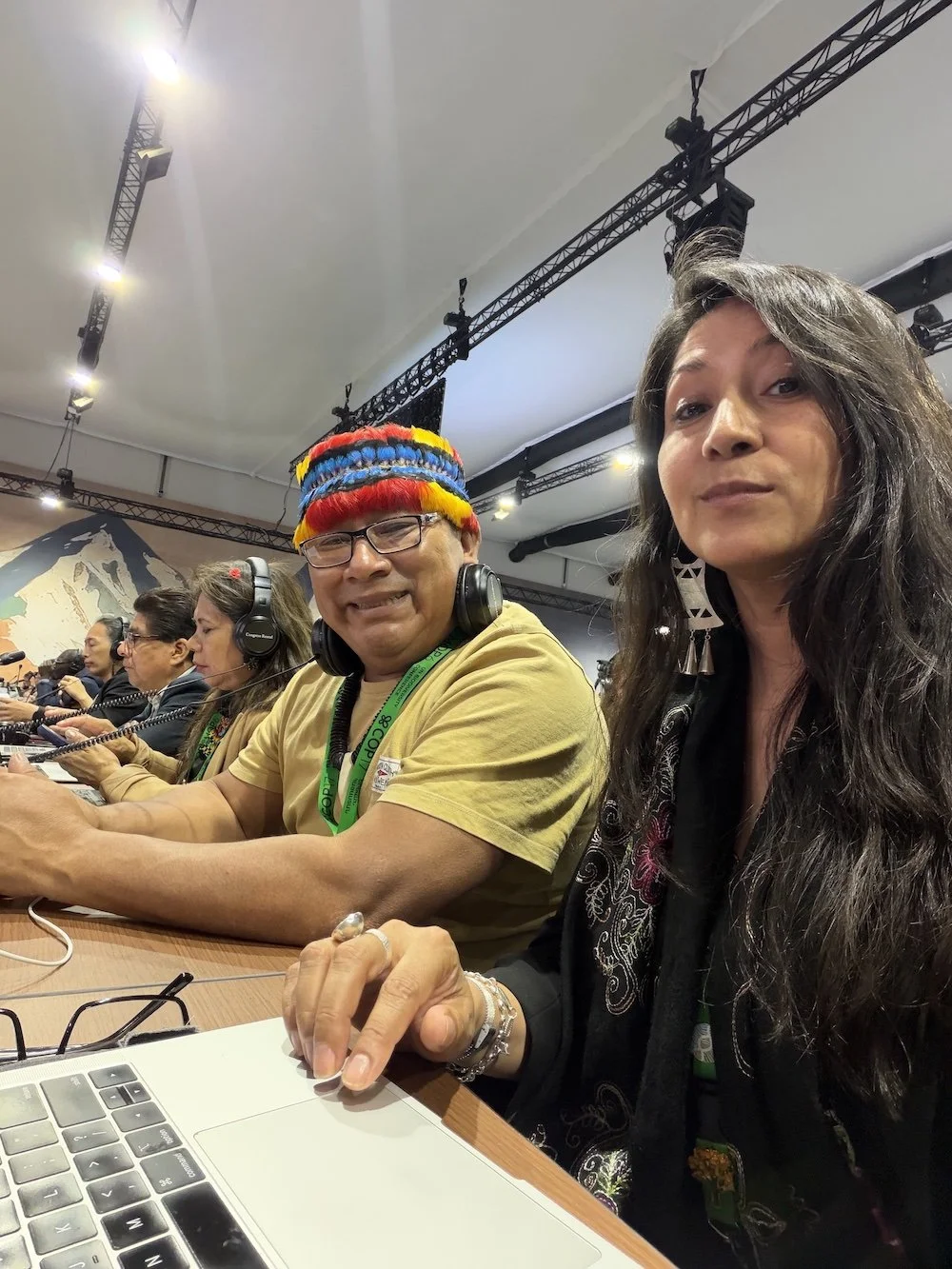
Lidia Arriagada Garcia, President and CEO of Images for Inclusion Inc (IFI), alongside Marco Martínez, Coordinator of Territories and Natural Resources of COICA, during a Working Group session at CBD COP17. Yerevan, Armenia, October 30, 2026. © 2026 Images for Inclusion Inc (IFI)
Describing the situation as “un consenso desconsensuado” (“consensus without consensus”), she received expressions of support from representatives of the Arctic/Sámi region, Latin America, and North America.
Lidia returned to the WhatsApp discussion, reproducing the exact wording of paragraphs 17 alt. bis and 10 from the circulated proposal to substantiate her objection. She emphasized that “La propuesta No establece en ninguna parte 7 SEATS para Pueblos Indígenas” (“Nowhere does the proposal establish seven seats for Indigenous Peoples”).
Although the document proposed ten seats collectively for Indigenous Peoples and local communities and recognized their own governance structures and selection procedures, it neither explicitly preserved the seven Indigenous Peoples sociocultural regions nor guaranteed seven seats for Indigenous Peoples in the friends of the Bureau.
Her intervention highlighted the distinction between acknowledging Indigenous Peoples’ representation in general terms and securing its explicit recognition in the operative negotiating text.
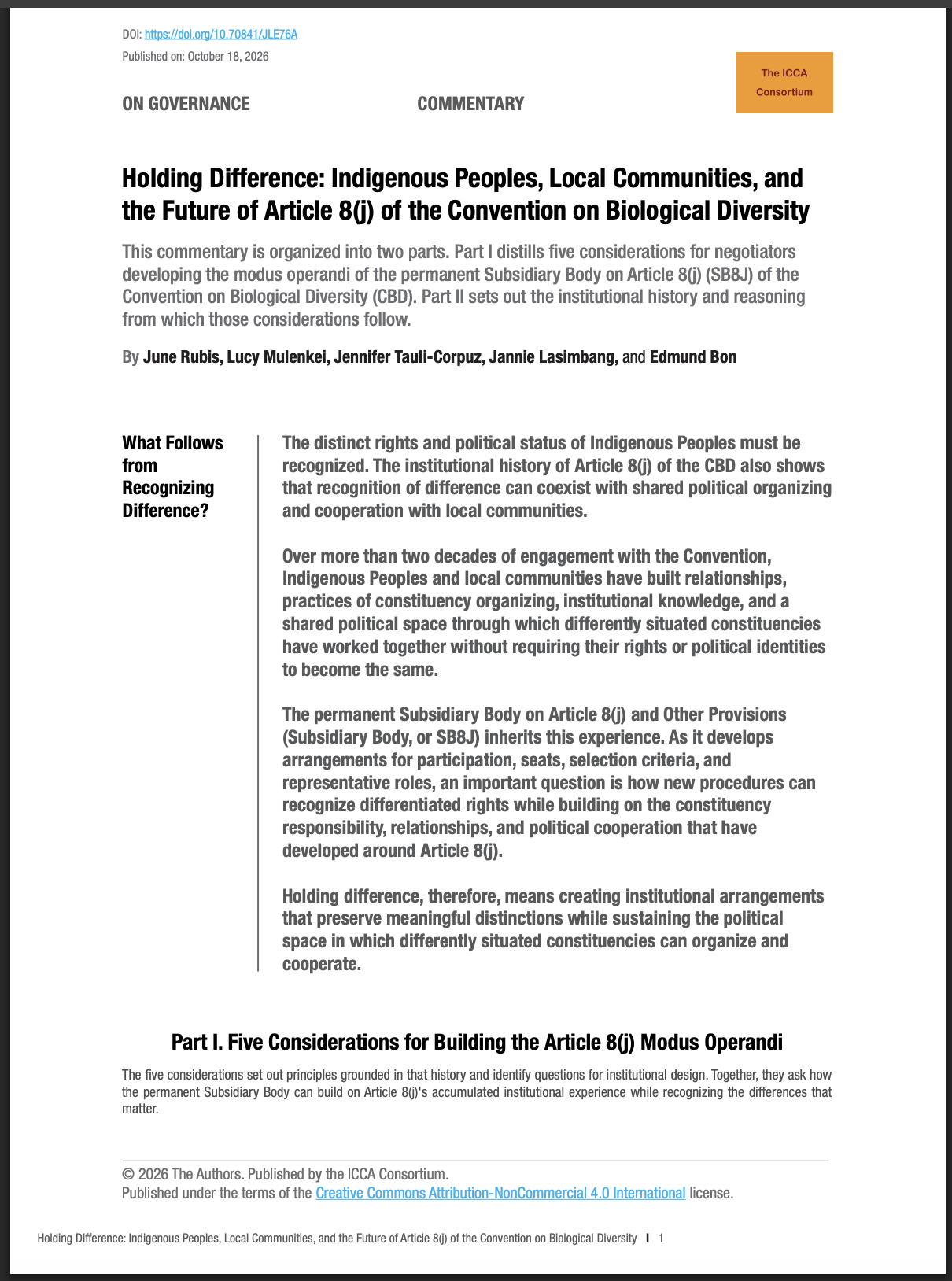
First page of “Holding Difference: Indigenous Peoples, Local Communities, and the Future of Article 8(j).” October, 2026.
The Clash Between Institutional Rhetoric and Floor Reality
The same day, a document titled Party Leadership and Constituency Choice: Building on Article 8(j)'s Institutional Experience was shared within the IIFB Article 8(j) WhatsApp group. It referred participants to Holding Difference: Indigenous Peoples, Local Communities, and the Future of Article 8(j) of the Convention on Biological Diversity, co-authored by June Rubis, Lucy Mulenkei, Jennifer Tauli-Corpuz, Jannie Lasimbang, and Edmund Bon (ICCA Consortium).
The publication portrayed the IIFB as a “Shared Political Caucus for Working Across Difference,” where Indigenous Peoples and local communities could “work through differences, identify common priorities,” and cooperate while preserving their distinct rights. It argued that recognizing differentiated rights did not necessarily require separate political constituencies.
Contrasting this portrayal with her firsthand experience at COP17, Lidia Arriagada Garcia wrote in the WhatsApp group. Her criticism echoed the dispute over an IIFB negotiating proposal reportedly circulated to States Parties despite unresolved disagreements within the Caucus, raising questions about who influenced negotiating positions and whether participants' objections were meaningfully considered.
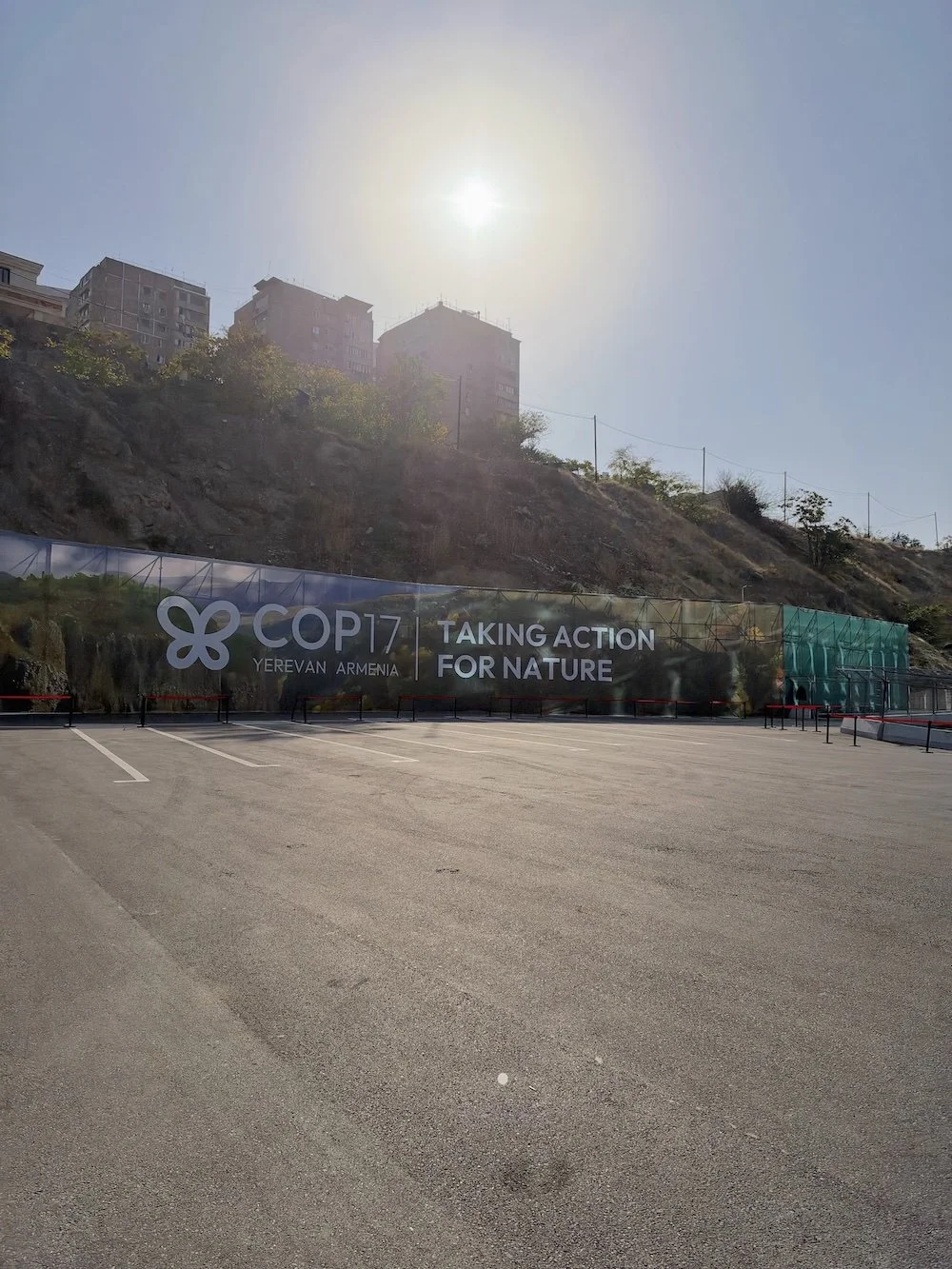
COP17's official message, “Taking Action for Nature,” displayed outside the conference venue. Yerevan, Armenia, October 2026. © 2026 Images for Inclusion Inc (IFI)
Drawing on her firsthand participation at COP16 in Cali, Colombia, in 2024, the first meeting of the Subsidiary Body on Article 8(j) (SB8J-1) in Panama in 2025, and the ongoing COP17 in Yerevan, Armenia, in 2026, Lidia Arriagada Garcia questioned this portrayal in the WhatsApp group, contrasting it with the dynamics she had witnessed throughout these processes. Her criticism mainly echoed the dispute over an IIFB negotiating proposal reportedly circulated to States Parties despite unresolved disagreements within the Caucus, raising questions about who influenced negotiating positions and whether Indigenous participants' objections were meaningfully considered.
Lidia also challenged the publication's portrayal of cooperation around Indigenous Peoples' distinct individual and collective rights, recalling tensions within the Caucus and the CBD Secretariat's intervention concerning the Code of Conduct.
In addition, she questioned the publication's discussion of transparency and accountability in representative selection, principles that Caucus participants had themselves challenged during the two weeks of negotiations.
Drawing a parallel with the gap between diplomatic declarations and Indigenous Peoples' realities on the ground, she concluded:
“It resembles the statements (rhetoric) from Parties when they speak about the advances with Indigenous Peoples on the territory.”
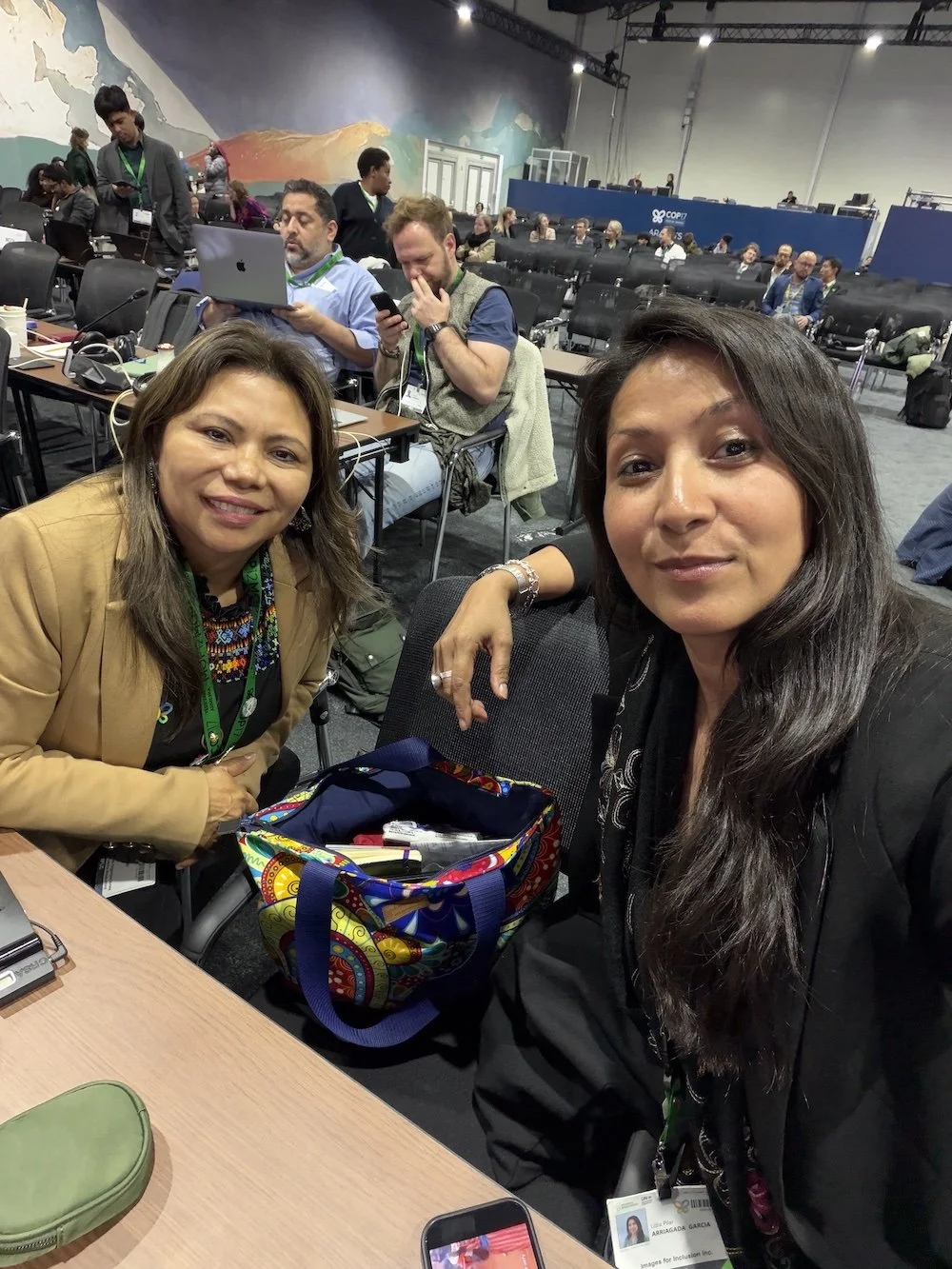
Fany Kuiru Castro, General Coordinator of the Coordinator of Indigenous Organizations of the Amazon River Basin (COICA), alongside Lidia Arriagada Garcia, President and CEO of Images for Inclusion Inc (IFI), at 7:45 a.m. on October 31, 2026, following an overnight COP17 plenary session in Yerevan, Armenia. © 2026 Images for Inclusion Inc (IFI)
Another indigenous participant subsequently expressed the view that the publication favored local communities while diminishing Indigenous Peoples' rights.
The exchange exposed the gap between institutional recognition of Indigenous Peoples' distinct individual and collective rights and their ability to defend those rights within the Caucus's own negotiating processes.
For Arriagada Garcia, the central question was whether transparency, accountability, self-determination, and full and effective participation were being upheld in practice, particularly when Indigenous Peoples’ representatives challenged proposals they believed weakened their rights under UNDRIP.
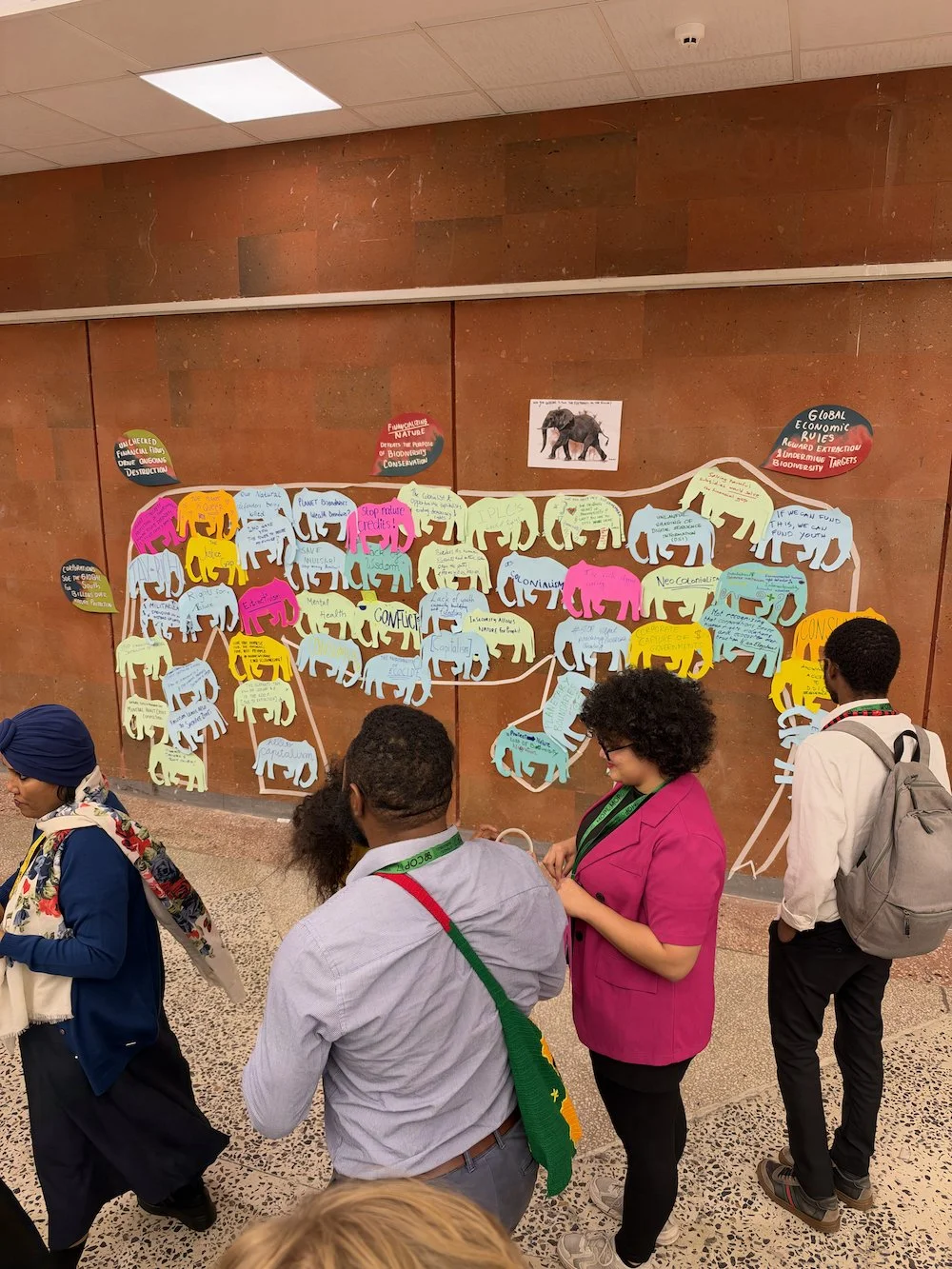
COP17 Participants examining an elephant-themed display highlighting environmental, social, and biodiversity concerns. Yerevan, Armenia, October 29, 2026. © 2026 Images for Inclusion Inc (IFI)
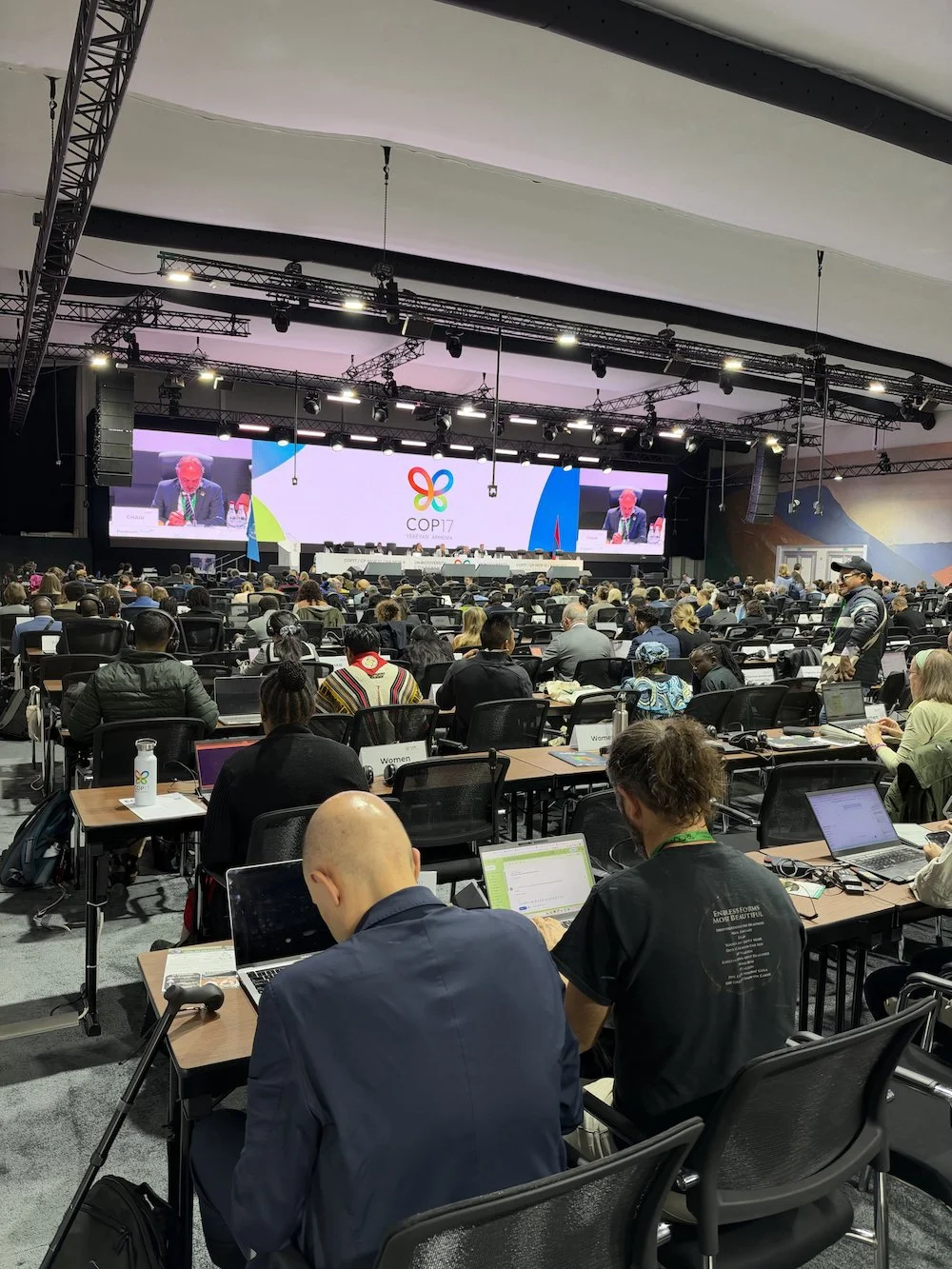
Delegates viewing an elephant-themed display highlighting environmental and biodiversity concerns in the COP17 conference hall. Yerevan, Armenia, October 29, 2026. © 2026 Images for Inclusion Inc (IFI)
Formal Negotiations: National Legislation and Indigenous Territories
In Working Group I, negotiations continued over biodiversity mainstreaming, financing, and engagement with subnational governments. Argentina proposed additional references to national legislation, supported by the Russian Federation, while other delegations sought alternative formulations.
The Chair repeatedly tested compromises, emphasizing that a single objection could prevent consensus. Some provisions advanced, while others remained bracketed.
In the Article 8(j) Contact Group, discussions continued on the recognition of Indigenous and traditional territories under Target 3, including their relationship to protected areas and free, prior and informed consent (FPIC). Proposed language concerning national circumstances and legislation remained under consideration. Meanwhile, ministerial consultations and smaller negotiating groups sought compromises on outstanding issues as the Conference approached its final sessions.
October 29 exposed a fundamental challenge: the search for agreement among States Parties was advancing while questions of representation, accountability, and consensus remained unresolved within the Caucus itself.
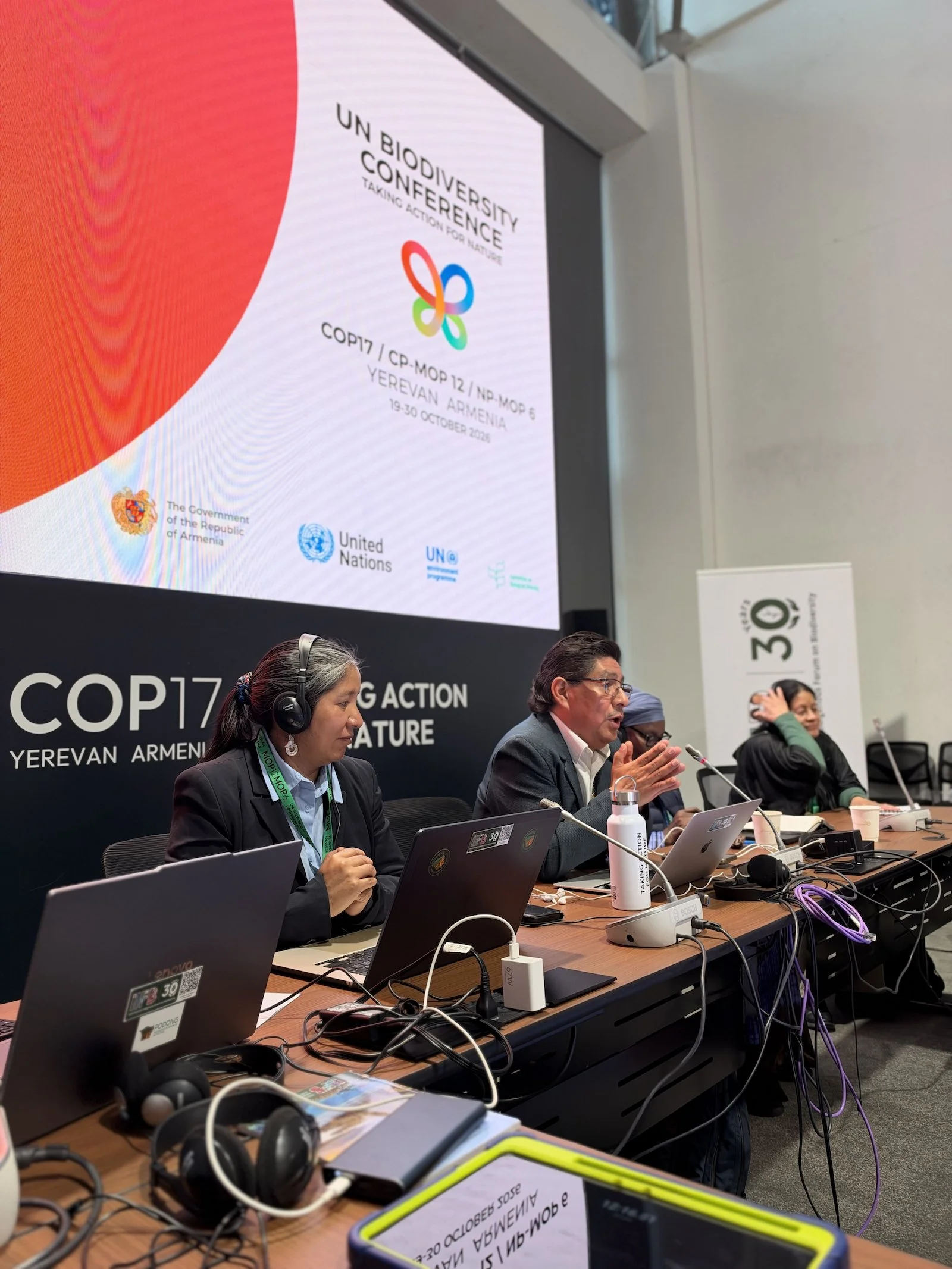
IIFB Caucus Co-Chairs during the final day of Caucus meetings at CBD COP17. Yerevan, Armenia, October 30, 2026. © 2026 Images for Inclusion Inc (IFI)
October 30–31: The Final Negotiations — Indigenous Representation Remains Unresolved
The Battle Within LAC Coordination: When Consensus Became Contested
On the morning of Friday, October 30, as negotiations among States Parties to the Convention on Biological Diversity (CBD) entered a critical stage, increasingly tense discussions unfolded within the IIFB Caucus and its Latin America and the Caribbean (LAC) regional coordination network, coordinated by the newly elected IIFB interim Co-Chair.
These disagreements exposed a fundamental structural tension between the political pressure to secure the adoption of the Modus Operandi of the Subsidiary Body on Article 8(j) and the need to ensure that its institutional arrangements explicitly safeguarded Indigenous Peoples' distinct systems of representation.
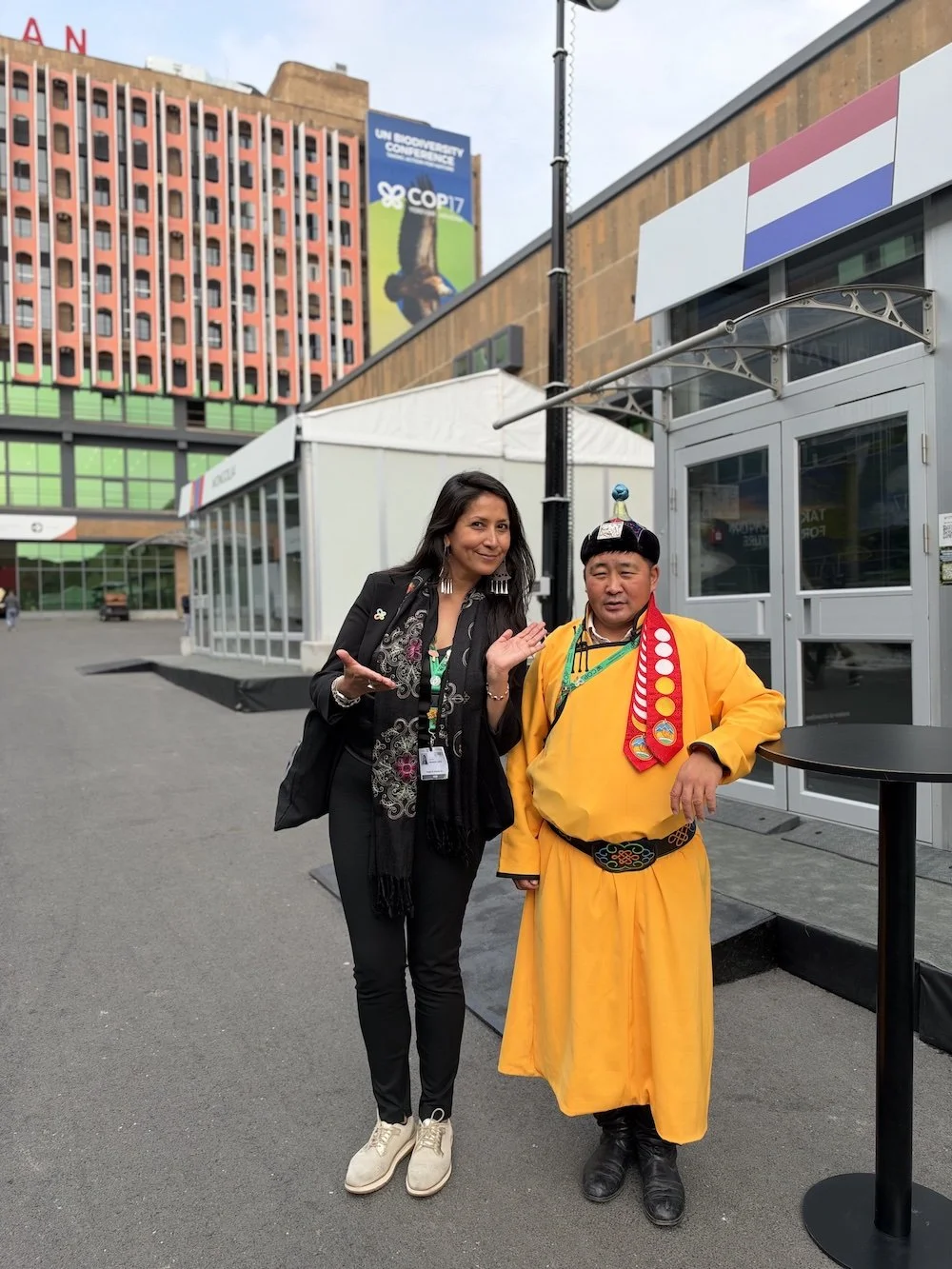
President and CEO of Images for Inclusion, alongside an Indigenous Peoples’ representative from Mongolia. CBD COP17, Yerevan, Armenia, October 30, 2026. © Images for Inclusion Inc (IFI)
At approximately 11:00 a.m. in Yerevan, IFI’s delegate questioned the absence of further regional consultations (LAC) to establish a common position on the Modus Operandi.
Although several participants reiterated an earlier sociocultural regional agreement to seek ten seats in the Friends of the Bureau, Arriagada Garcia emphasized that the outstanding questions extended beyond a numerical compromise: whether the seven Indigenous Peoples’ sociocultural regions would be explicitly recognized, whether seven seats would be allocated to Indigenous Peoples and three to local communities, and whether these provisions would be defended during the ongoing negotiations or deferred to a later stage.
The distinction was highly consequential. Securing ten seats collectively for Indigenous Peoples and local communities did not, by itself, establish their distribution or guarantee representation according to Indigenous Peoples' seven sociocultural regions. Other regional participants questioned the omission of those regions, while a proposal emerged to formulate a written LAC position supporting the 7–3 allocation, alongside a co-presidency arrangement involving Indigenous Peoples and States Parties.
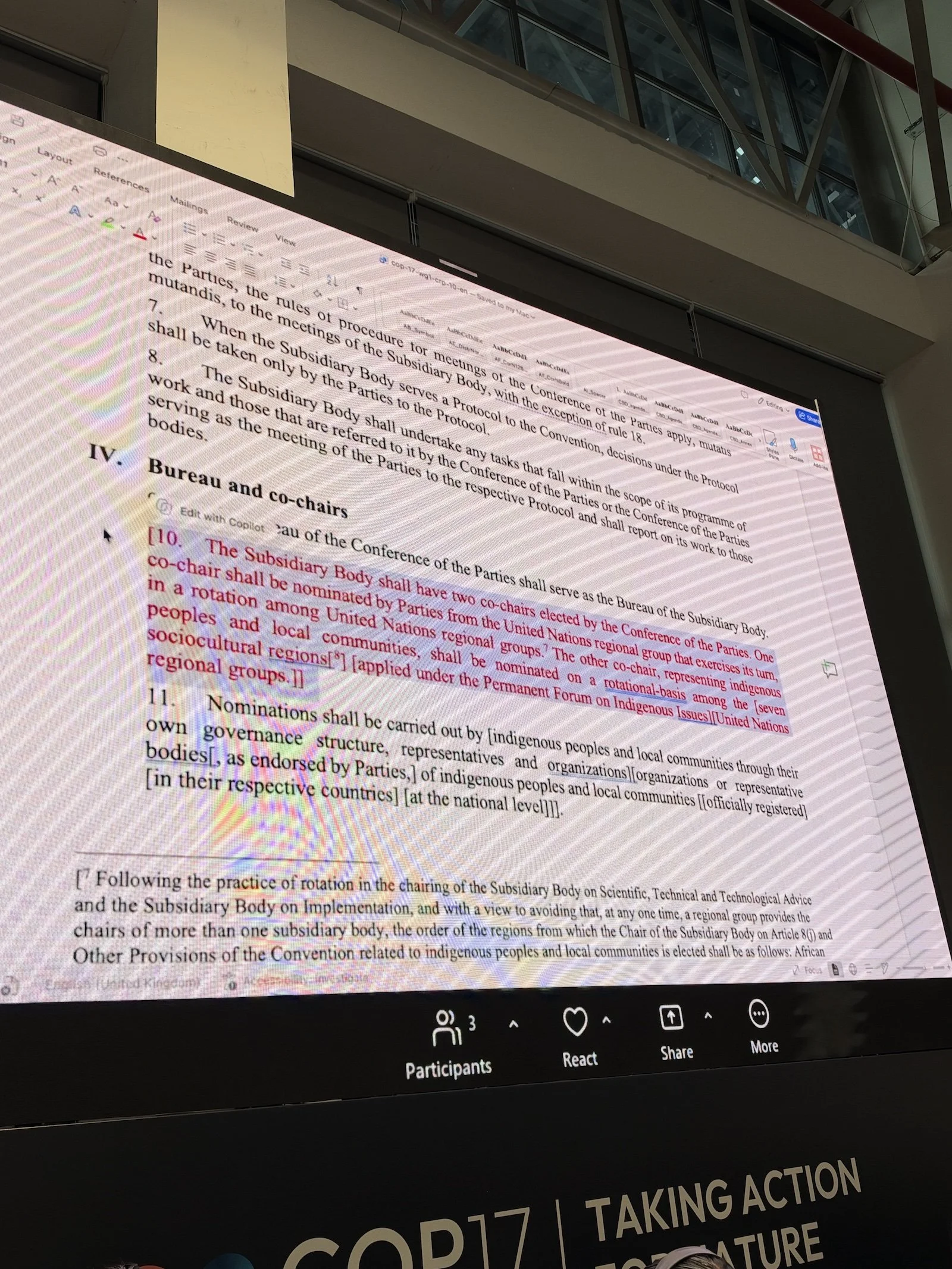
Proposed provisions concerning the Bureau and Co-Chair arrangements of the Subsidiary Body on Article 8(j). CBD COP17, Armenia, October 30, 2026. © 2026 Images for Inclusion Inc (IFI)
The evolution of the text and how proposals were contested, defended, and brought back into discussion
The morning Caucus deliberations further exposed the absence of agreement on several substantive provisions. Regional coordinators reported on internal organizational arrangements, including the selection of coordinators and interim co-chairs, while participants questioned whether the positions being communicated to States Parties reflected genuine consensus. Some maintained that the earlier agreement on ten seats should remain the common position; others argued that the absence of an explicit allocation and recognition of the seven sociocultural regions left essential questions of Indigenous Peoples’ representation unresolved.
The strategic divide became particularly pronounced when concerns continued to raised regarding the Conflation of IPLC terms issue and when participants insisted on mentioning Indigenous Peoples allocation, including the 7 Sociocultural regions and the explicit 7 seats for the friends of the Bureau for Indigenous Peoples and 3 for Local Communities allocation, which, of course, could lead certain States Parties to completely block adoption of the Modus Operandi.
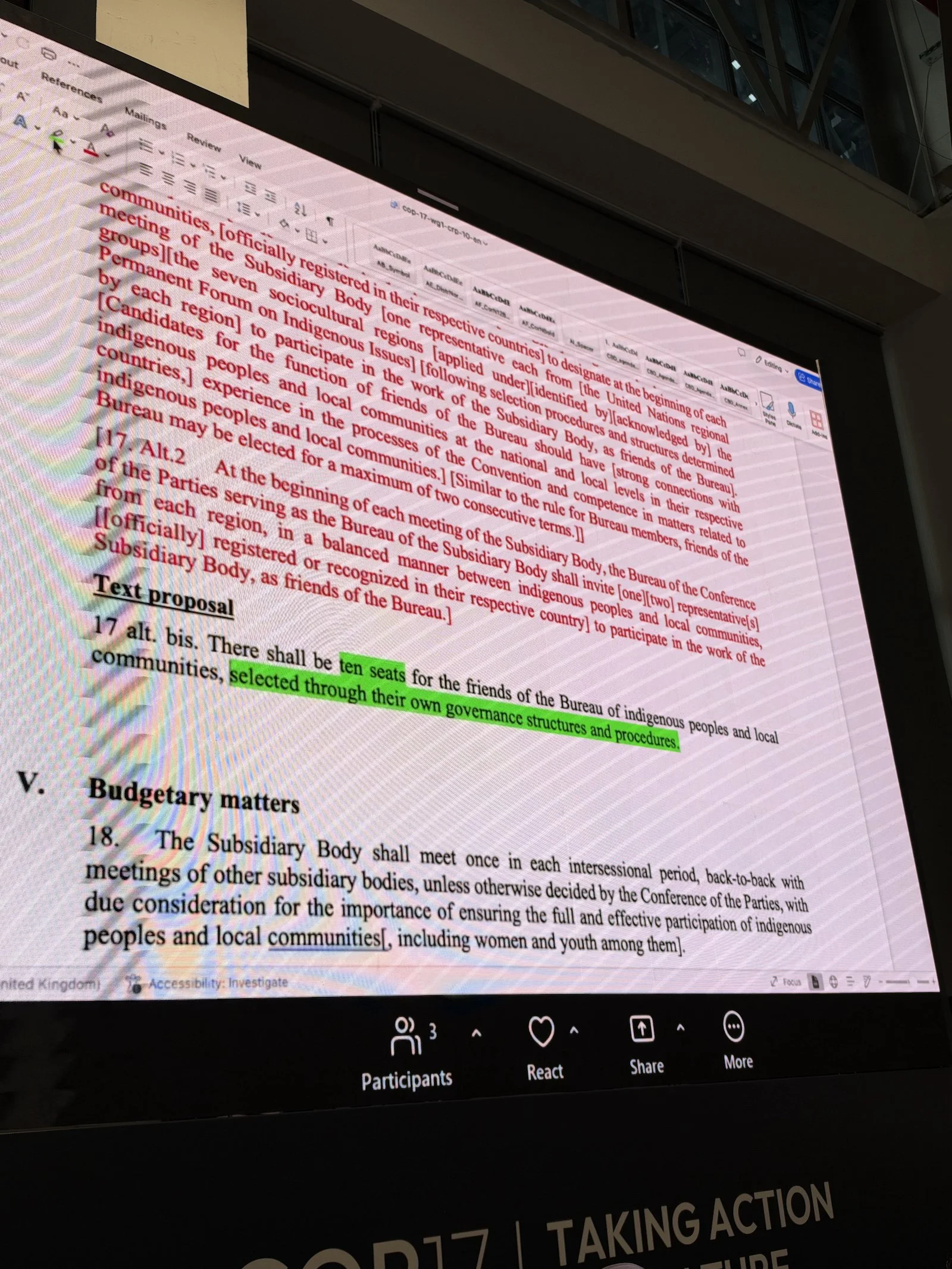
Negotiating text showing competing proposals concerning the Friends of the Bureau and the representation of Indigenous Peoples and local communities. CBD COP17, Armenia, October 2026. © 2026 Images for Inclusion Inc (IFI)
One participant challenged this reasoning through the Guatemalan expression “asustar con el petate del muerto,” questioning whether the prospect of an institutional blockade was being invoked to encourage acceptance of a weaker compromise.
Conversely, other participants maintained that securing the Modus Operandi was the overriding priority, since without an agreed institutional framework, the proposed seats would have little practical significance.
Toward the end of the Caucus meeting, participants were encouraged to approach States Parties in support of the IIFB's negotiating positions, including the adoption of the Modus Operandi of the Subsidiary Body on Article 8(j). However, an Arctic Caucus member repeatedly questioned how participants could advocate for an IIFB position before States Parties when no consensus had been reached within the Caucus. Eventually, acknowledging these reservations, a member of the IIFB Secretariat, encouraged participants to speak directly with their respective States about the positions they wished to advance.
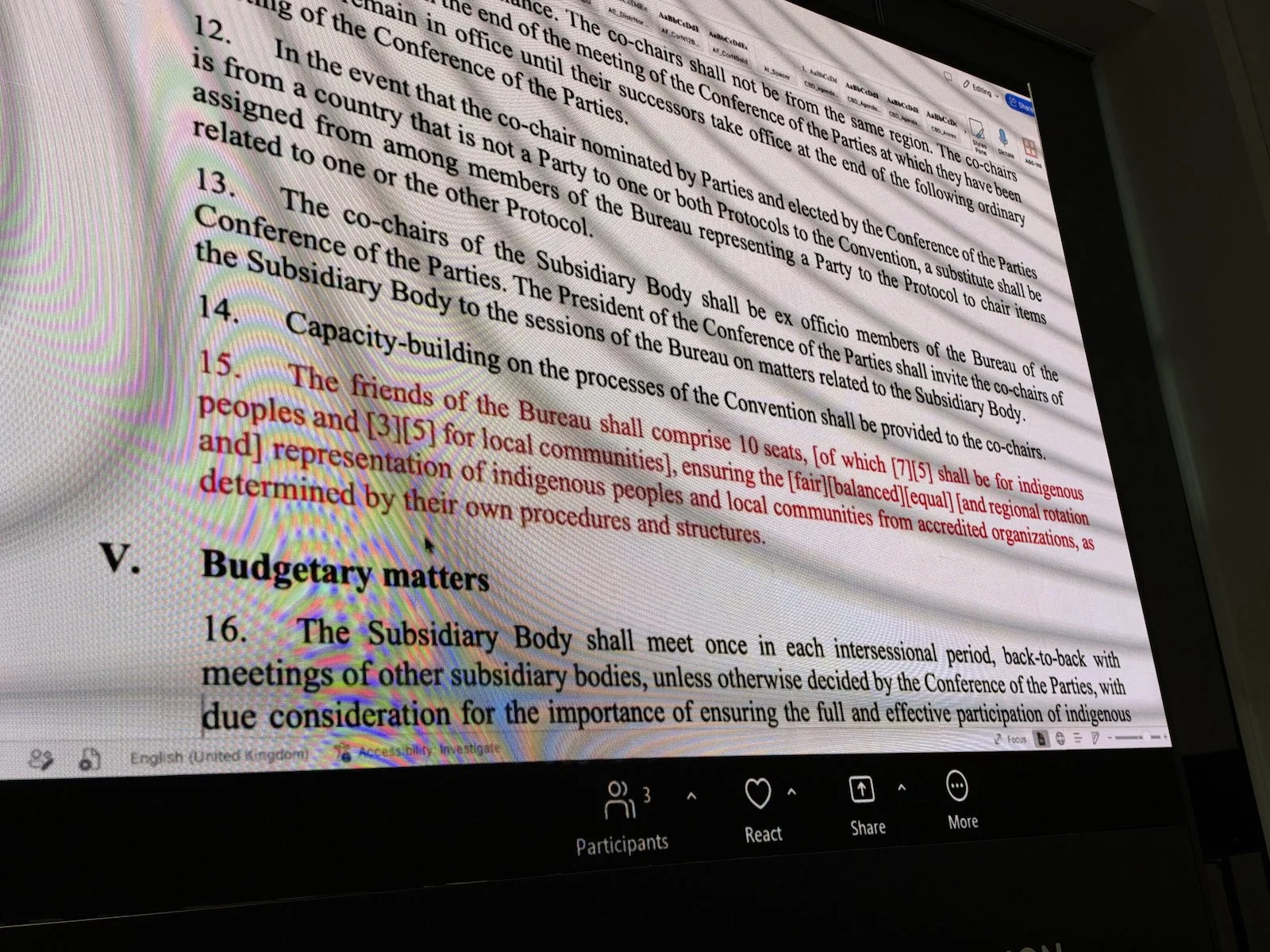
Proposed provisions concerning the composition and representation of the Friends of the Bureau during CBD COP17 negotiations. Armenia, October 30, 2026. © 2026 Images for Inclusion Inc (IFI)
Furthermore, during these deliberations, the newly elected IIFB Co-chair supported removing the competing 5–5 allocation and the language referring to a “fair, balanced and equal” distribution. Arriagada Garcia endorsed this approach, advocating the removal of the brackets surrounding the alternative 7–3 allocation and the retention of the seven Indigenous sociocultural regions.
Yet through persistent challenges, interventions, and pressure within the Caucus, they succeeded in bringing those provisions back into the negotiating text.
For IFI, the episode highlighted the importance of transparent regional consultation, clearly articulated negotiating positions, and decision-making procedures that allow Indigenous Peoples representatives to defend their distinct collective rights without those demands being prematurely set aside in the pursuit of consensus.
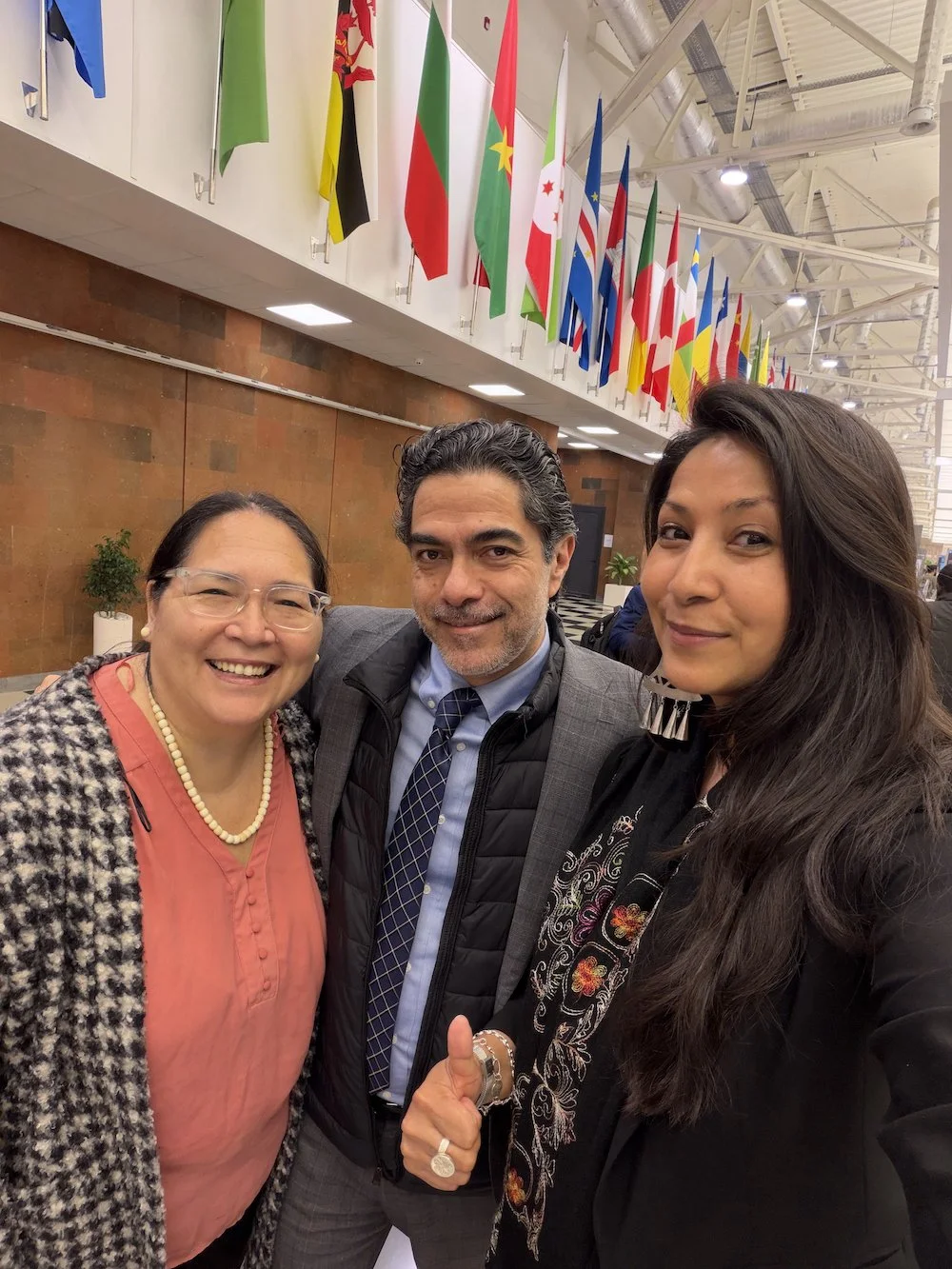
Lidia Arriagada Garcia, Aluki Kotierk, Chair of the UNPFII, and a Mexican delegate during the final diplomatic efforts at CBD COP17. Yerevan, Armenia, October 30, 2026. © 2026 Images for Inclusion Inc (IFI)
The Final Diplomatic Window: Defending the 7–3 Proposal
As the October 30 deliberations progressed, Arriagada Garcia pursued a parallel strategy of direct engagement with States Parties while continuing to advocate within the Caucus for explicit recognition of the seven Indigenous Peoples sociocultural regions and the proposed allocation of seven seats for the friends of the Bureau to Indigenous Peoples and three to local communities.
With limited time available before Working Group I (WGI) reached the relevant Article 8(j) discussions, Arriagada Garcia undertook direct diplomatic cabildeo (lobbying) with States Parties. She approached a Mexican delegate involved in WGI and shared a screenshot of the negotiating text, advocating for three specific changes: removing the proposed 5–5 allocation, lifting the brackets surrounding the alternative 7–3 allocation, and preserving explicit recognition of the seven Indigenous sociocultural regions.
Her diplomatic outreach extended to representatives of Mexico, Panama, Peru, Argentina, Namibia, the Russian Federation, and Chile.
According to Arriagada Garcia's account of these conversations, Mexico expressed support for the proposal, while Panama advised her to approach Parties that remained unconvinced.
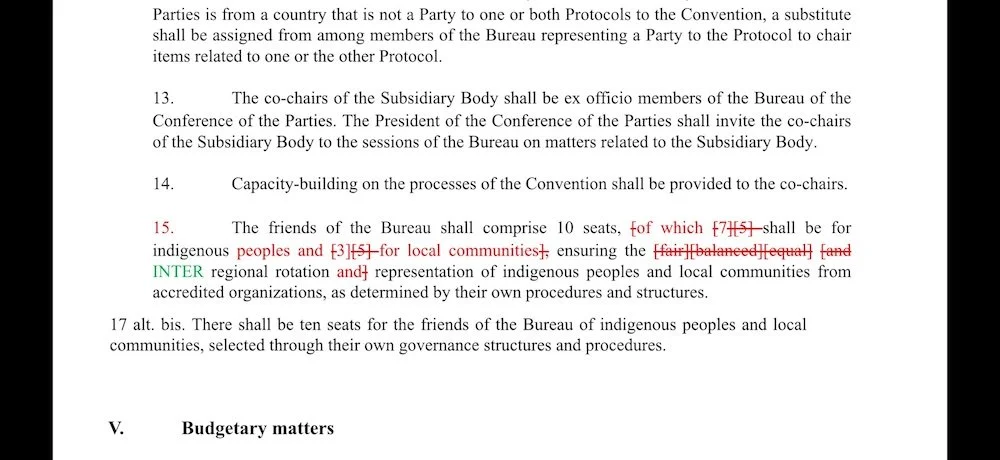
Excerpt from the draft Modus Operandi of the Subsidiary Body on Article 8(j), showing paragraph 15 and competing proposals concerning the allocation of ten seats for the Friends of the Bureau, including the proposed 7–3 distribution between Indigenous Peoples and local communities, the alternative 5–5 allocation, and provisions on regional representation. CBD COP17, Yerevan, Armenia, October 2026.
Arriagada Garcia continued engaging directly with States Parties that remained unconvinced or opposed the proposals, advocating for the adoption of the Modus Operandi of the Subsidiary Body on Article 8(j), the proposed allocation of seven seats for Indigenous Peoples and three for local communities within the Friends of the Bureau, and explicit recognition of the seven Indigenous Peoples' sociocultural regions rather than the five UN geographic regions.
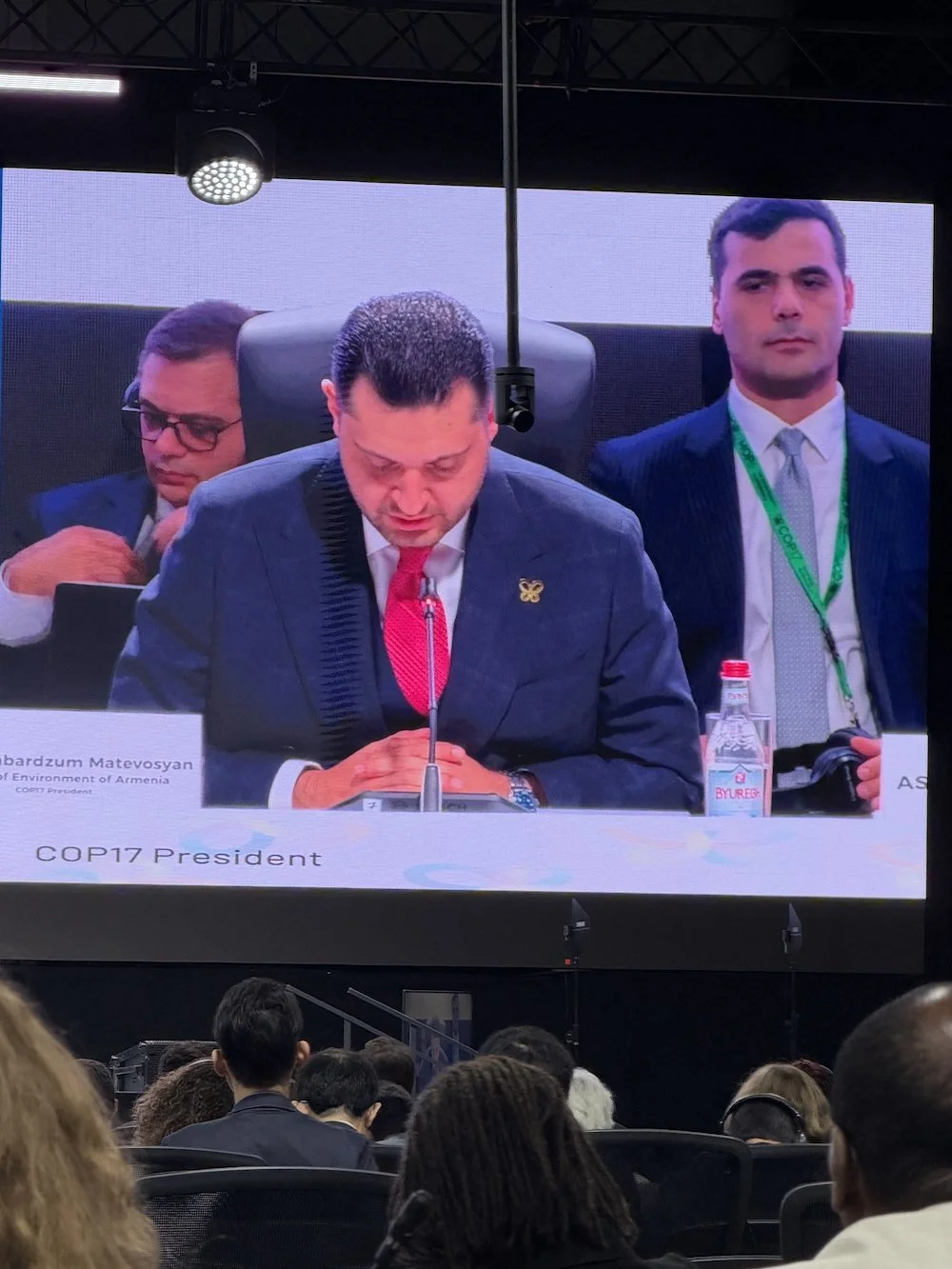
Hambardzum Matevosyan, President of CBD COP17. Yerevan, Armenia, October 30, 2026. © 2026 Images for Inclusion Inc (IFI)
Argentina indicated to Lidia that its delegation had not received State instructions concerning the numerical allocation of seats. Peru questioned the rationale behind allocating seven seats to Indigenous Peoples and three to local communities. Arriagada Garcia explained the reasoning behind the proposed distribution, although the Peruvian representative indicated that the delegation had no explicit instructions to support it.
Namibia defended the representation of local communities and did not support either the 7–3 allocation or recognition of the seven Indigenous sociocultural regions. Its representative emphasized the significant presence of local communities in Namibia and discussed tourist (trophy) hunting to stimulate the local economy.
The Russian Federation maintained a firm position. During Arriagada Garcia's direct engagement, a representative explained that the delegation had received strict instructions that did not align with the proposed changes.
Arriagada Garcia also approached Chile, whose delegation had two negotiators. She was informed that neither was participating in the negotiations concerning the Modus Operandi under Agenda Item 10(a) on Article 8(j).
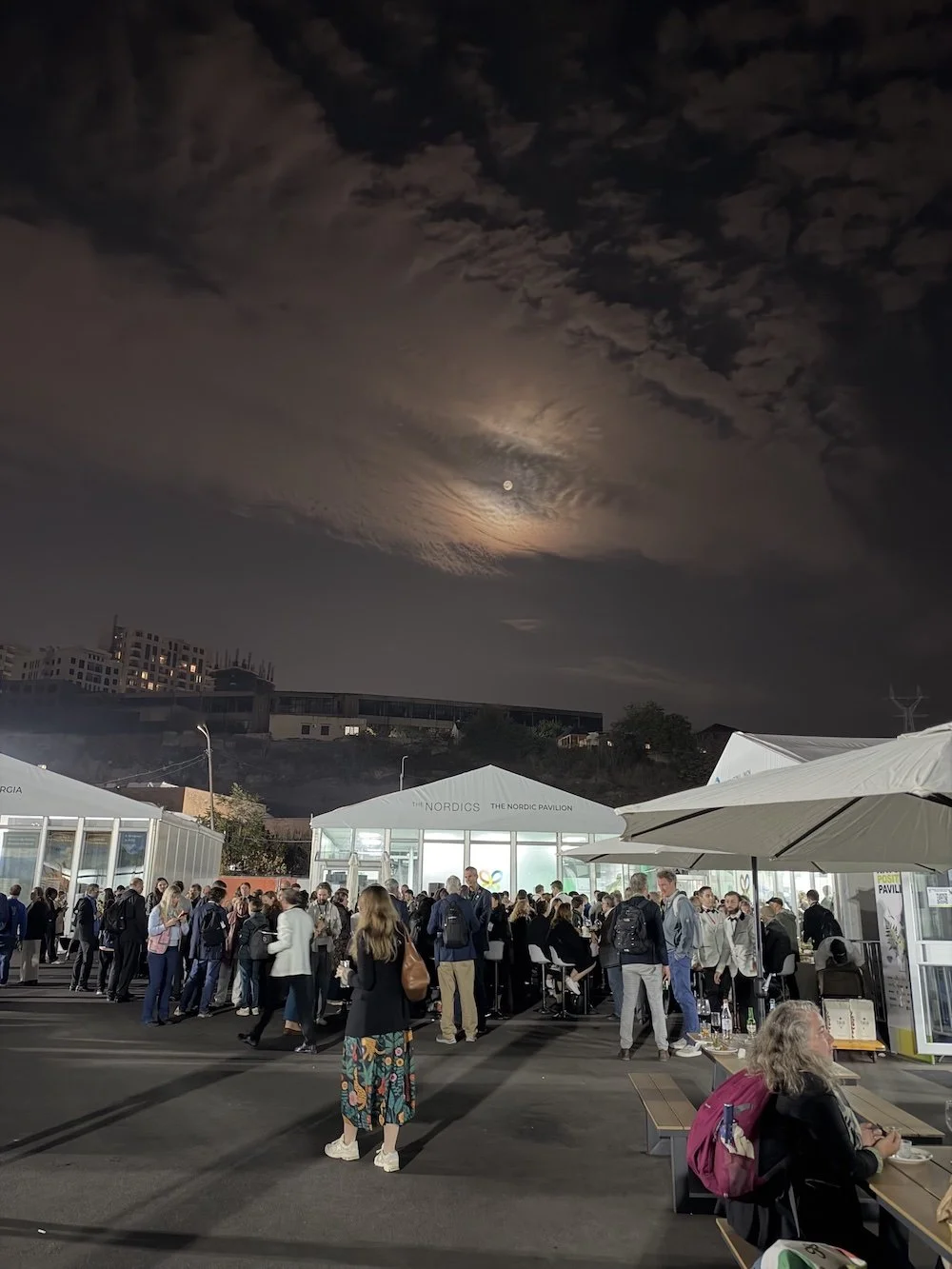
Moonlit evening at the CBD COP17 pavilions. Yerevan, Armenia, October 2026. © 2026 Images for Inclusion Inc (IFI)
The Battle Over Representation: The Realities of Self-Determination
The controversy surrounding the Modus Operandi of the SB8J extended beyond procedural disagreements over the composition of the Friends of the Bureau. At its core was a fundamental question: whether Indigenous Peoples would be represented through their own sociocultural regions, institutions, and decision-making processes, or through arrangements determined by States Parties.
During CBD COP17, Jocabed Reina Solano Miselis, a Gunadule negotiator representing the State of Panama, had emphasized the importance of self-determination in an interview published by for Indigenous Peoples Rights International (IPRI) where she says:
“We are here because we are defending the rights of Indigenous Peoples. The Subsidiary Body on Article 8(j) is a very important organ because our mothers and fathers fought for many years so that our rights could become a reality. From the perspective of States, they often do not include the voices of Indigenous Peoples, which is why it is important that we maintain our fight, and why it is good to remember that there is no climate justice without the rights of Indigenous Peoples.
This is about the Modus Operandi—that is to say, how we want to be represented, and we cannot be represented outside our own realities. Why is this important to us? Because we have our own ways of understanding life, which is our self-determination, and we must recognize that without the voices and rights of Indigenous Peoples, there is no biodiversity.”
Her remarks captured what was ultimately at stake: not simply the allocation of seats for the friends of the Bureau, but recognition of Indigenous Peoples' rights.
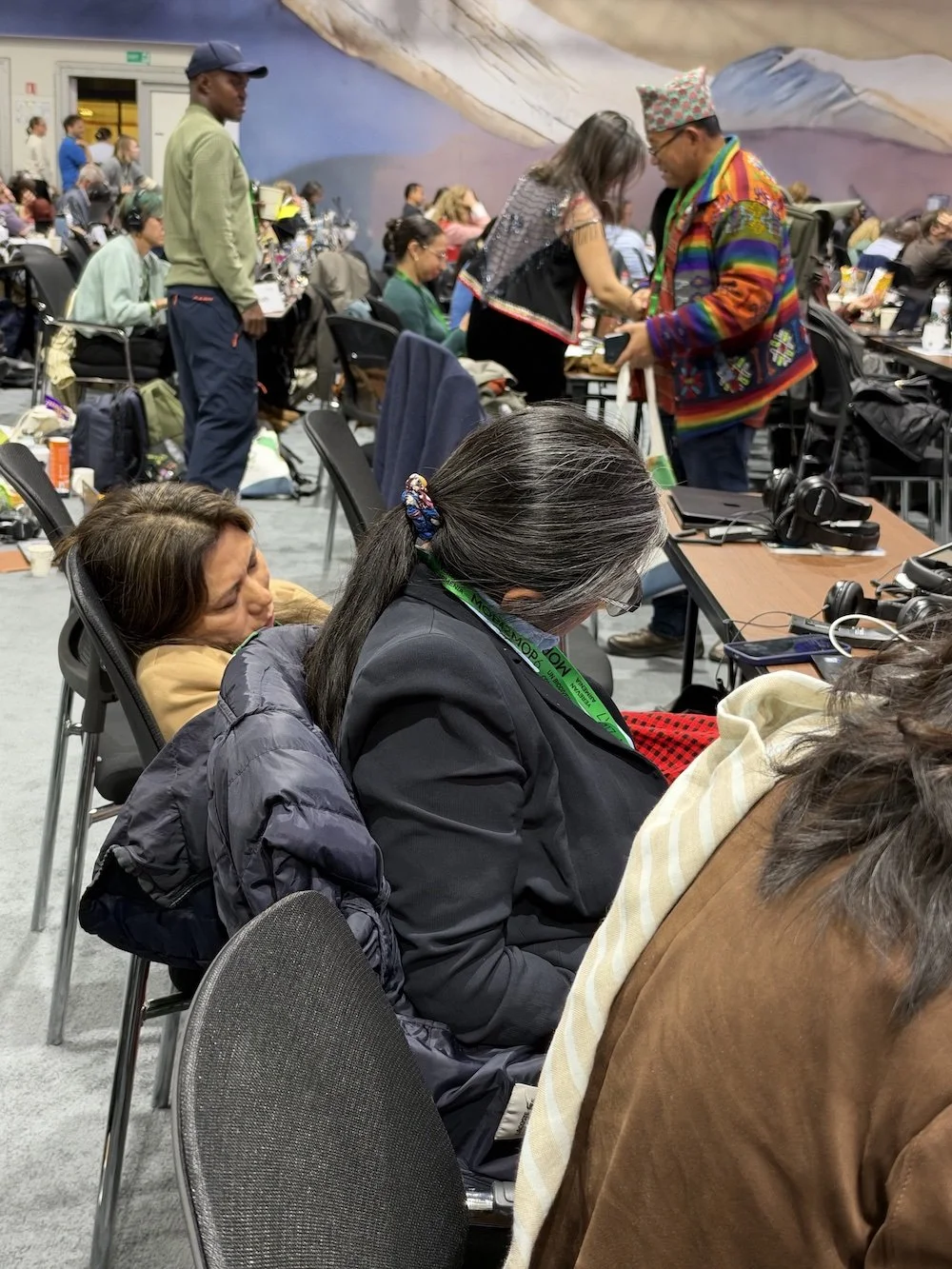
Indigenous Peoples’ leaders taking a very brief rest during the exhausting overnight negotiations while awaiting decisions by States Parties. CBD COP17, Yerevan, Armenia, October 30–31, 2026. © 2026 Images for Inclusion Inc (IFI)
The intensity and duration of that overnight session placed severe physical and mental demands on everyone in the room.
Exhaustion became visibly apparent in the Working Group—with some participants falling asleep at their desks, others pushing forward with hope, and many with deep disappointment or a mixture of both.
Even several State delegations such the Democratic Republic of the Congo, openly voiced their frustration over the grueling pace, reminding the room of their basic human limits as fatigue began to compromise effective participation.
As the negotiations stretched past 3:30 a.m. on October 31, the physical toll of two relentless weeks became visible across the plenary floor.
Sustained by the complimentary coffee and food provided at one point during the night by the Armenian host country, along with filtered water available at various locations throughout the venue, Lidia Arriagada Garcia remained vigilant throughout the night, closely monitoring every procedural turn as Indigenous leaders and negotiators pushed through exhaustion to see the process through to the final gavel.
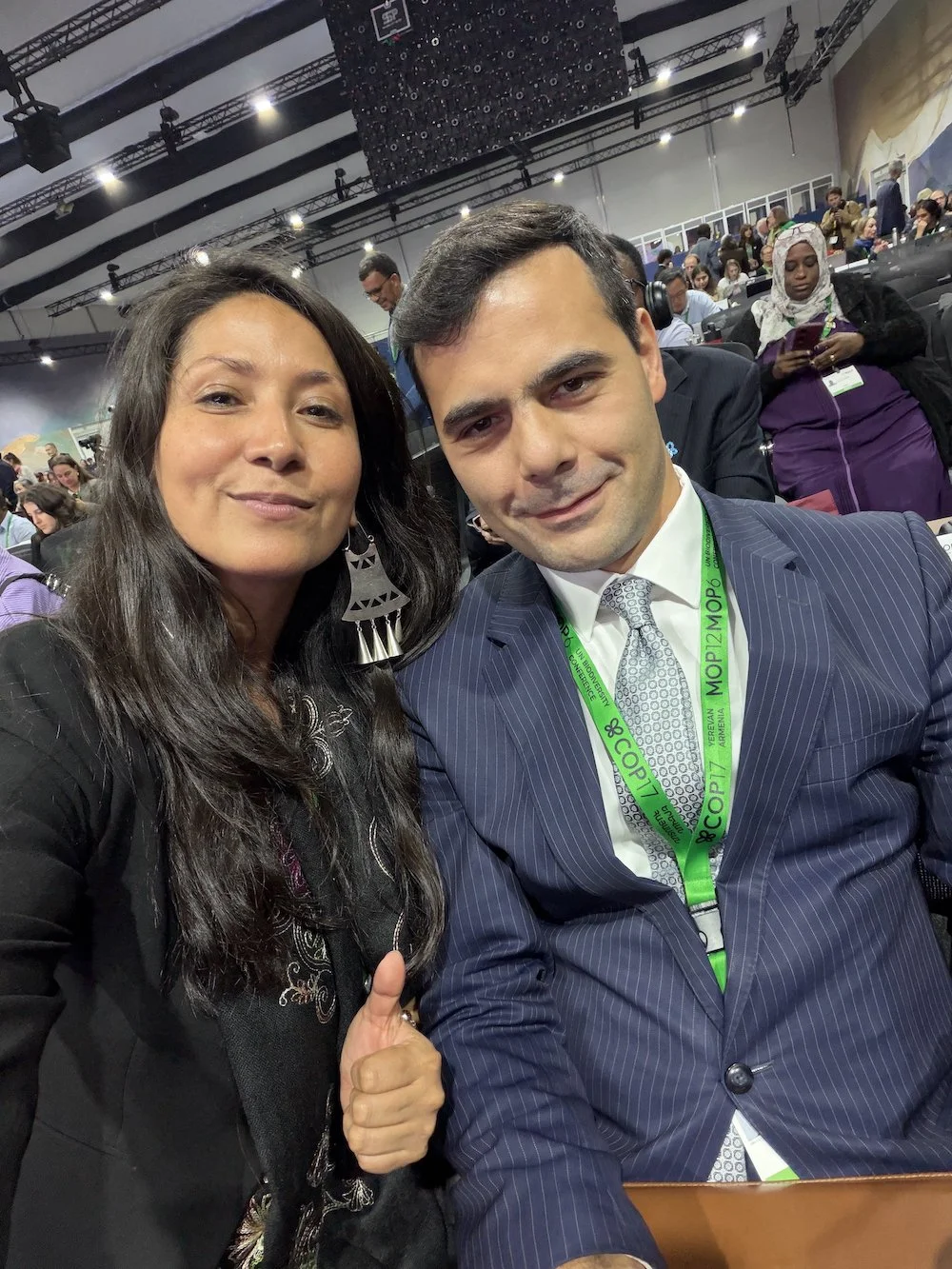
Lidia Arriagada Garcia and Mr. Davit Manukyan, Counselor at Armenia's Ministry of Foreign Affairs and representative of the Armenian COP17 Presidency. Yerevan, Armenia, October 2026. © 2026 Images for Inclusion Inc (IFI)
In that regard, IFI acknowledges and expresses its deep appreciation to Armenia, as the host country of the CBD COP17, for its exceptional hospitality and thoughtful support throughout the Conference.
In particular, during that overnight session on the night of October 30, the provision of food, coffee, and other refreshments in the Working Group conference room around midnight was especially appreciated, helping participants sustain their engagement through the remaining hours leading to the final plenary.
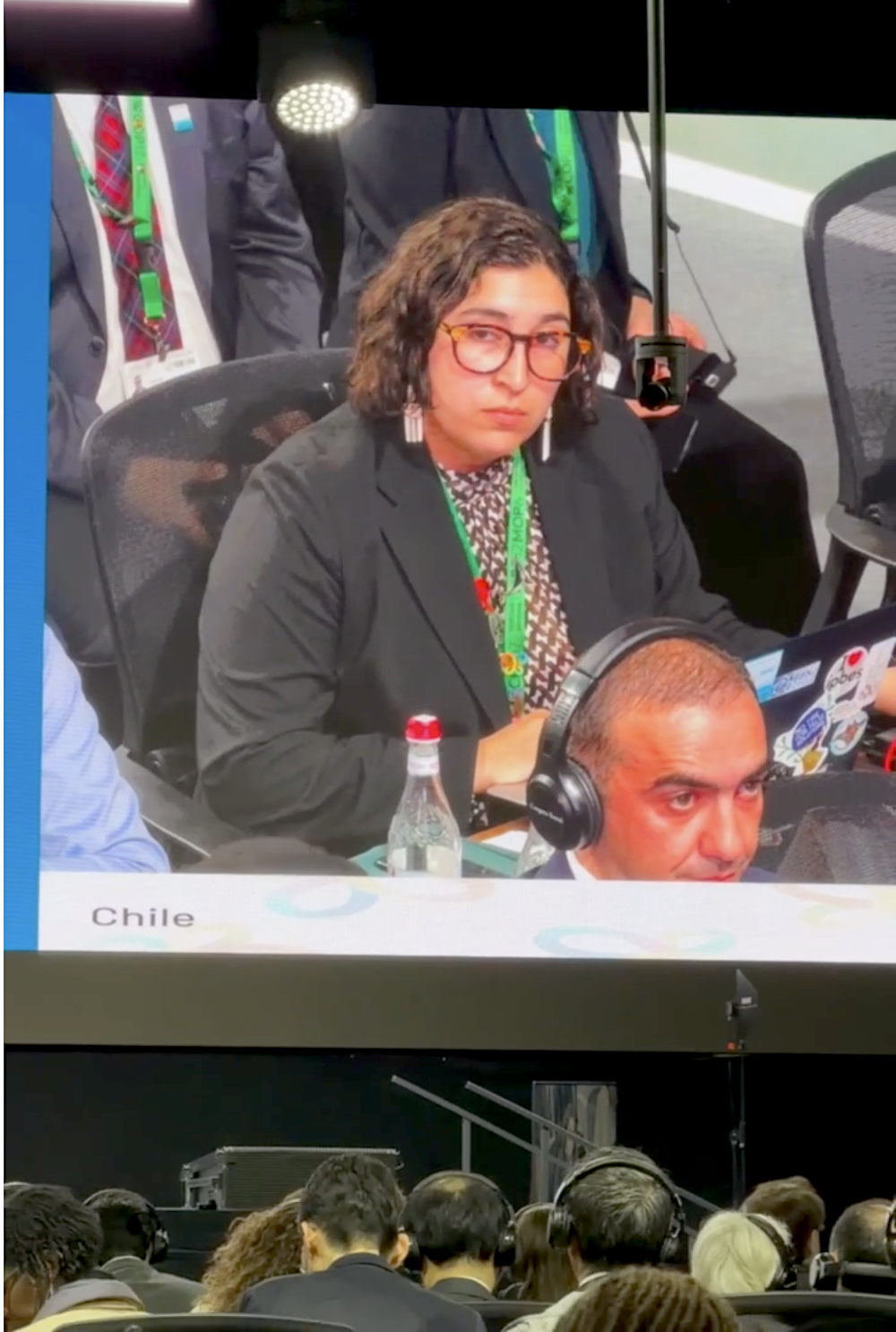
Chilean delegate following her statement, shortly before midnight. CBD COP17, Yerevan, Armenia, October 30, 2026. © 2026 Images for Inclusion Inc (IFI)
Chile’s Defense of Previously Agreed Human Rights Language and Its Absence from the Article 8(j) Modus Operandi Negotiations
Around 11:30 p.m., Chile requested the floor to make a statement for the record, expressing profound concern over setbacks in previously agreed language, particularly the removal of references to Indigenous Peoples, women, and youth, warning: “Estamos viendo retrocesos en el lenguaje adoptado.”
After reaffirming its commitment to pragmatism, flexibility, and reaching agreements, the delegation concluded with the pointed expression:
“Estamos borrando con el codo lo que hemos escrito con la mano.” / "We are erasing with our elbow what we have written with our hand."
The intervention received exactly one minute of applause throughout the plenary hall.
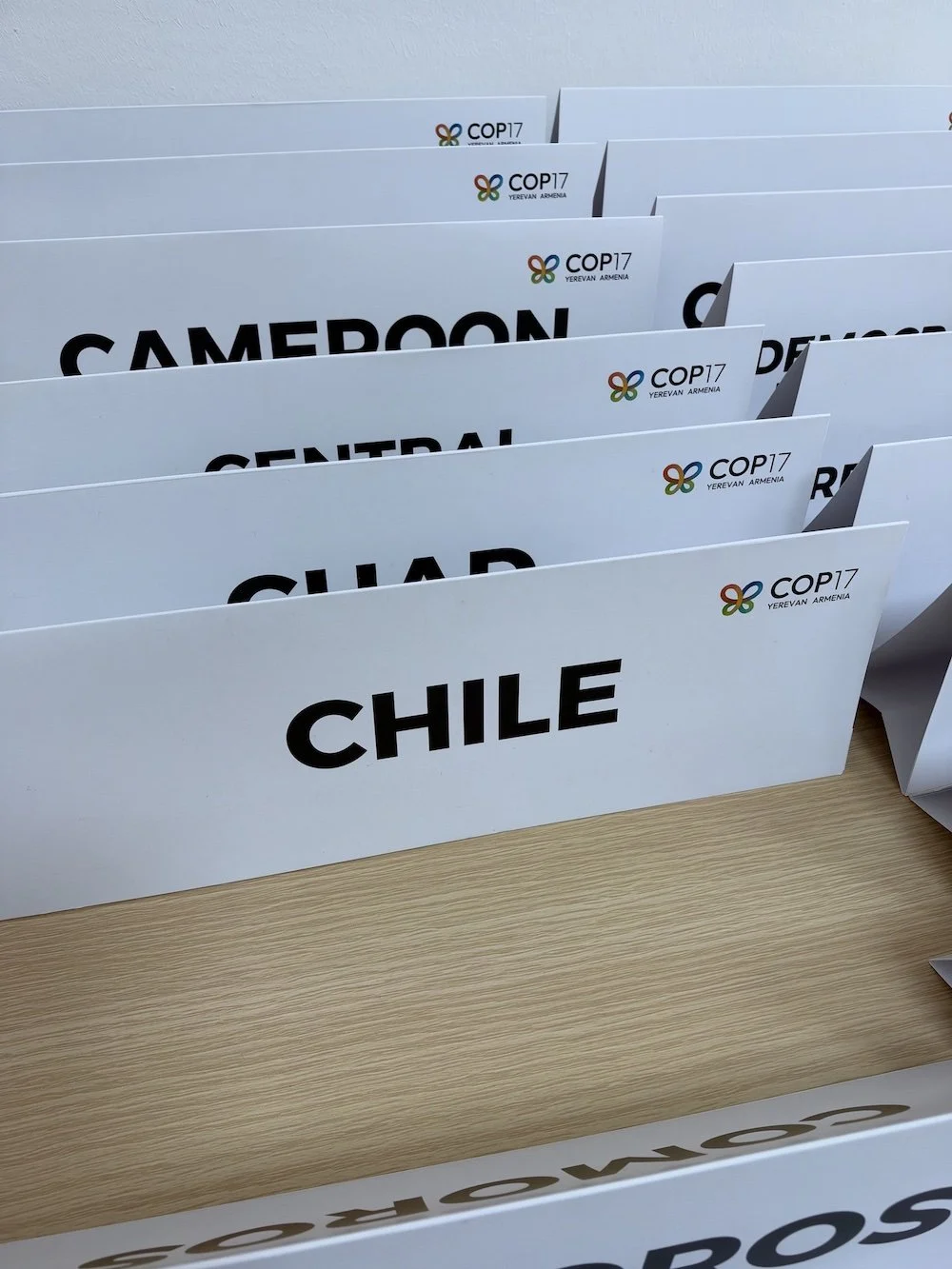
Chile’s designated delegation placard among those of other States Parties at CBD COP17. Yerevan, Armenia, October 19, 2026. © 2026 Images for Inclusion Inc (IFI)
While Chile’s defense of previously agreed human rights language was deeply appreciated for its accuracy and courage, its failure to engage in the Modus Operandi negotiations of the Subsidiary Body on Article 8(j) marked a significant regression, particularly given its previous participation and contributions at COP16 in Cali and SB8J-1 in Panama.
Although two Chilean delegates were attending COP17’s final plenary, including one who had participated in the negotiations for the adoption of the Subsidiary Body on Article 8(j) at COP16, neither engaged in the decisive negotiations to adopt the Modus Operandi.
This lack of engagement reflects a lack of political will at a time when Indigenous Peoples’ rights in Chile are increasingly under threat from proposed budget cuts affecting Indigenous Peoples’ culture and land restitution, alongside legislative initiatives to amend or repeal key Indigenous Peoples’ legal protections, particularly Law No. 19.253 (Ley Indígena) and Law No. 20.249 (Ley Lafkenche).
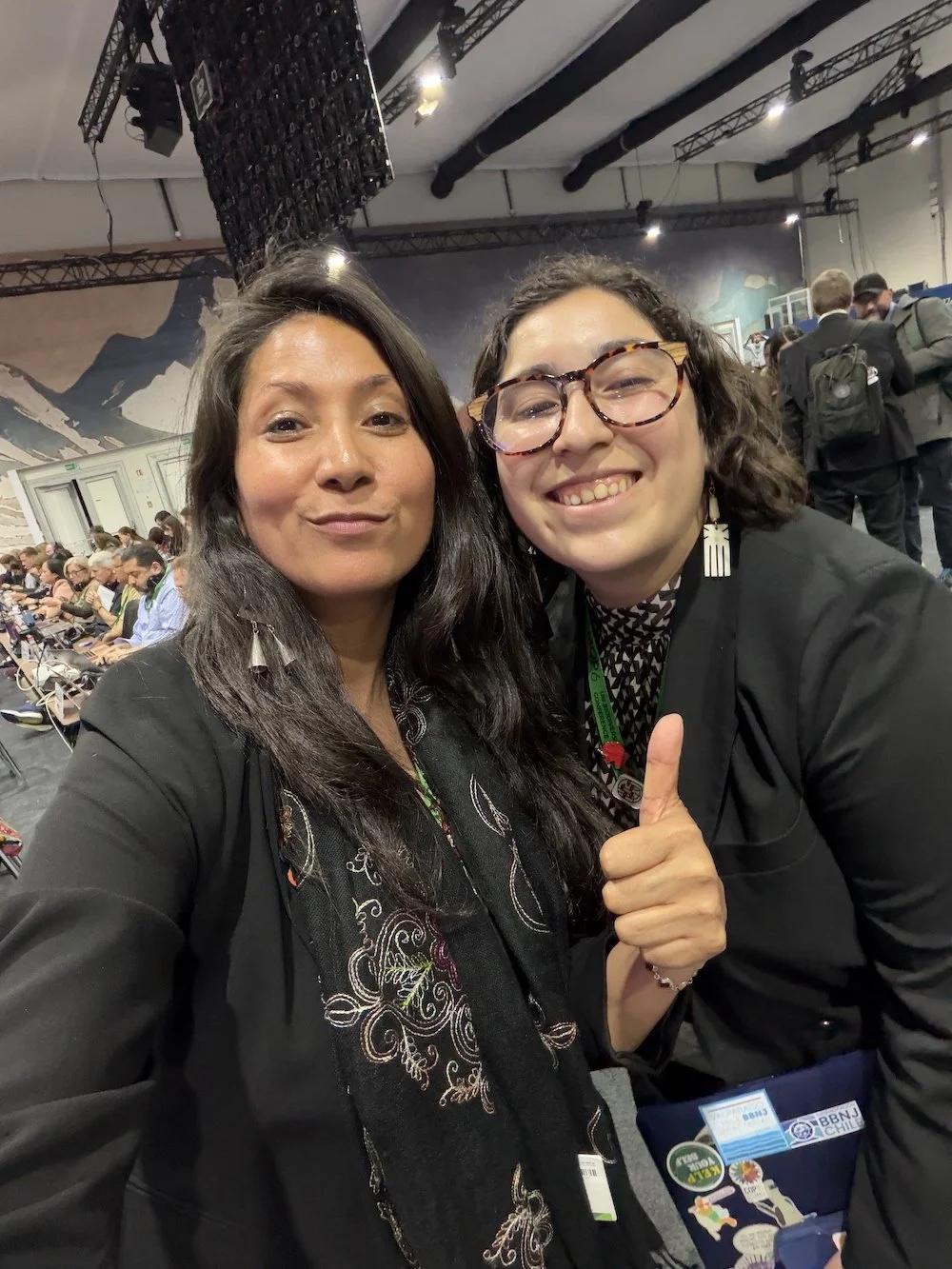
Lidia Arriagada Garcia acknowledging the female Chilean delegate’s defense of previously agreed human rights language concerning Indigenous Peoples, women, and youth, following her intervention at CBD COP17. Yerevan, Armenia, October 30, 2026. © 2026 Images for Inclusion Inc (IFI)
These setbacks, together with administrative failures and compromised Indigenous Consultations under previous administrations—including the July 2026 proceedings initiated by Chile’s Ministry of the Environment to invalidate Indigenous consultation agreements under Law No. 21.600, which establishes the Biodiversity and Protected Areas Service (SBAP) and the National System of Protected Areas, following the loss of the original document containing Indigenous Peoples representatives’ signatures—expose a continuing pattern of regression across successive governments, whether from the left or the right.
Ultimately, this selective engagement underscores the urgent need to hold all States Parties accountable for upholding international human rights instruments and standards in CBD negotiations and national implementation to achieve the Convention’s objectives.
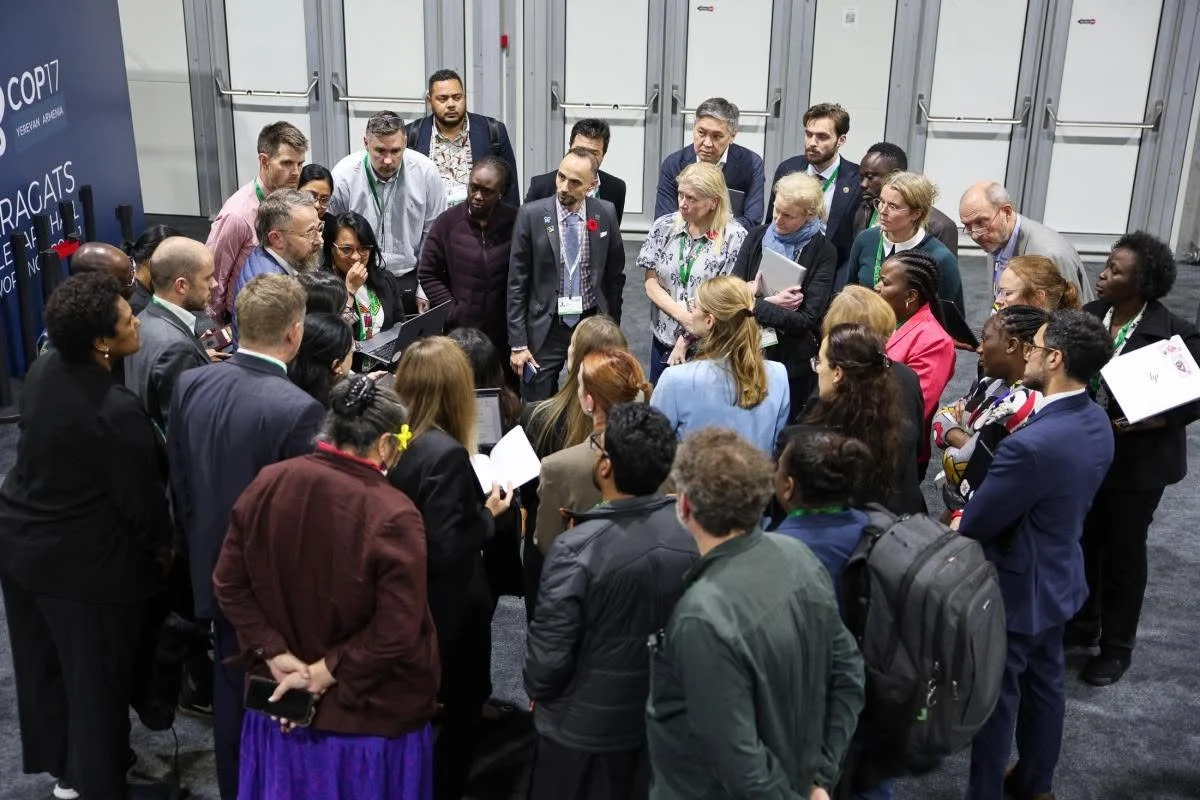
Delegates in final negotiations before 8:00 a.m. CBD COP17, Armenia, 2026. Photograph: CBD COP17 Armenia.
The Final Hours: A Proposed Compromise versus Principles
As October 30 gave way to October 31, negotiations continued into the early morning amid persistent disagreements over the Modus Operandi and other outstanding decisions.
Shortly after midnight, the Voluntary Guidelines to Strengthen the Legal and Policy Framework for the Recognition of the Role of Indigenous Peoples and Local Communities and Their Indigenous and Traditional Territories in Spatial Planning, Ecosystem Restoration, Area-Based Conservation and Environmental Impact Assessments were adopted.
The discussions concerning the Modus Operandi, however, remained difficult.
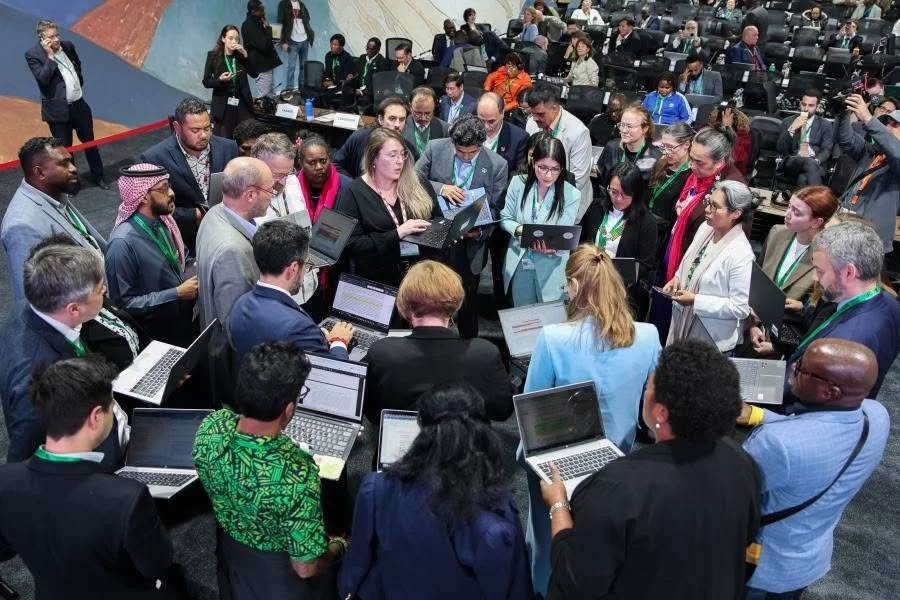
Parties in final negotiations before 8:00 a.m. CBD COP17, Armenia, 2026. Photograph: COP17 Armenia.
The Russian Federation insisted that the Subsidiary Body should operate under an agreed Modus Operandi, while Colombia expressed willingness to consider the Russian proposal as a basis for moving forward. Brazil raised concerns that the negotiating process had deepened divisions between Indigenous Peoples and local communities, urging Parties to protect the participation of both constituencies without establishing a hierarchy between them.
The negotiations had reached a point where the Presidency proposed deferring the Modus Operandi itself until COP18. Therefore, a different compromise was subsequently negotiated.
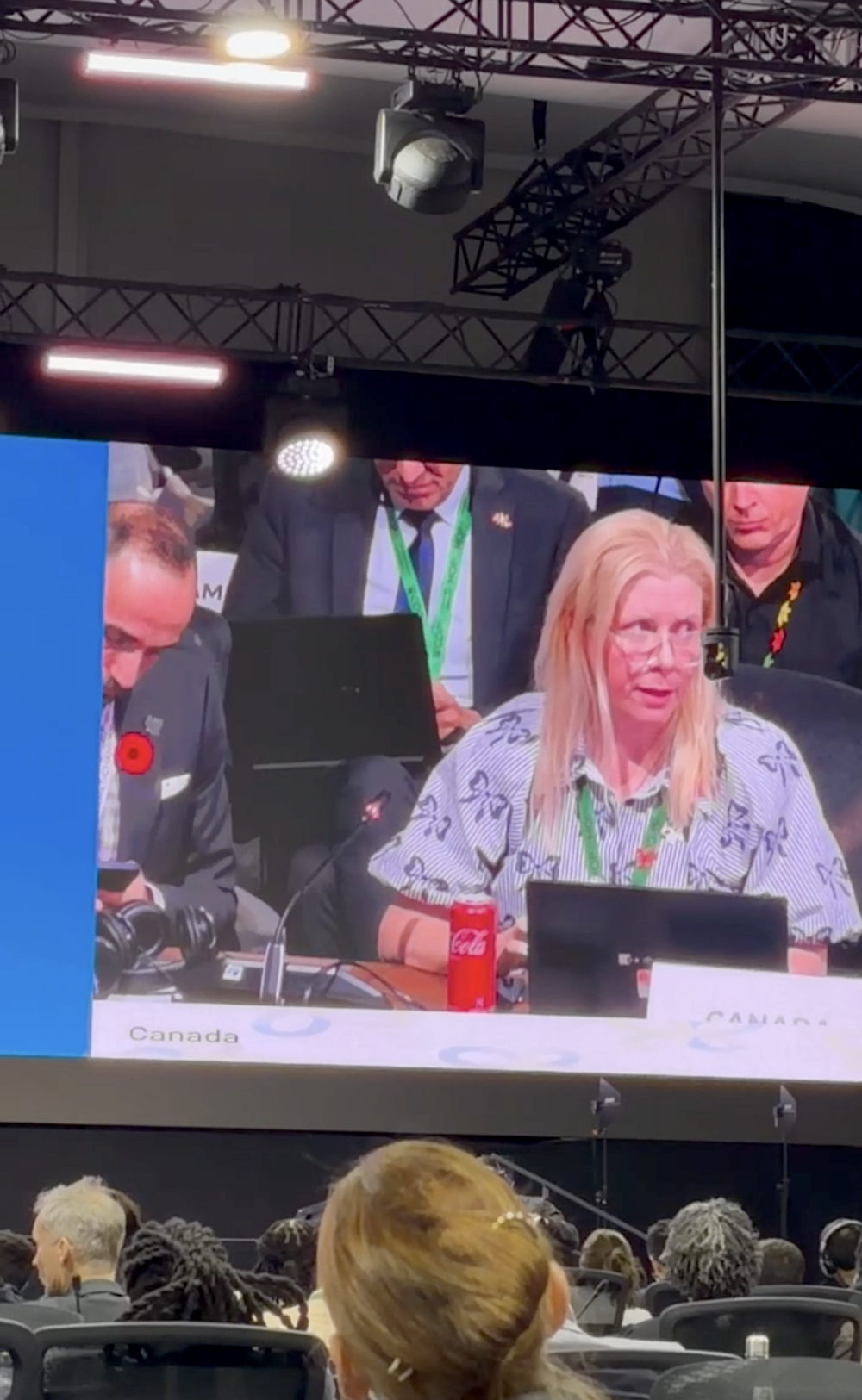
Canada delegate addressing the COP17 plenary. Yerevan, Armenia, October 31, 2026. © 2026 Images for Inclusion Inc (IFI)
Canada and Panama: Telling It Like It Is — Defending Principles Before Adoption, Confronting Racism After
As negotiations continued, the COP Presidency presented compromise language intended to overcome the lack of consensus on the floor.
At approximately 8:00 a.m. on October 31, prior to the official adoption of the text, Canada took the floor to accept the proposed compromise while explicitly stating its own position. The delegation reaffirmed its commitment “to ensure the full and meaningful participation of Indigenous Peoples and local communities in this new Subsidiary Body.” The delegation also acknowledged having demonstrated considerable flexibility and made significant compromises to facilitate the adoption of the Modus Operandi, while expressing clear concern over language affecting the distinct identities, rights, and representation of Indigenous Peoples and local communities. It nevertheless emphasized that “compromise should not be mistaken for the absence of principles,” concluding:
“Ultimately, the credibility and success of the Subsidiary Body will be measured not simply by its ability to adopt its operating procedures, but whether Indigenous Peoples can participate meaningfully and effectively in its work.”
Following these statements, the Parties adopted the compromised text. This arrangement established a Friends of the Bureau mechanism comprising representatives of Indigenous Peoples and local communities while leaving questions concerning its composition, the selection of members, and its working modalities deferred entirely for consideration and decision at COP18 in Ecuador.
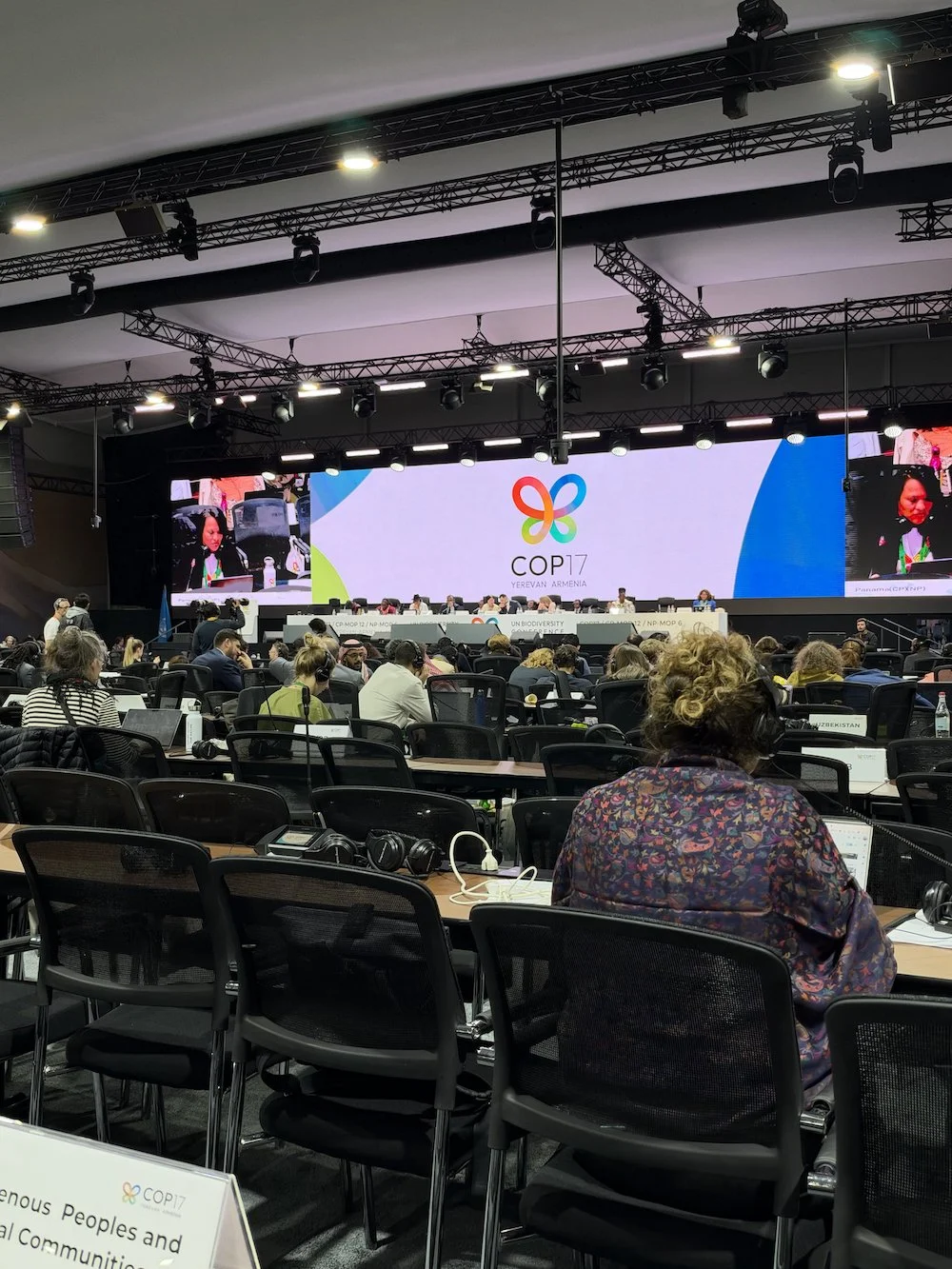
Jocabel Reina Solano Miselis, Indigenous Gunadule, representative of Panama, addressing racism and Indigenous Peoples’ self-determination during the COP17 closing plenary. Yerevan, Armenia, 2026. © 2026 Images for Inclusion Inc (IFI)
Immediately after the text was adopted, the Delegate from Panama, a Gunadule woman, addressed the plenary, explicitly identifying racism within the institutional attitudes that continue to shape the recognition of Indigenous Peoples' voices, rights, and representative institutions. She connected these concerns to colonialism, discrimination, and Indigenous self-determination, emphasizing that decisions about whose identities and institutions are recognized carry substantive consequences.
She stated:
“Because an old belief persists that others know better than we do what is best for us, and that our words need translation, approval, and permission to be validated. That belief has a name, and although it may be difficult for us to say it here, it is racism—not always intentional, not always visible.”
For IFI, the final outcome of the session was significant but fundamentally incomplete. While the administrative framework of the Subsidiary Body moved forward, the structural guarantees concerning Indigenous Peoples' seven sociocultural regions and the strict distribution of seats remained entirely unresolved.
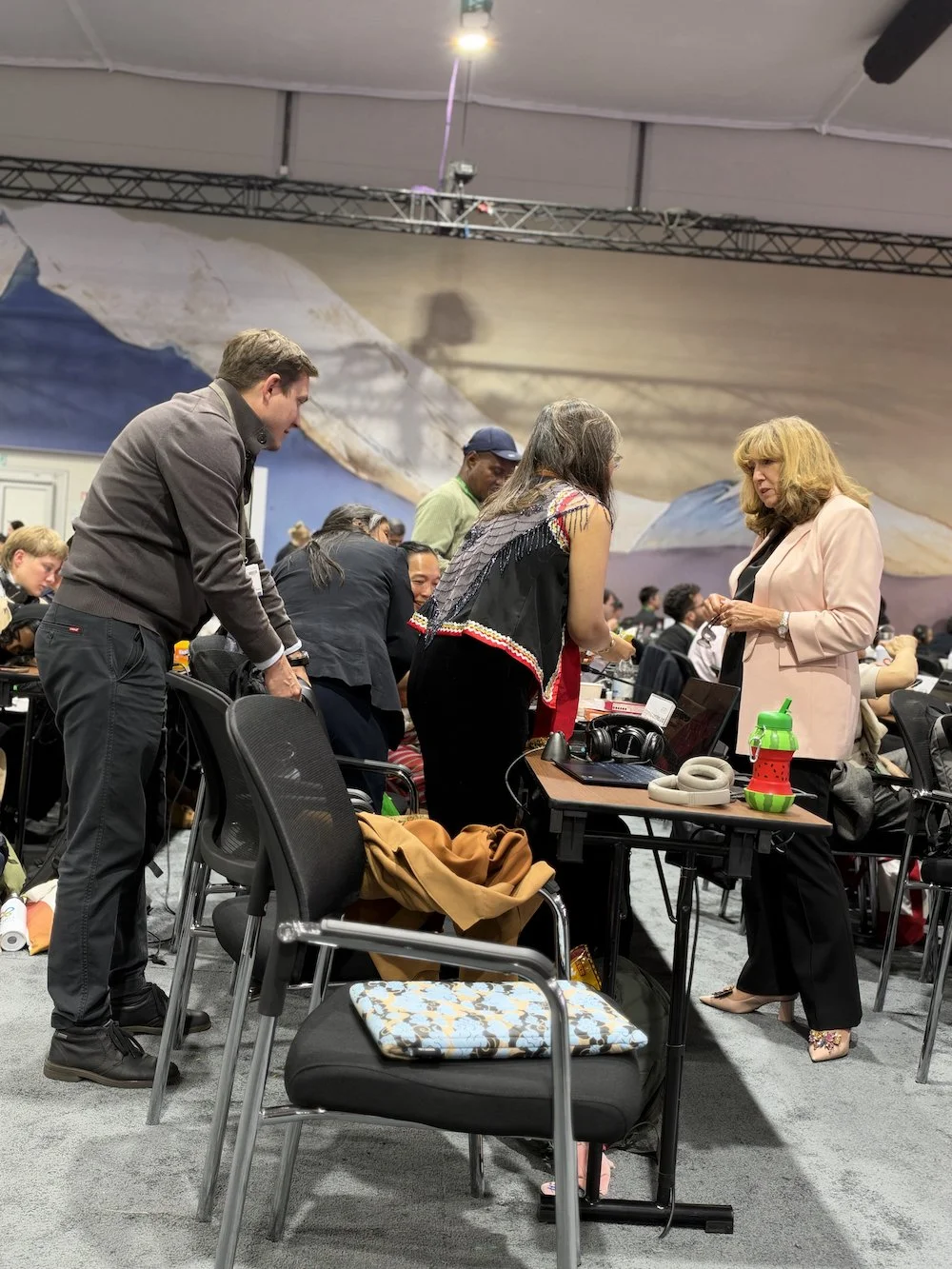
CBD Executive Secretary Astrid Schomaker speaking with IPLC representatives. COP17, Armenia, 2026. © 2026 Images for Inclusion Inc (IFI)
The Cost of Consensus
COP17 adopted the Modus Operandi, marking an important procedural achievement. One key provision recognized that the Indigenous Peoples and local communities Co-Chair could be nominated according to their own procedures, affirming the principle of participation through their own representative institutions.
During the tense final hours, as States Parties negotiated and delegates awaited the outcome, CBD Executive Secretary Astrid Schomaker approached some IPLC representatives. When the decision was finally gavelled through, relief swept across the room—yet for IFI, the achievement remained incomplete.
The negotiations exposed a central contradiction: a Subsidiary Body established to strengthen the full and effective participation of Indigenous Peoples had yet to formally recognize their own systems of representation.
Throughout the negotiations, negotiators were repeatedly encouraged to speed up the process of cleaning text, removing brackets, and being flexible in pursuit of consensus. As the Chair of one of the Working Groups playfully urged Parties to “do yoga,” “be flexible,” and “not ruin his day,” IFI questioned whether the flexibility being demanded was disproportionately expected of Indigenous Peoples when the provisions under consideration concerned their own distinct rights, institutions, and representative structures.
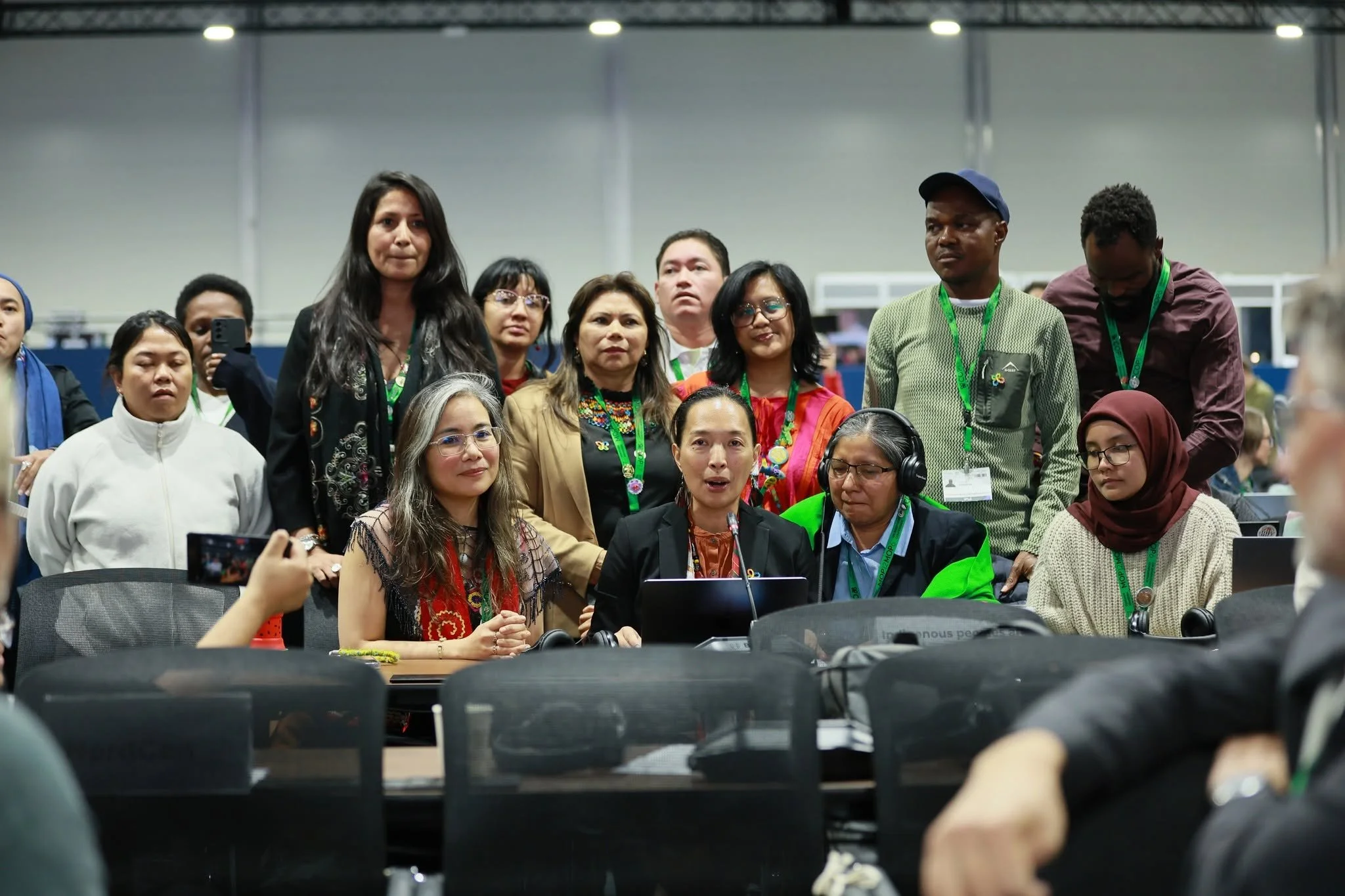
Representative of the IIFB reading their closing statement following the adoption of the Modus Operandi of the SB8J, with Lidia Arriagada Garcia, President and CEO of Images for Inclusion Inc (IFI), standing at the back, second from the left. Yerevan, Armenia, October 2026. Photograph: COP17 Armenia.
The IIFB Closing Statement: Questions of Consensus and Representation
Following the adoption of the Modus Operandi of the Subsidiary Body on Article 8(j), Jennifer Corpuz delivered a closing statement on behalf of the International Indigenous Forum on Biodiversity (IIFB), celebrating the decision as a historic achievement. She declared:
“Good morning, Mister President. We celebrate this historic adoption of the Modus Operandi on the Subsidiary Body on Article 8(j). At COP16, we made history by establishing the Subsidiary Body—a permanent home for Indigenous Peoples and local communities within the CBD.
After more than two weeks of late nights, early mornings, and ‘Daily Drama,’ we finally have operational guidance for the Subsidiary Body. We thank the Presidency for their support, and the Parties for their flexibility and commitment to moving forward.
We came here with the ambition to participate fully and effectively, and for a Modus Operandi that trusts us with our own selection processes and mechanisms. While we regret that the seven sociocultural regions are not explicitly recognized in the adopted text, we believe this decision gives us the basis to apply our own governance systems and selection processes, including those of the seven sociocultural regions.”
Kakailyan, wada et nan dap-ay tako asna. Iya-iyaman unay ken dakayo am-in. — Relatives, we now have a home here. Thank you very much to all!"
While IFI acknowledges and appreciates the efforts of those who may have contributed to the closing statement, it was not presented to the wider IIFB Caucus for discussion, amendment, or collective approval. IFI's delegate and other participants who remained throughout the overnight closing plenary had no opportunity to review or contribute to a statement delivered on their behalf.
Diplomatic Responsibility, Institutional Accuracy, and the Missed Opportunity for Collective Representation
The reference to “Daily Drama” warrants closer scrutiny. Did it refer to difficult negotiations among State Parties, internal disagreements within the IIFB Caucus, or objections defending Indigenous Peoples’ rights? Delivered in what IFI perceived as a dismissive tone, the expression risked trivializing the substantive work undertaken throughout the negotiations.
Equally concerning was the lack of specific acknowledgment of Indigenous Peoples and local community participants. While the statement thanked the Presidency and Parties, it offered no comparable recognition of Caucus members' sustained contributions, technical analysis, and coordination.
Speaking on behalf of a collective requires speaking with those represented. When a statement is broadcast internationally through UN Web TV, its content carries significant diplomatic and institutional responsibility.
The ambiguous language and insufficient recognition of Caucus members' contributions, compounded by the exclusion of their perspectives, resulted in an incomplete account of the negotiations and their outcome. A statement of such significance demands diplomatic care, institutional responsibility, transparency, and accountability to those it claims to represent.
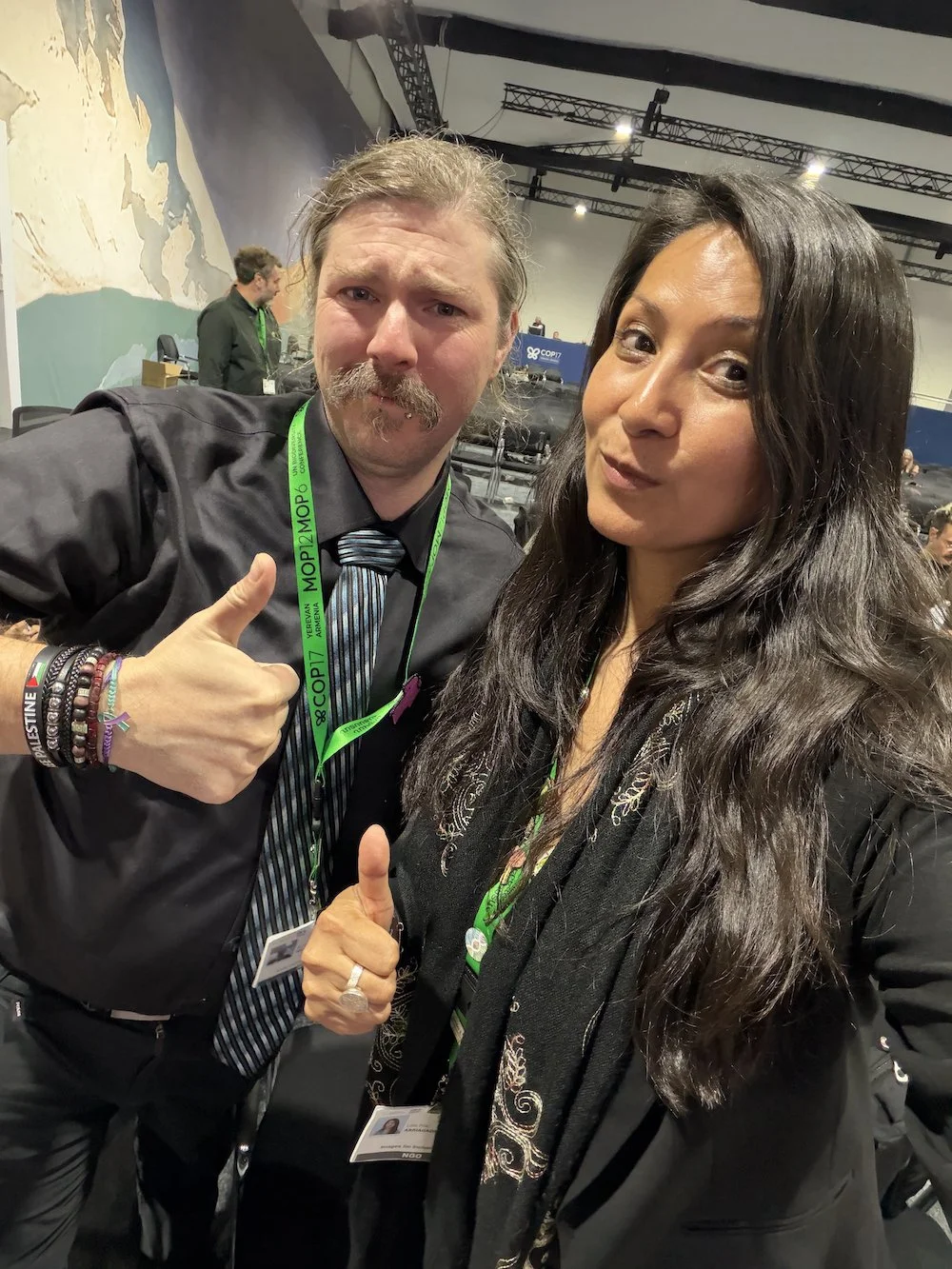
Lidia Arriagada Garcia with an Indigenous representative from the Arctic region. COP17, Armenia, 2026. © 2026 Images for Inclusion Inc (IFI)
As the IIFB delivered its final statement, Arriagada Garcia noticed a representative from the Arctic region seated at the other end of the same row in the plenary hall.
He was visibly moved, struggling to hold back his tears.
She waited until the statement concluded, then hurried over and sat beside him.
They agreed that the fight was not over, and when the Arctic representative observed that the outcome could have been worse, Arriagada Garcia nodded in agreement.
It was a bittersweet outcome.
Exterior of the Green Zone venue displaying the official CBD COP17 emblem. Yerevan, Armenia, October 2026. © 2026 Images for Inclusion Inc (IFI)
While IFI values strategic cooperation with local communities, the organization opposes merging Indigenous Peoples and local communities into a single common constituency within the Convention on Biological Diversity (CBD).
Under the foundational rule of pacta sunt servanda—that agreements must be kept—and the duty to act bona fide (in good faith), States cannot use CBD institutional arrangements to dilute the binding obligations they have already undertaken regarding Indigenous Peoples’ hard-won individual and collective rights, distinct legal status, and right to participate through their own representative institutions.
Beyond COP17: Inclusion Must Be Practiced
The COP17 Presidency's final remarks, delivered by H.E. Hambardzum Matevosyan, President of COP17, at the closing plenary emphasized shared responsibility and provided an important institutional reference point for evaluating these processes.
For IFI, meaningful inclusion requires consistency between institutional commitments and actual practices. It must be reflected in how decisions are negotiated, differing positions are respected, representatives are selected, and collective statements are prepared.
Indigenous Peoples' full and effective participation must be grounded in respect for their self-determination, distinct collective rights, and their own representative institutions.
The work toward that objective continues beyond COP17.
Photograph: COP17 biodiversity sculpture and signage outside the Green Zone venue. Yerevan, Armenia, October 31, 2026. © 2026 Images for Inclusion Inc (IFI)
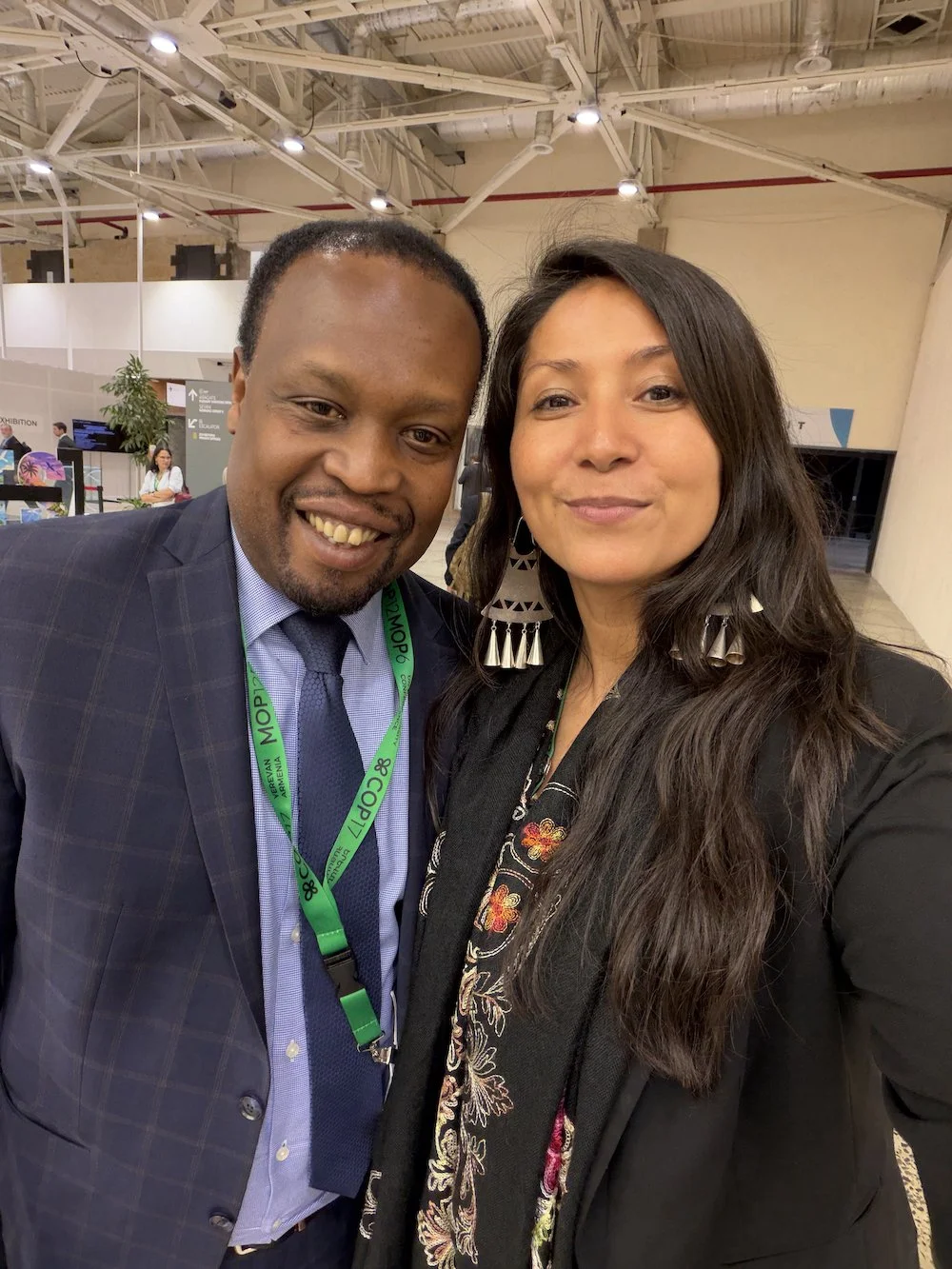
Lidia Arriagada Garcia and Olivier Rukundo, Head of Engagement and Cooperation at the CBD Secretariat. COP17, Armenia, 2026. © 2026 Images for Inclusion Inc (IFI)
Final Reflections: Indigenous Peoples’ Self-Determination, Institutional Reform, and State Accountability
For Indigenous Peoples, lands, territories, and waters cannot be reduced to environmental resources, conservation targets, economic valuation, or biodiversity indicators. They embody living relationships rooted in their cosmovision and their ancestral territories, the exercise of spirituality, the transmission of languages and intergenerational ancestral knowledge and intelligence, food sovereignty, cultural continuity, collective identity, and ultimately, their survival and dignity as Indigenous Peoples. Protecting these relationships is inseparable from the sacred responsibility to protect biodiversity and safeguard all forms of life for future generations. Consequently, full, meaningful and effective participation and direct funding for initiatives led by Indigenous Peoples and grounded in their own indigenous sciences, ancestral knowledge and traditions must be an absolute priority, rather than being subordinated to national legislation and circumstances that exempt States from compliance with international legal instruments. In Mapudungun, the word Mapuche combines Mapu (earth) and Che (people), meaning "People of the Earth." As the Mapuche People say, "We belong to the earth; the earth does not belong to us."
These considerations raise fundamental questions about the institutional arrangements governing Indigenous Peoples' participation within the Convention on Biological Diversity: Should an autonomous and exclusive Caucus for Indigenous Peoples be established within the CBD? Should local communities be afforded their own separate Caucus to independently advance their distinct rights, interests, histories, and ways of life, without conflating their legal status with that of Indigenous Peoples? Will the CBD Secretariat recognize and facilitate such a structural distinction, including through the necessary technical cooperation and institutional support? And, fundamentally, will States Parties respect Indigenous Peoples' right to determine their own representation, priorities, and participation through their own institutions and decision-making processes?
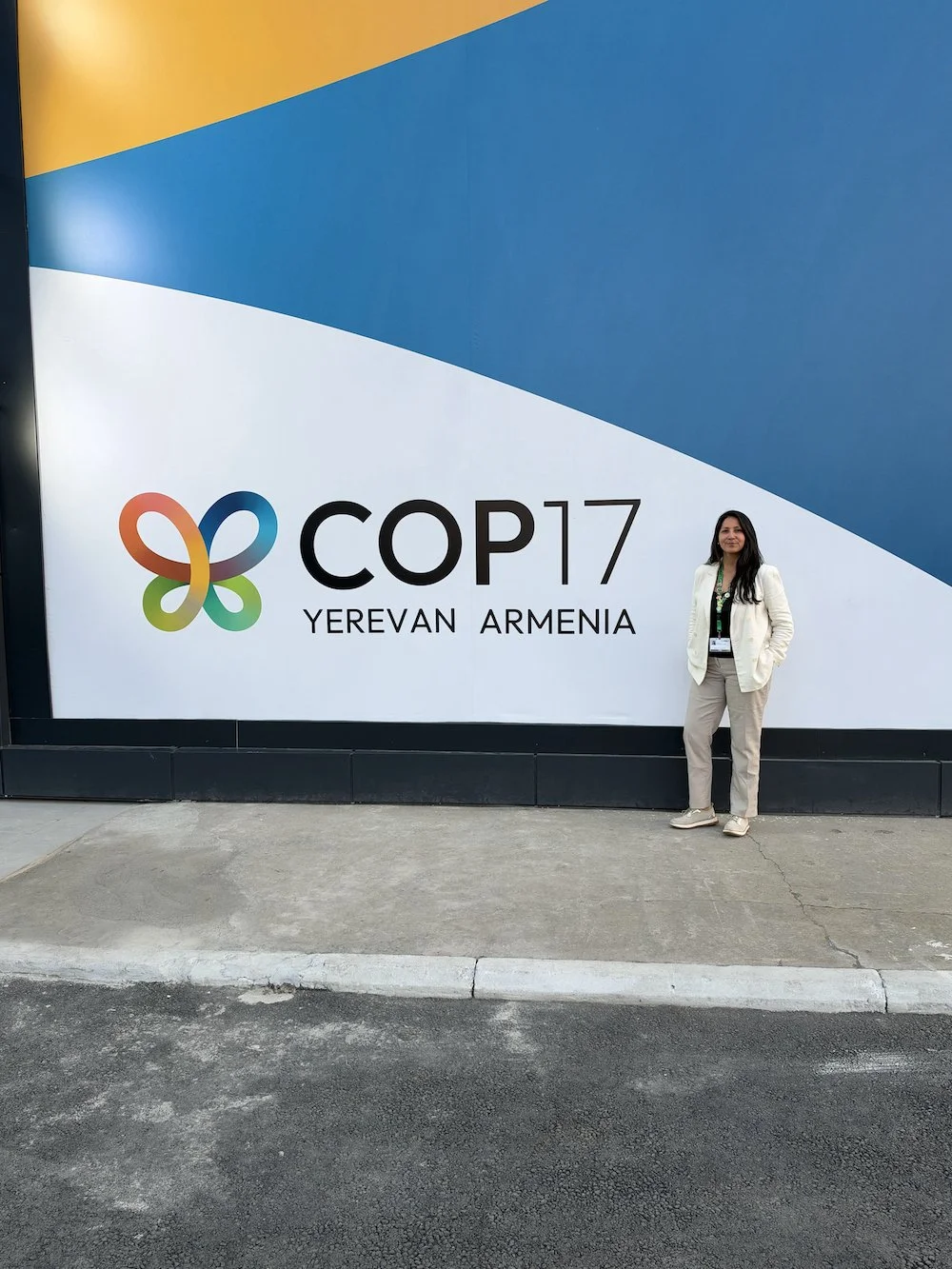
Images for Inclusion Inc President and CEO, Lidia Arriagada Garcia, at COP17, Armenia, 2026. © 2026 Images for Inclusion Inc (IFI)
Images for Inclusion Inc (IFI) calls upon the Convention on Biological Diversity Secretariat and States Parties to formally review the continued use of the terminology “Indigenous Peoples and local communities” (IPLC), particularly where it risks conflating their distinct legal status, rights, and representative institutions.
This review should take into account the 2023 joint statement of the United Nations Permanent Forum on Indigenous Issues (UNPFII), the Expert Mechanism on the Rights of Indigenous Peoples (EMRIP), and the Special Rapporteur on the rights of Indigenous Peoples, which called for an end to the conflation of Indigenous Peoples with other groups.
IFI further calls for concrete institutional measures to ensure that Indigenous Peoples' individual and collective rights—including self-determination, Free, Prior and Informed Consent (FPIC), and full and effective participation through their own representative institutions—are explicitly recognized and respected throughout all CBD processes leading up to and at COP18.
Evening traffic along a Yerevan boulevard. Armenia, October 2026. © 2026 Images for Inclusion Inc (IFI)
International Obligations and the Principles of Good Faith
Opposition to internationally recognized human rights, or attempts to undermine their protection through institutional negotiations, must not be normalized or accepted as legitimate negotiating practice. Consultative mechanisms must respect Indigenous Peoples’ rights, including their distinct identities, representative institutions, and full and effective participation in decision-making processes.
Attempts to remove or weaken agreed human rights language should be challenged in accordance with applicable international law and the obligations undertaken by States.
IFI deeply values the principled positions taken by the delegations of Canada, the European Union, Norway, Panama, and Mexico in defending fundamental principles enshrined in the Charter of the United Nations, the United Nations Declaration on the Rights of Indigenous Peoples (UNDRIP), and applicable international human rights instruments. International law cannot be invoked selectively, respected only when politically convenient, or subordinated to shifting national interests. States must fulfill their international obligations consistently and in good faith.
Republic Square illuminated at night. Yerevan, Armenia, October 2026. © 2026 Images for Inclusion Inc (IFI)